Facts
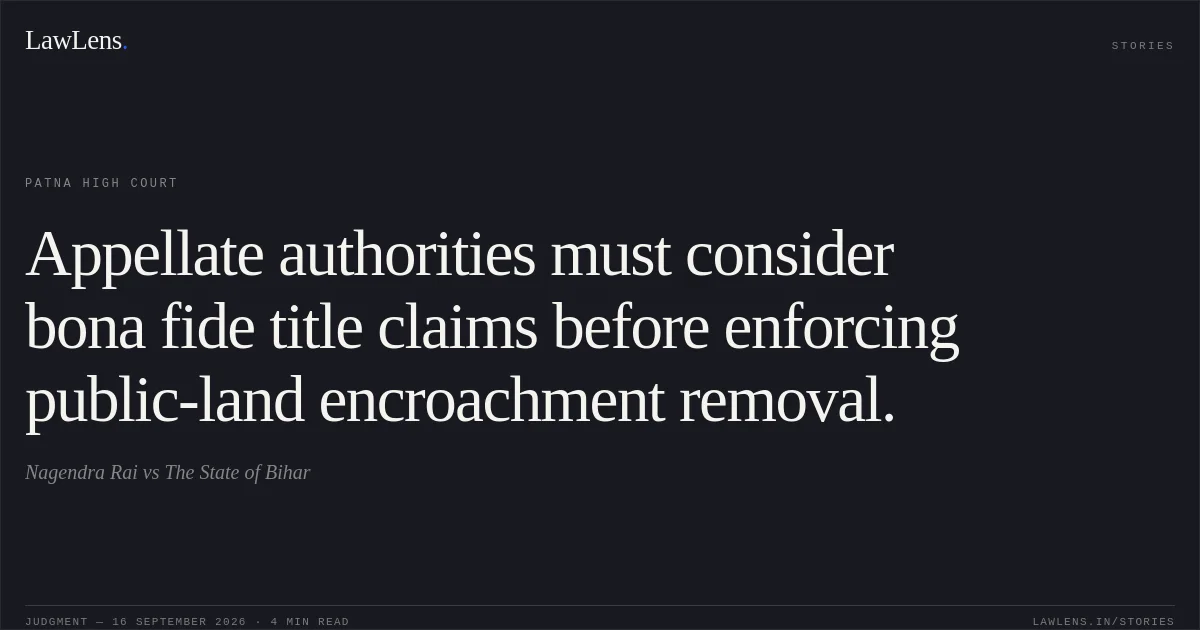
The petitioner challenged the Circle Officer’s order dated 17 May 2017 directing removal of alleged encroachments over public land comprised in Plot Nos. 1020, 1022 and 1023, Village Kudarbadha, P.S. Garkha, District Saran.
Source reference: p.1He claimed that the land had been settled in favour of his grandfather through a patta granted by the erstwhile landlord in 1924, and that his family had remained in possession and constructed a residential house thereon for nearly a century.
Source reference: pp.2–3The petitioner alleged that no valid notice or opportunity of hearing was provided before the measurement of the land or the passing of the removal order.
Source reference: p.3The State maintained that notice had been served and that the petitioner had been given an opportunity of hearing in encroachment case No. 115 of 2014–15, initiated under the Bihar Public Land Encroachment Act, 1956.
Source reference: p.3The proceedings followed a spot inquiry and measurement by the Anchal Amin, who reported encroachment over a village road situated on Plot Nos. 1020 and 1023.
Source reference: pp.4–5The petitioner had submitted a reply on 5 May 2017, after which the Circle Officer passed the final order under Section 6(1) of the Act on 17 May 2017.
Source reference: p.5Respondent No. 5 relied on an earlier order in CWJC No. 18164 of 2015, in which the High Court had directed conclusion of the encroachment proceedings after hearing the concerned parties, including the present petitioner.
Source reference: pp.4–6The petitioner had not impleaded Respondent No. 5 when the present writ petition was initially filed, although the earlier writ proceedings had been disclosed in the petition.
Source reference: pp.6–7, 12Issues
Whether the writ petition was maintainable when the petitioner had an alternative statutory remedy of appeal under Section 11 of the Bihar Public Land Encroachment Act, 1956, particularly in view of the alleged violation of natural justice and the petitioner’s title claim?
Source reference: pp.2–3, 12–13Whether the petitioner’s claim based on the alleged 1924 patta, rent receipts, possession and construction of a residential house required consideration by the appellate authority before the encroachment order could be conclusively implemented?
Source reference: pp.11–13Whether the petitioner had suppressed material facts or obtained interim protection unfairly by failing initially to implead Respondent No. 5?
Source reference: pp.6–7, 12–13Law Applied
The Court applied Sections 6(1) and 11 of the Bihar Public Land Encroachment Act, 1956: a final encroachment order may be passed under Section 6(1), while an aggrieved person has a statutory right of appeal under Section 11.
Source reference: pp.2–3, 12–13The Court recognised the general rule that writ jurisdiction is discretionary and may ordinarily be declined where an efficacious statutory remedy exists, but that issues involving jurisdiction, natural justice or substantial title claims may justify judicial intervention or appropriate directions.
Source reference: pp.2–3, 12–13It referred to the principles of res judicata and constructive res judicata discussed in Forward Construction Co. v. Prabhat Mandal (Regd.), (1986) 1 SCC 100.
Source reference: p.7It referred to the requirement that a writ petitioner approach the Court with clean hands under K.D. Sharma v. Steel Authority of India Ltd., (2008) 12 SCC 481.
Source reference: pp.7–8It referred to the pleading and proof requirements stated in Bharat Singh v. State of Haryana, (1988) 4 SCC 534.
Source reference: pp.8–9The appellate authority was directed to consider title-related issues in accordance with Asharfi Yadav v. State of Bihar, 2026 (5) PLJR 211.
Source reference: p.13Reasoning
The Court found that the allegation that the petitioner had concealed the earlier proceedings was only partially sustainable because he had annexed the order in CWJC No. 18164 of 2015 and referred to it in the writ petition.
Source reference: p.12The record also indicated that the petitioner had participated in the encroachment proceedings by filing a reply, weakening the absolute allegation that he had been denied an opportunity of hearing.
Source reference: pp.5, 12Nevertheless, the Court considered the petitioner’s asserted 1924 settlement, longstanding possession and residential occupation to be material issues requiring adjudication and not matters that could simply be ignored in the encroachment proceedings.
Source reference: pp.11–12Without setting aside the Circle Officer’s order, the Court preserved the petitioner’s statutory appellate remedy and directed the appellate authority to examine the alleged patta or settlement, rent receipts, possession documents and the petitioner’s occupation of the residential house.
Source reference: p.13The Court further held that, if the documents did not establish a valid settlement, the petitioner would have to seek a declaration from a competent civil court; conversely, if valid settlement and possession were established, the State would have to take appropriate steps to exclude the land from the operation of the Encroachment Act in accordance with Asharfi Yadav.
Source reference: p.14Holding
The writ petition was disposed of without disturbing the Circle Officer’s order dated 17 May 2017 under Section 6(1) of the Bihar Public Land Encroachment Act, 1956.
The petitioner was granted liberty to file an appeal under Section 11 before the Commissioner within four weeks, with any delay condoned.
Source reference: p.13The appellate authority was directed to hear all concerned parties, including Respondent No. 5, and conclude the proceedings within three months of filing the appeal.
Source reference: p.13Although the interim stay was not continued because Respondent No. 5 had initially not been impleaded, the appellate authority was directed not to dispossess the petitioner and his family from the residential house until final adjudication of the matter.
Source reference: p.14Acts & Sections Cited
3 provisions across 2 statutes referred to in this judgment. Linked provisions open on LawLens.
Bihar Public Land Encroachment Act, 19562
Indian Evidence Act, 18721
Original Court PDF
Nagendra RaivsThe State of Bihar
Click to open original judgment
Original judgment, available to read, download and summarize on LawLens.in