01Facts
The petitioner (original complainant) filed a complaint against the respondent (accused) for dishonor of cheques.
The trial court convicted the respondent, who subsequently filed Criminal Appeal No. 39 of 2018.
¶ 1-2During the appeal, the respondent filed applications (Exhibits 38 and 41) seeking to produce certified copies of documents to support his defense that the cheques were given as security for a loan from a third party and were misused.
¶ 5The Additional Sessions Judge allowed these applications, observing that the documents were necessary for deciding the appeal and would be treated as additional evidence under Section 391 of the Cr.P.C.
¶ 7The petitioner challenged these orders via the present writ petition, contending that the respondent had only asked for "production" and not to "lead additional evidence," and had failed to provide reasons for not producing them during the trial.
¶ 302Issues
i.1. Whether the Appellate Court can exercise powers under Section 391 of the Cr.P.C. to treat produced documents as additional evidence even if the applicant did not specifically invoke that section or pray to lead additional evidence.
¶ 4, 11ii.2. Whether the production of certified copies of documents at the appellate stage was "necessary" for a just decision of the case.
¶ 7, 1403Law Applied
The court primarily applied Section 391 of the Code of Criminal Procedure (Cr.P.C.), which empowers an Appellate Court to take additional evidence or direct it to be taken if it thinks such evidence is "necessary," provided it records reasons.
¶ 8The court relied on the precedent *Brig. Sukhjeet Singh (Retd.) MVC v. State of Uttar Pradesh*, which established that the power to take additional evidence is intended to achieve the ends of justice and cannot be restricted by a fixed formula; it depends on the facts of each case.
¶ 8, 14It also referenced *Sarika Shirodkar v. The Bicholim Urban Cooperative Bank Ltd.*, holding that mere production of documents without the right to read them in evidence is inconsequential.
¶ 12Provisions in the judgment · 1 · Linked ones open on LawLens
Code of Criminal Procedure, 1973 Section 391
04Reasoning
The court reasoned that Section 391 of the Cr.P.C. grants inherent and discretionary powers to the Appellate Court to ensure justice.
It rejected the petitioner's technical objection that the respondent had only sought "production," noting that if the court finds documents necessary for the merits of the appeal, it can treat them as additional evidence regardless of the specific prayer in the application.
¶ 11The court found that the Respondent had already laid a foundation for his defense during cross-examination in the trial court regarding the misuse of security cheques.
¶ 13Since the documents sought were certified copies, the court held that no serious prejudice would be caused to the complainant, and the "relevancy" of such documents would ultimately be determined during the final adjudication of the appeal.
¶ 7, 13, 1405Holding
The High Court dismissed the writ petition, holding that there was no error in the Appellate Court's decision to permit the documents as additional evidence.
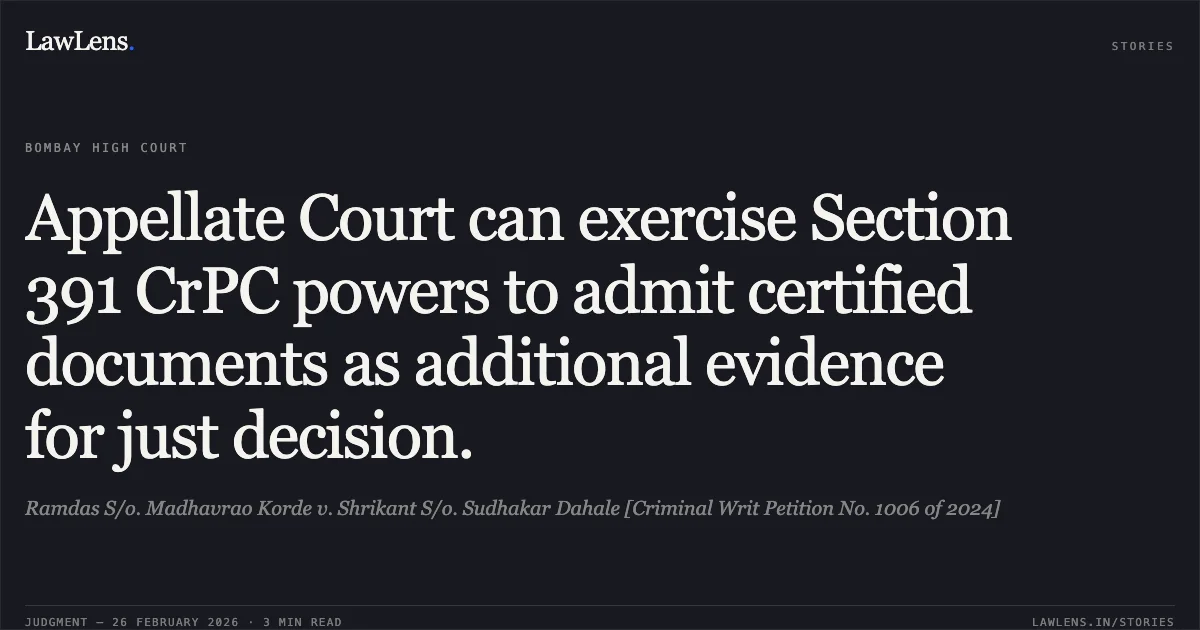
¶ 14The court ruled that an accused has the right to lead additional evidence if the Appellate Court deems it necessary for a just decision.
¶ 14The stay on the appeal proceedings was vacated, and the learned Sessions Judge was directed to decide the appeal expeditiously, preferably within one year.
¶ 15Original Court PDF
Ramdas S/o. Madhavrao Korde v. Shrikant S/o. Sudhakar Dahale [Criminal Writ Petition No. 1006 of 2024]
Click to open original judgment
Original judgment, available to read, download and summarize on LawLens.in