Facts
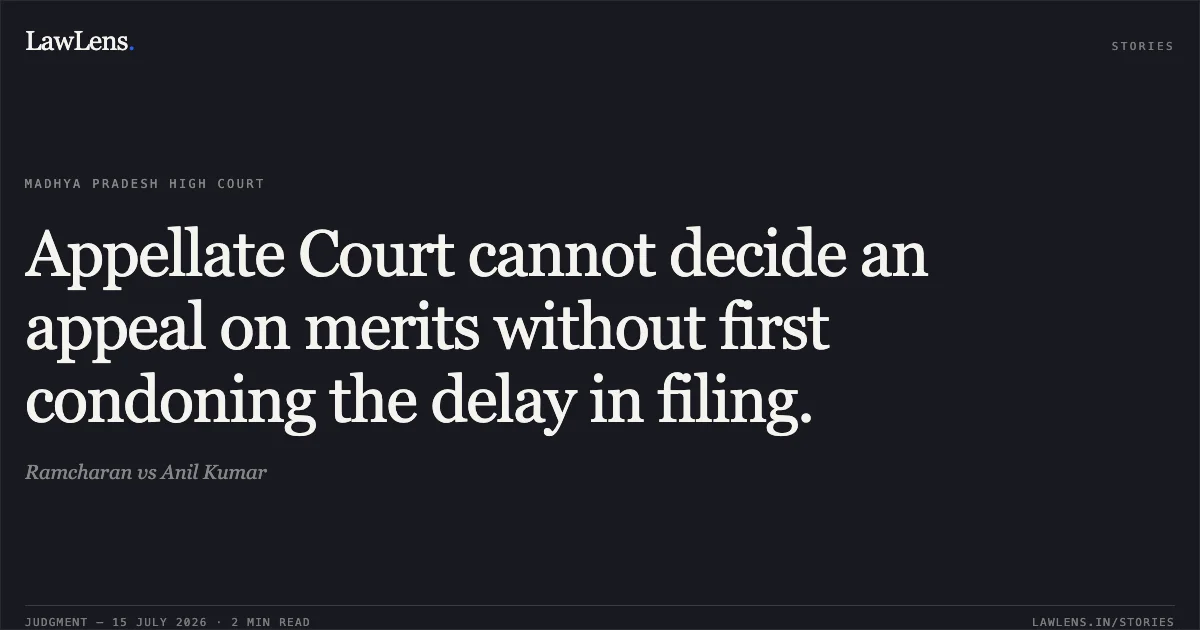
The plaintiff (Respondent No. 1) filed a suit for title declaration, easementary rights, and mandatory injunction regarding an encroachment. On 24/07/2018, the Trial Court decreed the suit in favor of the plaintiff.
Source reference: para. 3The defendants (appellants) filed a Regular First Appeal on 06/01/2021, incurring a delay of approximately two and a half years.
Source reference: para. 4They sought condonation of delay under Section 5 of the Limitation Act, alleging that their previous counsel failed to file the appeal despite receiving the record and subsequently passed away during the COVID-19 pandemic.
Source reference: para. 7The First Appellate Court rejected the application and dismissed the appeal as time-barred. The appellants challenged this before the High Court.
Source reference: para. 4Issues
1. Whether the First Appellate Court committed an error in not condoning the delay in filing the first appeal?
Source reference: para. 52. Whether an Appellate Court is legally obligated to decide an appeal on merits even if it is dismissed as barred by limitation?
Source reference: para. 8Law Applied
Section 5 of the Limitation Act, 1963, regarding the condonation of delay upon showing "sufficient cause".
Source reference: para. 4Dr. V.K. Verma v. Dawoodi Bohra Masjid Committee, which establishes that an Appellate Court lacks jurisdiction to decide an appeal on merits without first condoning the delay.
Source reference: para. 12Principles from Maniben Devraj Shah v. Municipal Corporation of Brihan Mumbai and Basawaraj & Another v. Special Land Acquisition Officer, which mandate that "sufficient cause" must be bona fide and not a result of negligence, inaction, or concocted explanations.
Source reference: para. 16, 17Reasoning
The High Court found that the appellants failed to demonstrate "sufficient cause" for the two-and-a-half-year delay. While the appellants blamed their advocate, the Court noted records showing they were regularly appearing in person for execution proceedings related to the same decree from 2018 to 2020; thus, their plea of being unaware of the non-filing of the appeal was deemed unbelievable.
Source reference: para. 13The Court rejected the argument that the appellate court must decide merits alongside limitation, distinguishing the precedent H. Guruswamy v. Krishnaiah as applicable only to Trial Courts, not Appellate Courts dealing with time-barred filings.
Source reference: para. 12The Court concluded the appellants were "thoroughly negligent" and their explanation was "concocted" to cover inaction.
Source reference: para. 15-18Holding
The High Court answered the substantial question of law against the appellants, holding that the First Appellate Court was justified in refusing to condone the delay.
The Court affirmed that an appeal cannot be heard on merits if the delay is not condoned first. Consequently, the Second Appeal was dismissed, and the order of the First Appellate Court was upheld.
Source reference: para. 12, 18Acts & Sections Cited
2 provisions across 2 statutes referred to in this judgment. Each provision opens on LawLens.
Code of Civil Procedure, 19081
Limitation Act, 19631
Original Court PDF
RamcharanvsAnil Kumar
Click to open original judgment
Original judgment, available to read, download and summarize on LawLens.in