Facts
The appellants were accused of raping a 52-year-old woman at her residence on January 10, 2021
Source reference: para. 3The Sessions Court (Fast Track) convicted them under Sections 376D, 376(2)(n), and 450 read with Section 34 of the IPC
Source reference: para. 4For the offence of gang rape under Section 376D, the Trial Court sentenced them to 12 years of rigorous imprisonment
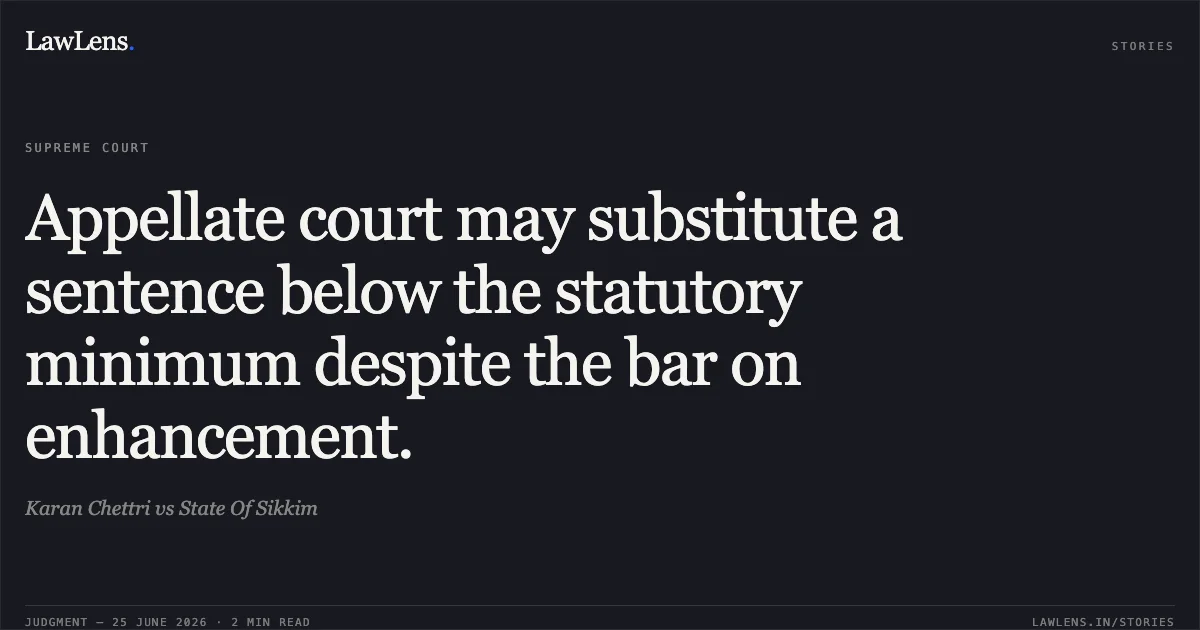
Source reference: para. 4The appellants challenged this conviction and sentence before the High Court of Sikkim. The High Court upheld the conviction under Section 376D but, noting that the statutory minimum for gang rape is 20 years, it exercised suo motu powers to enhance the sentence from 12 to 20 years
Source reference: para. 5The appellants then approached the Supreme Court, arguing that the High Court could not enhance the sentence in an appeal filed by the accused
Source reference: para. 8Issues
1. Whether the High Court, while exercising appellate jurisdiction in an appeal filed by the convict, can suo motu enhance a sentence that is below the mandatory statutory minimum
Source reference: para. 17, 212. Whether the restriction in Section 386(b)(iii) of the CrPC, which prohibits enhancement of sentence in a convict's appeal, applies when the original sentence is patently illegal
Source reference: para. 22, 23Law Applied
Section 376D of the IPC, which mandates a minimum punishment of 20 years for gang rape
Source reference: para. 11Section 386(b)(iii) of the CrPC, which outlines the powers of the Appellate Court in an appeal from conviction
Source reference: para. 20Section 401 of the CrPC regarding the High Court’s revisional powers
Source reference: para. 19The court distinguished the precedent in Sachin v. State of Maharashtra (2025) 9 SCC 507, noting it does not apply to cases involving sentences below the statutory minimum
Source reference: para. 21Sahab Singh v. State of Haryana (1990) 2 SCC 385 and Kumar Ghimirey v. State of Sikkim (2019) 6 SCC 166 regarding the necessity of notice before enhancement
Source reference: para. 15-16Reasoning
The Court reasoned that while Section 386(b)(iii) of the CrPC generally prevents an appellate court from making an accused "worse off" in their own appeal, this protection assumes the original sentence was lawful
Source reference: para. 23In this case, Section 376D IPC explicitly mandates a minimum of 20 years; thus, the Trial Court’s 12-year sentence was a "patent illegality" and a jurisdictional error
Source reference: para. 23-24The Court clarified that correcting an illegal sentence to bring it in line with the mandatory statutory minimum does not constitute "enhancement" in the discretionary sense, but rather a suo motu horizontal correction of an error apparent on the face of the record
Source reference: para. 22, 25Since the High Court provided the appellants an opportunity to be heard before the correction, the principles of natural justice were satisfied
Source reference: para. 21The Court emphasized that a procedural limitation cannot be used to perpetuate a sentence that the law expressly forbids
Source reference: para. 25Holding
It held that the High Court is legally permitted to substitute an illegal sentence with the mandatory statutory minimum even in an appeal filed by the convict
The court concluded that an accused has a right to challenge a conviction but no vested right to the continuance of an illegal sentence that falls below the minimum prescribed by Parliament
Source reference: para. 23, 25The Supreme Court dismissed the appeals and upheld the High Court's judgment
Source reference: para. 26Acts & Sections Cited
14 provisions across 3 statutes referred to in this judgment. Each provision opens on LawLens.
Indian Penal Code, 18603
Code of Criminal Procedure, 19737
Protection of Children from Sexual Offences Act, 20124
Original Court PDF
Karan ChettrivsState Of Sikkim
Click to open original judgment
Original judgment, available to read, download and summarize on LawLens.in