Facts
The dispute concerned approximately 18 acres and 10 gunthas of agricultural land in Sanathal village, Ahmedabad District, comprising Block Nos. 850P, 853 and 859P.
Source reference: para. 2The legal heirs of Hirabai Desai executed MoUs dated 30 October 2013 and 15 April 2015 concerning transfer of the land in favour of Respondent Nos. 2 and 3. The respondents subsequently obtained a consent decree for specific performance from the Bombay High Court in Suit No. 955 of 2015 on 6 May 2016, and execution proceedings were initiated through E.A. (L) No. 5258 of 2021.
Source reference: para. 4An application for delivery of vacant possession was allowed on 11 March 2022. The appellants, claiming an interest in the land, sought recall of that order through I.A. (L) No. 10443 of 2022.
Source reference: para. 5The Bombay High Court Division Bench dismissed the appellants’ appeal and also disposed of the pending interlocutory application, holding that the appellants had proceeded on an erroneous assumption regarding the appointment of the Court Receiver.
Source reference: para. 7Separately, the appellants claimed that they had been declared “protected tenants” under Section 32G of the Gujarat Tenancy and Agricultural Lands Act, 1948, on 3 June 2024. The respondents challenged that position in Special Civil Application Nos. 9081 and 10167 of 2024 before the Gujarat High Court.
Source reference: para. 9The learned Single Judge directed maintenance of status quo and permitted the appellants to reap any standing crops; the Division Bench dismissed the appellants’ Letters Patent Appeals on 24 December 2024.
Source reference: para. 9Issues
1. Whether the Bombay High Court Division Bench exceeded the scope of Appeal (L) No. 12396 of 2022 by disposing of I.A. (L) No. 10443 of 2022 and effectively foreclosing the appellants’ objections in the execution proceedings?
Source reference: paras. 11–152. Whether the interim orders of the Gujarat High Court maintaining status quo required modification in view of the competing claims to possession and the need for administration of the disputed agricultural land pending adjudication?
Source reference: paras. 11, 163. Whether the Supreme Court should determine the parties’ substantive claims concerning the MoUs, possession, tenancy and protected-tenant status at the interlocutory stage?
Source reference: paras. 6, 11, 14–16Law Applied
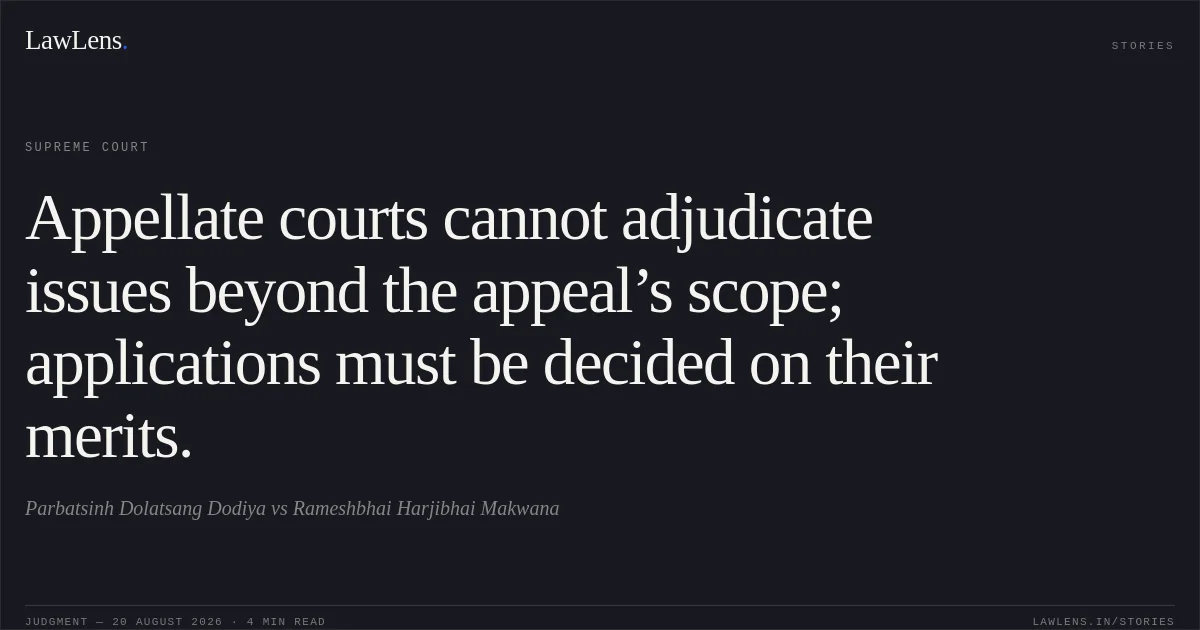
The Court applied the procedural principle that an appellate court must confine its determination to the scope of the appeal and should not prematurely dispose of an independent interlocutory application or foreclose issues that remain pending before the competent court.
Source reference: para. 15It further applied the principle that disputed questions concerning possession, tenancy and title should not ordinarily be finally determined in interlocutory proceedings where the substantive proceedings remain pending.
Source reference: paras. 6, 11In relation to the Gujarat proceedings, the Court exercised its power to mould interim relief by directing appointment of an Advocate Receiver to administer and supervise the disputed property during pendency of the writ proceedings, subject to the final outcome of those proceedings.
Source reference: para. 16The appellants’ claim of protected tenancy arose under Section 32G of the Gujarat Tenancy and Agricultural Lands Act, 1948, but the Supreme Court did not adjudicate the merits of that claim.
Source reference: para. 9Reasoning
The Supreme Court found that the Bombay High Court Division Bench had gone beyond the limited question arising in the appeal against the order dated 4 April 2022.
Source reference: para. 15By disposing of I.A. (L) No. 10443 of 2022 itself, the Division Bench had prevented the appellants from pursuing their objections in the execution proceedings, although the application remained to be considered by the learned Single Judge.
Source reference: para. 15The Supreme Court therefore held that the impugned order had traversed beyond the scope of the appeal and restored the interlocutory application for decision in accordance with law, without expressing any view on the merits.
Source reference: para. 15As regards Gujarat, the Court noted the “scramble for possession” and the parties’ divergent claims, making a neutral interim arrangement necessary.
Source reference: para. 16Rather than determine possession or tenancy rights, it modified the existing status-quo arrangement by directing appointment of an Advocate Receiver to administer and supervise the property pending disposal of the writ petitions.
Source reference: para. 16Holding
The appeals were disposed of in part.
In the Bombay appeals, the Supreme Court set aside the findings contained in paragraphs 8 to 11 of the Bombay High Court’s order dated 28 June 2022 and restored I.A. (L) No. 10443 of 2022 to the file for hearing and disposal in accordance with law.
Source reference: para. 15In the Gujarat appeals, the Supreme Court modified the interim orders dated 16 October 2024 and directed the learned Single Judge to appoint an Advocate Receiver and fix the Receiver’s remuneration for administration and supervision of the disputed land.
Source reference: para. 16The appointment was made subject to the final outcome of Special Civil Application Nos. 9081 and 10167 of 2024 and was to operate for the benefit of the ultimately successful party.
Source reference: para. 16The Court expressly declined to decide the merits of the parties’ competing claims.
Source reference: para. 11Acts & Sections Cited
1 provisions across 1 statute referred to in this judgment. Linked provisions open on LawLens.
Bombay Tenancy and Agricultural Lands Act, 19481
Original Court PDF
Parbatsinh Dolatsang DodiyavsRameshbhai Harjibhai Makwana
Click to open original judgment
Original judgment, available to read, download and summarize on LawLens.in