Facts
The State appealed under Section 378 CrPC against the trial court’s acquittal of Ameer Basha, a college lecturer, on allegations that he made gestures towards a student and, on 19 August 2014, touched her cheek and offered to help her obtain a Ph.D. if she complied with his wishes.
Source reference: para. 3–4The prosecution examined 22 witnesses and relied on 21 documents; the accused denied the allegations and led no defence evidence.
Source reference: para. 7At trial, the victim (PW1) did not support the prosecution and was treated as hostile.
Source reference: para. 7The High Court dismissed the State’s appeal.
Source reference: para. 22The judgment describes the POCSO charge inconsistently: paragraph 3 refers to Section 12, while the appeal’s prayer in the cause title refers to Section 8.
Source reference: para. 3Issues
1. Whether the evidence, including the victim’s testimony and her statement recorded under Section 164 CrPC, established the alleged offences beyond reasonable doubt.
Source reference: para. 12–16, 222. Whether the trial court’s acquittal was a view reasonably available on the evidence, or one warranting interference in an appeal under Section 378 CrPC.
Source reference: para. 11Law Applied
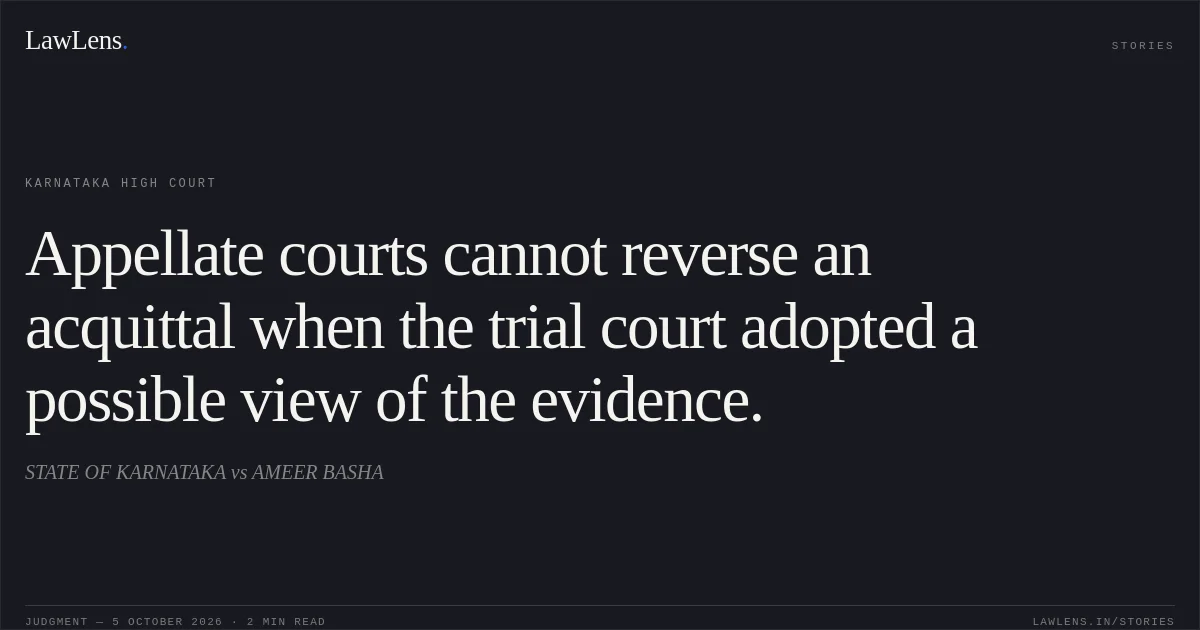
The Court applied Section 378 CrPC and the principles governing appeals against acquittal: an appellate court may reappreciate the evidence, but the acquittal strengthens the presumption of innocence; if the trial court’s view is a possible view on the evidence, it cannot be displaced merely because another view is also possible. Interference is warranted where the acquittal is perverse, rests on a misreading or omission of material evidence, or where the evidence permits only a conclusion of guilt.
Source reference: para. 11The Court also applied the rule that a statement recorded under Section 164(5) CrPC is not substantive evidence and cannot, by itself, establish the prosecution case.
Source reference: para. 12Constable 907 Surendra Singh v. State of Uttarakhand, (2025) 5 SCC 433; Babu Sahebgouda Rudrागौदार v. State of Karnataka, (2024) 8 SCC 149; Chandrappa v. State of Karnataka, (2007) 4 SCC 415; H.D. Sundara v. State of Karnataka, (2023) 9 SCC 581.
Source reference: para. 11Reasoning
The victim denied the contents of the relevant mahazar and did not support the prosecution case or speak to her Section 164 statement in court.
Source reference: para. 12The Court held that the Section 164 statement could not substitute for substantive testimony.
Source reference: para. 12Several other witnesses had turned hostile, while the witnesses identified as hearsay did not provide direct proof of the alleged acts; PW13 testified that the victim had informed her of the incident.
Source reference: para. 13–17On its review of the record, the Court found no cogent and convincing evidence establishing guilt and concluded that the trial court had properly assessed the evidence.
Source reference: para. 22The acquittal was therefore a permissible view and disclosed no basis for appellate interference.
Source reference: para. 11, 22Holding
The High Court held that the State had not shown that the trial court’s acquittal was legally or factually erroneous or that the evidence compelled a finding of guilt.
The appeal was dismissed, and the acquittal was left undisturbed.
Source reference: para. 22Acts & Sections Cited
5 provisions across 2 statutes referred to in this judgment. Each provision opens on LawLens.
Code of Criminal Procedure, 19733
Protection of Children from Sexual Offences Act, 20122
Original Court PDF
STATE OF KARNATAKAvsAMEER BASHA
Click to open original judgment
Original judgment, available to read, download and summarize on LawLens.in