Facts
The plaintiff, Madhav Rao Borse, instituted a suit for eviction against Kasturi Bai, claiming ownership of a house at Sakopant Ka Bagh, Gwalior, and alleging that Kasturi Bai had been inducted as a tenant in part of the premises on 5 January 1964 at a monthly rent of ₹100.
Source reference: p.2–3, paras. 3–6The plaintiff sought eviction primarily on the ground of bona fide residential requirement for his sons and also claimed arrears of rent.
Source reference: p.2–3, paras. 3–6The defendant denied the landlord–tenant relationship and asserted ownership over the property herself, later claiming through a Will in favour of her grandson.
Source reference: p.2–3, paras. 3–6The trial Court dismissed the suit, holding that the plaintiff had failed to establish his title to the suit property and the relationship of landlord and tenant.
Source reference: p.3–4, para. 7The First Appellate Court affirmed the dismissal.
Source reference: p.3–4, para. 7During the first appeal, the plaintiff sought permission under Order XLI Rule 27 CPC to produce the original tenancy document, the Nazul Officer’s NOC and property-tax receipts, and also sought amendment under Order VI Rule 17 CPC to plead that the tenancy was written rather than oral.
Source reference: p.4–6, para. 8Issues
1. Whether the Courts below erred in deciding the plaintiff’s title in an eviction suit instituted under the Madhya Pradesh Accommodation Control Act, 1961?
Source reference: p.4–5, para. 92. Whether the First Appellate Court erred in rejecting the plaintiff’s applications under Order XLI Rule 27 CPC and Order VI Rule 17 CPC, despite the additional documents and proposed amendment being material for determining the landlord–tenant relationship and the plaintiff’s claim?
Source reference: p.4–6, paras. 8–9Law Applied
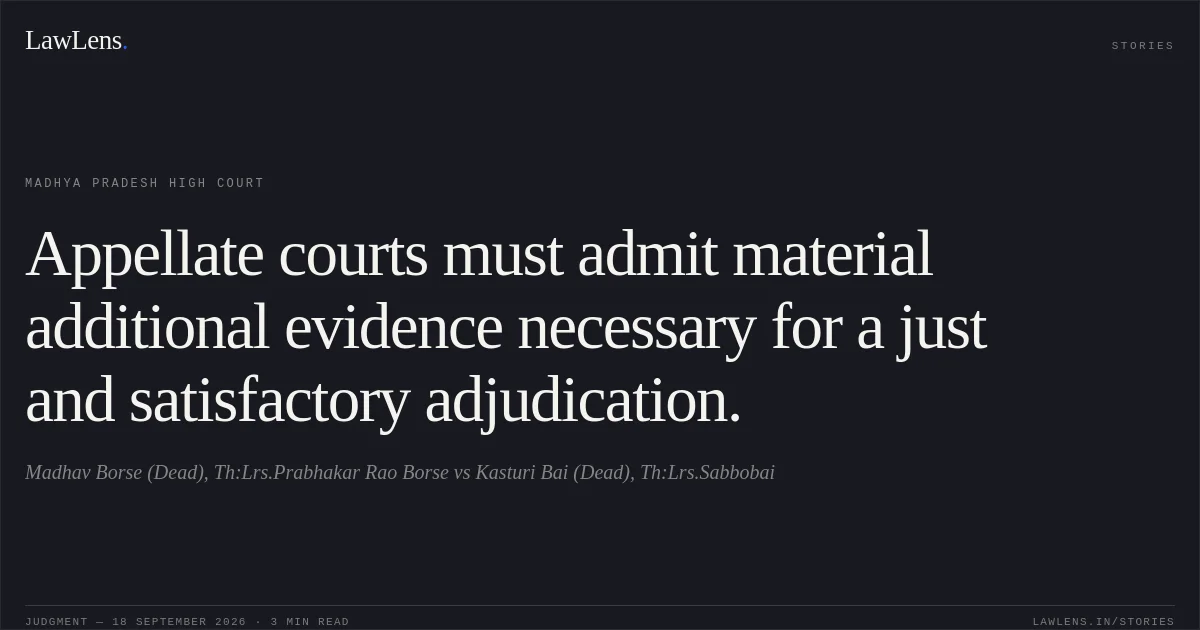
The Court applied Order XLI Rule 27 CPC, which permits an appellate court to admit additional evidence where the lower court improperly refused evidence, where despite due diligence the evidence could not previously be produced, or where the appellate court requires it to pronounce judgment or for another substantial cause.
Source reference: p.8–10, para. 17Relying on North Eastern Railway Administration, Gorakhpur v. Bhagwan Das (Dead) by LRs., (2008) 8 SCC 511, and Sanjay Kumar Singh v. State of Jharkhand, (2022) 7 SCC 247, the Court held that additional evidence may be admitted where it removes a cloud of doubt, has a direct bearing on the principal issue, or is necessary for a satisfactory adjudication.
Source reference: p.8–12, paras. 17–19The Court also applied Order VI Rule 17 CPC, under which pleadings may be amended where necessary for determining the real controversy and securing the ends of justice, including at the appellate stage in appropriate cases.
Source reference: p.12–13, paras. 21–22Reasoning
The High Court found that the concurrent findings of the Courts below were not perverse on the evidence originally available, since the plaintiff had not established either his title or the landlord–tenant relationship, particularly after the defendant expressly denied the tenancy and asserted ownership.
Source reference: p.7, para. 14However, the original tenancy document dated 5 January 1964 directly corresponded with the plaintiff’s pleaded date of induction and, being an original document, could potentially establish the landlord–tenant relationship.
Source reference: p.7–8, para. 16The Court accepted the explanation that the document had not been available earlier, noting that the original plaintiff was approximately 82 years old and that the tenancy had been created about thirty years before the suit.
Source reference: p.7–8, para. 16Similarly, the date of the Nazul Officer’s NOC had been pleaded in the plaint and matched the document produced at the appellate stage; therefore, the First Appellate Court was incorrect in stating that the non-production had not been explained.
Source reference: p.12, para. 20Since the additional evidence had a direct and important bearing on the principal controversy and was necessary for a just decision, its rejection merely because it had not been produced at trial was held erroneous.
Source reference: p.10–12, paras. 17–20The proposed amendment was also necessary to accurately plead the nature of the tenancy and to enable effective adjudication.
Source reference: p.12–13, para. 21Holding
The High Court answered the second substantial question of law in favour of the appellants and held that the First Appellate Court erred in rejecting the applications under Order XLI Rule 27 CPC and Order VI Rule 17 CPC.
The applications were allowed.
Source reference: p.12–13, para. 22The judgments and decrees dated 6 April 2010 and 14 November 2011 were set aside, and the matter was remanded to the trial Court for permitting the amendment, recording and proving of the additional evidence, and allowing the defendants to make consequential amendments and rebut the additional material.
Source reference: p.13, paras. 23–25The trial Court was directed to decide the suit afresh on the complete evidence.
Source reference: p.13, paras. 23–25Acts & Sections Cited
2 provisions across 1 statute referred to in this judgment. Each provision opens on LawLens.
Code of Civil Procedure, 19082
Original Court PDF
Madhav Borse (Dead), Th:Lrs.Prabhakar Rao BorsevsKasturi Bai (Dead), Th:Lrs.Sabbobai
Click to open original judgment
Original judgment, available to read, download and summarize on LawLens.in