01Facts
The appellant, a former Deputy Director in the Ministry of Environment and Forests, was convicted on 24.09.2026 under s. 13(1)(e) read with s. 13(2) of the Prevention of Corruption Act, 1988.
¶ 6On 06.10.2026, the Special Judge (PC Act) (CBI)-07, Rouse Avenue, sentenced him to four years' rigorous imprisonment and a fine of Rs. 25,00,000.
¶ 6He has been in custody since that date.
¶ 6He is also convicted in two other PC Act cases, where the sentences are stated to be suspended.
¶ 6The appellant, aged 59, sought suspension of sentence pending appeal, contending that the sentence is for a fixed term and the appeal will take substantial time.
¶ 7The CBI opposed the application, citing the nature of the offence and the huge recovery of cash.
¶ 8On the merits, the appellant contended that Rs. 21,62,000, recovered from the house of one Bijender Singh (DW-6) at Rohtak, was attributed to him solely on the statement of his wife, a government servant who has been acquitted.
¶ 12 · p. 5The appellant undertook to deposit the fine within four weeks.
¶ 14 · p. 502Issues
i.1. Whether the sentence of a fixed term of four years imposed on the appellant should be suspended during the pendency of his appeal under s. 430 BNSS, despite the CBI's objection based on the nature of the offence and the cash recovery.
¶ 8, 10 · p. 3ii.2. Whether the appellant's contention that the cash recovery was wrongly attributed to him on the basis of his wife's statement can be decided at the stage of the suspension application.
¶ 12–13 · p. 503Law Applied
The Court applied s. 430 BNSS, the statutory power to suspend sentence pending appeal, and the Supreme Court's principles on its exercise.
In Bhagwan Rama Shinde Gosai v. State of Gujarat, (1999) 4 SCC 421, the Supreme Court held that where a convict receives a fixed-term sentence and files an appeal as of statutory right, suspension should be considered liberally unless exceptional circumstances exist, and that where the appeal cannot be heard expeditiously, the appellate court must show special concern in suspending the sentence so that the appeal remains effective.
¶ 10 · p. 3In Aasif @ Pasha v. State of U.P., 2025 SCC OnLine SC 1644, the Supreme Court reaffirmed that the Bhagwan Rama Shinde Gosai principle applies to fixed-term sentences and that appellate courts may impose conditions when suspension is granted.
¶ 11 · pp. 3–4The Court recognised that the appellate court may impose conditions on suspension.
¶ 15 · p. 5Provisions in the judgment · 3 · Linked ones open on LawLens
Code of Criminal Procedure, 1973 Section 389
Bharatiya Nagarik Suraksha Sanhita, 2023 Section 430
Prevention of Corruption Act, 1988 Section 13
04Reasoning
The Court treated the four-year sentence as a fixed term, which attracts the liberal approach under Bhagwan Rama Shinde Gosai and Aasif.
¶ 10 · p. 3 · ¶ 11 · pp. 3–4The Court accepted that the appeal would take time to be heard and that the appellant's substantive points warranted consideration, which, on the reasoning in Bhagwan Rama Shinde Gosai, weighed in favour of preserving the effectiveness of the appeal.
¶ 7, 10 · pp. 2–3The CBI's objections based on the nature of the offence and the cash recovery were noted but did not displace this approach; the Court relied on "the totality of circumstances" together with the fine-deposit undertaking.
¶ 8, 15 · p. 5On the cash-attribution contention, the Court expressly declined to express any view, holding that it must be examined at the hearing of the appeal.
¶ 13 · p. 5The Court thus kept the question of guilt on this point separate from the suspension inquiry.
¶ 13 · p. 5Protective conditions were imposed to secure the appellant's availability and to prevent interference with witnesses or further criminal activity.
¶ 15(i)–(x) · pp. 5–605Holding
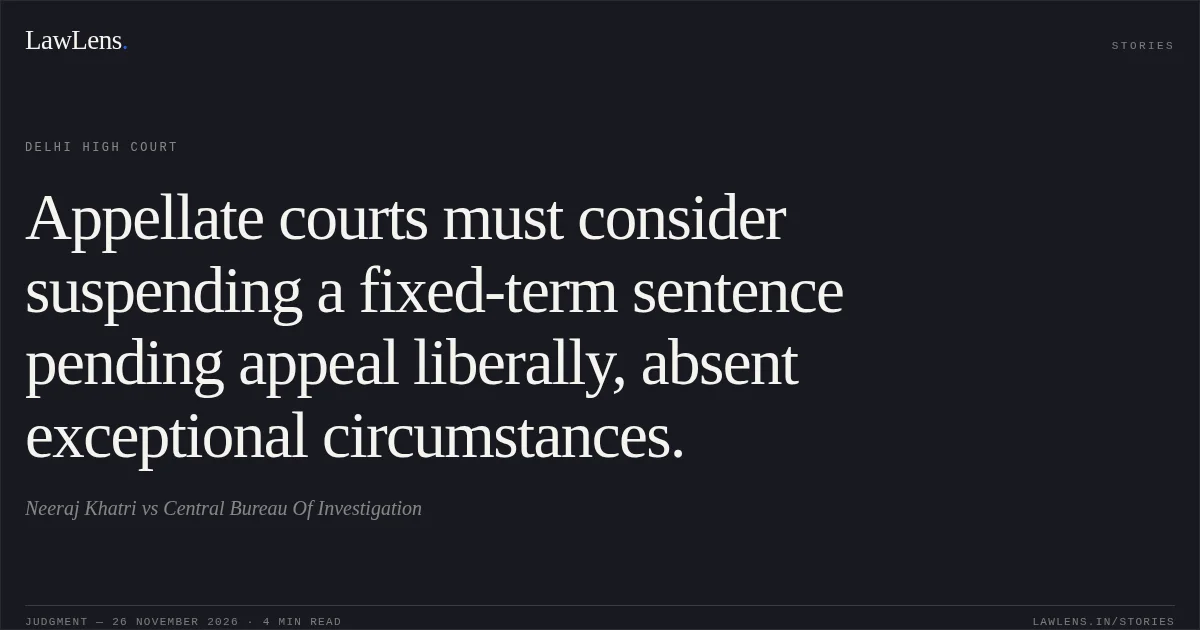
The Court held that the fixed-term sentence should be suspended during the pendency of the appeal, relying on the liberal standard in Bhagwan Rama Shinde Gosai and Aasif.
¶ 10, 15 · p. 3, 5The Court did not decide the cash-attribution issue, which is reserved for the appeal.
¶ 13 · p. 5The application (CRL.M.(BAIL) 2245/2026) was allowed. The sentence is suspended pending the appeal. The appellant is to be released on a personal bond of Rs. 1,00,000 with a surety of like amount before the trial court. The appellant must deposit the fine of Rs. 25,00,000 within four weeks before the trial court, with proof placed on record.
¶ 14, 15(viii) · pp. 5–6 · ¶ 15–16 · pp. 5–6Ten conditions apply, including: not leaving NCT of Delhi without permission; furnishing and updating his address and mobile number; not contacting prosecution witnesses; not indulging in criminal activity; and reporting to the SHO on the first Monday of each month. Any breach entitles the CBI to seek cancellation of the order. The order expresses no opinion on the merits of the appeal.
¶ 15(i)–(vii) · pp. 5–6 · ¶ 15(x) · p. 6 · ¶ 15(ix) · p. 6The appeal is to be listed in due course, and the trial court record is to be requisitioned.
¶ 3–4 · p. 2Original Court PDF
Neeraj KhatrivsCentral Bureau Of Investigation
Click to open original judgment
Original judgment, available to read, download and summarize on LawLens.in