Facts
On 28 February 2002, communal violence occurred in and around Pandarwada and other villages within Khanpur Police Station limits, Panchmahal.
Source reference: pp. 3–5, paras. 2.3–2.11The prosecution alleged that a large mob attacked members of the Muslim community, caused multiple deaths and injuries, and set fire to houses, religious structures and other properties.
Source reference: pp. 3–5, paras. 2.3–2.11Eight male bodies were recovered, and substantial damage to Muslim and Hindu properties was alleged.
Source reference: pp. 3–5, paras. 2.3–2.11A complaint was lodged by PSI H.V. Rathod on 1 March 2002, alleging offences under Sections 307, 302, 120B, 143, 147, 148, 149, 435 and 436 of the IPC and Section 135 of the Bombay Police Act.
Source reference: p. 5, para. 2.12Three Sessions Cases—Nos. 132, 215 and 300 of 2002—were consolidated and tried together.
Source reference: p. 2, paras. 2.1–2.2By judgment dated 29 October 2002, the Additional Sessions Judge, Panchmahal acquitted all the accused.
Source reference: p. 2, paras. 2.1–2.2The State preferred the present appeals against acquittal.
Source reference: no citationIssues
Whether the prosecution proved beyond reasonable doubt that the accused were members of the unlawful assembly responsible for the murders, injuries, rioting and destruction of property.
Source reference: pp. 7–10, paras. 12–23Whether the evidence of the prosecution witnesses was sufficient to establish the identity and individual involvement of the accused, notwithstanding the absence of a test identification parade.
Source reference: p. 11, para. 5Whether the appellate court should interfere with the trial court’s order of acquittal under Section 378 of the Code of Criminal Procedure.
Source reference: pp. 12–14, paras. 7–10Law Applied
The prosecution was required to establish the charged offences under Sections 302, 307, 120B, 143, 147, 148, 149, 435 and 436 of the IPC and Section 135 of the Bombay Police Act beyond reasonable doubt.
Source reference: p. 2, para. 2Section 149 IPC permits vicarious liability for acts committed by members of an unlawful assembly only when the accused’s membership of that assembly and the requisite common object are proved by reliable evidence.
Source reference: p. 10, para. 23In an appeal against acquittal under Section 378 CrPC, the appellate court may reconsider the evidence but must exercise restraint because acquittal strengthens the presumption of innocence; where two reasonable views are possible, the acquittal should not ordinarily be disturbed.
Source reference: pp. 12–14, paras. 8–9The Court relied on Sanjeev v. State of Himachal Pradesh, 2022 (6) SCC 294, which requires the appellate court to address the reasons for acquittal and interfere only where the judgment is palpably erroneous or unsustainable on the evidence.
Source reference: pp. 12–14, paras. 8–9Reasoning
The Court accepted that the evidence, including medical evidence, post-mortem reports and scene panchnamas, established that murders, injuries and extensive property damage had occurred.
Source reference: pp. 7–10, paras. 11 and 23However, proof that the offences occurred did not establish that the respondents were the perpetrators.
Source reference: no citationThe police witnesses did not identify or arrest any person at the scene, and no test identification parade was conducted.
Source reference: pp. 7–8, paras. 12–13; p. 11, para. 5The eyewitnesses and injured witnesses either failed to identify the accused, stated that the accused were not present, or could not say who had committed the particular acts of killing, assault or arson.
Source reference: pp. 8–10, paras. 14–22The vague police statements suggesting that some accused were present in the mob were insufficient, by themselves, to invoke Section 149 IPC.
Source reference: p. 10, para. 23Since the trial court’s assessment was supported by the record and represented a permissible view of the evidence, the High Court found no compelling or substantial ground for appellate interference.
Source reference: pp. 12–14, paras. 7–10Holding
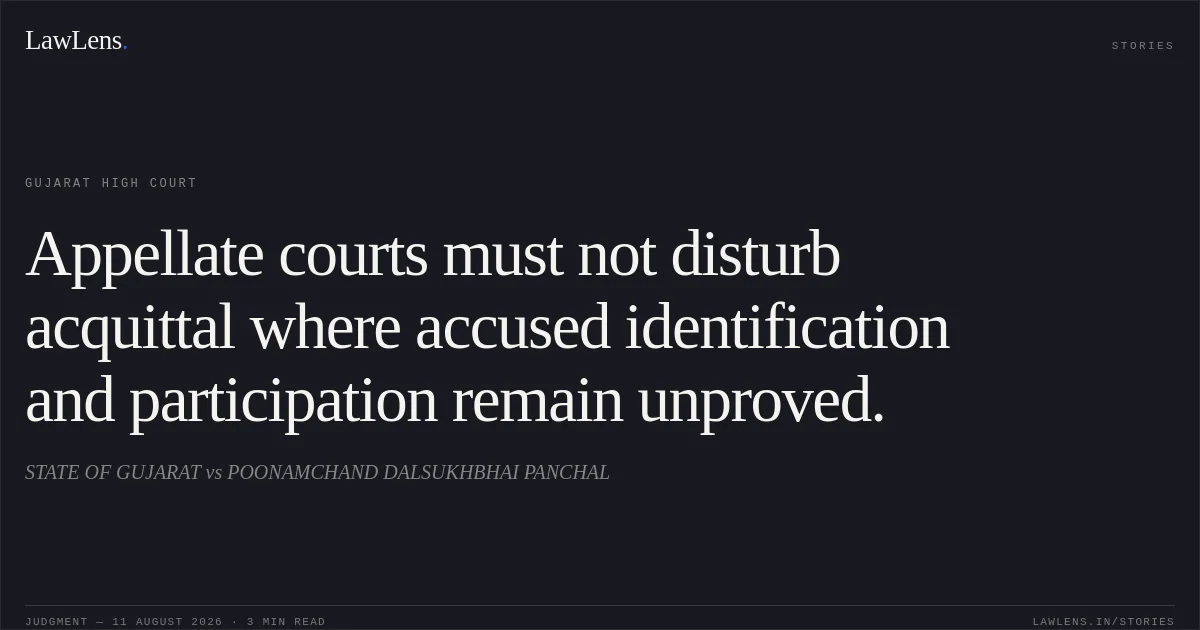
The High Court held that the prosecution failed to prove beyond reasonable doubt that the accused participated in the unlawful assembly or committed the charged offences.
The absence of reliable identification and the failure to conduct a test identification parade rendered the evidence insufficient to sustain criminal liability, including vicarious liability under Section 149 IPC.
Source reference: p. 11, para. 5; p. 10, para. 23The State’s appeals were dismissed, the judgment and order of acquittal dated 29 October 2002 were confirmed, and the Records and Proceedings were directed to be remitted to the concerned court.
Source reference: p. 14, para. 10Acts & Sections Cited
9 provisions across 2 statutes referred to in this judgment. Each provision opens on LawLens.
Indian Penal Code, 18608
Code of Criminal Procedure, 19731
Original Court PDF
STATE OF GUJARATvsPOONAMCHAND DALSUKHBHAI PANCHAL
Click to open original judgment
Original judgment, available to read, download and summarize on LawLens.in