Facts
The petitioner was convicted under Section 138 of the Negotiable Instruments Act (N.I. Act) by the Judicial Magistrate First Class, Pandariya, on January 1, 2026
Source reference: para. 2The trial court sentenced the petitioner to one year of simple imprisonment and directed the payment of ₹40,00,000/- as compensation
Source reference: para. 2The petitioner subsequently preferred a Criminal Appeal under Section 415 of the Bharatiya Nagarik Suraksha Sanhita (BNSS), 2023, along with an application for suspension of execution under Section 430 of the BNSS
Source reference: para. 3On January 31, 2026, the Second Additional Sessions Judge, Kawardha, allowed the suspension of the sentence subject to the condition that the petitioner deposit 20% of the compensation amount (₹8,00,000/-) within 60 days
Source reference: para. 1, 3The petitioner challenged this condition before the High Court under Section 528 of the BNSS, arguing that the Appellate Court exercised its discretion without providing specific reasons as required by law
Source reference: para. 1, 4Issues
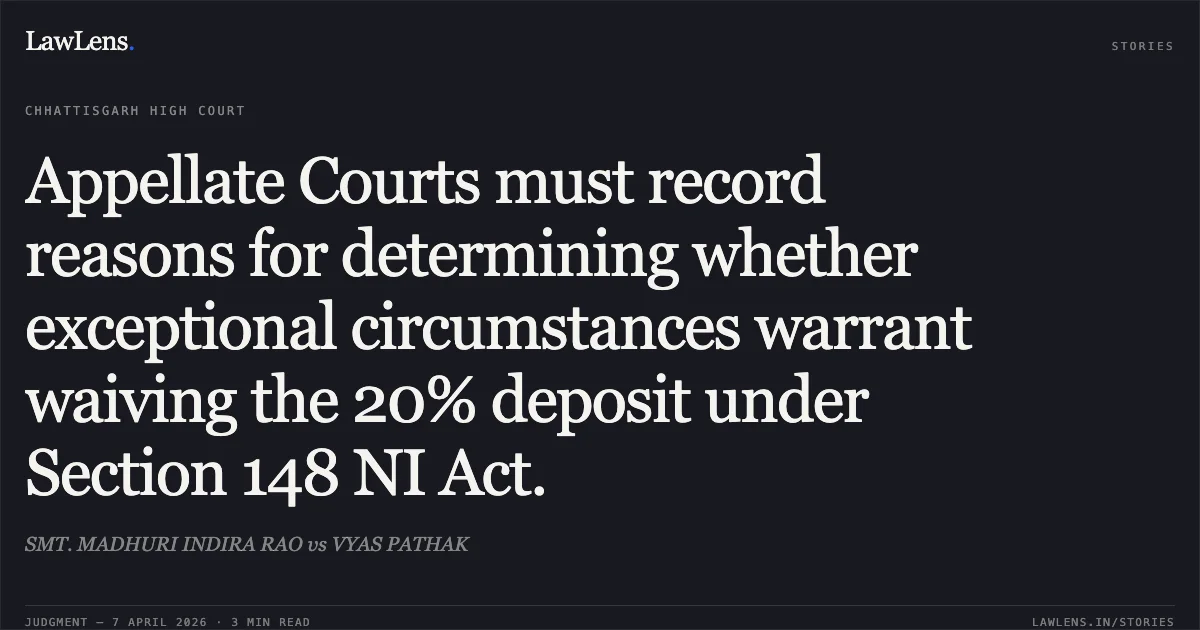
1. Whether the Appellate Court is required to record reasons and consider the existence of "exceptional cases" when imposing a condition to deposit 20% of the fine or compensation amount under Section 148 of the N.I. Act.
Source reference: para. 5, 8Law Applied
The court primarily applied Section 148 of the Negotiable Instruments Act, 1881, which empowers an Appellate Court to order a minimum deposit of 20% of the fine or compensation pending appeal
Source reference: para. 5It further relied on the Supreme Court's interpretation in Jamboo Bhandari v. M.P. State Industrial Development Corporation Ltd. & Ors. (2023), which established that while the deposit is the norm, the Appellate Court must consider whether the matter constitutes an "exceptional case" warranting suspension without the deposit condition, and must record reasons for its conclusion
Source reference: para. 6This principle was reaffirmed in Muskan Enterprises & Anr. v. State of Punjab & Anr. (2024)
Source reference: para. 7Procedurally, the court applied Sections 430 and 528 of the BNSS regarding the suspension of sentence and inherent powers of the High Court
Source reference: para. 1, 9Reasoning
The High Court observed that Section 148 of the N.I. Act uses the word "may," indicating discretionary power rather than a mandatory imposition
Source reference: para. 4, 5Applying the mandate of Jamboo Bhandari, the court noted that an Appellate Court, when considering a prayer for suspension of sentence under Section 389 of the Cr.P.C. (now Section 430 of the BNSS), must determine if the case is exceptional
Source reference: para. 6In the present matter, the High Court found that the impugned order of the Sessions Court was mechanical; it did not disclose whether the court had considered if the case fell within an exception or why the 20% deposit was necessary despite the petitioner’s objections
Source reference: para. 8The court reasoned that the failure to record such considerations or provide a reasoned order rendered the imposition of the condition legally unsustainable
Source reference: para. 9Holding
The High Court allowed the petition and set aside the impugned order dated January 31, 2026
The court restored the petitioner’s application for suspension of sentence before the Appellate Court and directed the learned Second Additional Sessions Judge to reconsider the application afresh and pass a reasoned order as expeditiously as possible
Source reference: para. 9Pending the fresh decision, the execution of the trial court’s judgment dated January 1, 2026, was ordered to remain suspended
Source reference: para. 9The CRMP was disposed of at the admission stage
Source reference: para. 10Acts & Sections Cited
7 provisions across 3 statutes referred to in this judgment. Each provision opens on LawLens.
Bharatiya Nagarik Suraksha Sanhita, 20233
Negotiable Instruments Act, 18812
Code of Criminal Procedure, 19732
Original Court PDF
SMT. MADHURI INDIRA RAOvsVYAS PATHAK
Click to open original judgment
Original judgment, available to read, download and summarize on LawLens.in