Facts
On 5 December 1994 at approximately 9:15 p.m., a quarrel allegedly occurred between the complainant, Gulabbhai Bhanabhai Patel, and the accused at Nava Faliya, Village Machhiya Vasan, Navsari.
Source reference: paras. 1–2.6During the altercation, the complainant’s father, Bhanabhai Sukhabhai Patel, was allegedly assaulted with a crowbar, sticks and other weapons; the complainant was also allegedly injured when he intervened.
Source reference: paras. 1–2.6Bhanabhai subsequently died, while the complainant sustained injuries.
Source reference: paras. 1–2.6The prosecution alleged that the accused formed an unlawful assembly and committed offences under Sections 143, 148, 302 read with Section 149, 324 and 323 of the Indian Penal Code.
Source reference: paras. 1–2.6After investigation and committal, the Additional Sessions Judge, Navsari at Valsad, acquitted all the accused in Sessions Case No. 135 of 1995 by judgment dated 21 October 1997.
Source reference: paras. 1–2.6The State preferred the present appeal under Section 378 of the Code of Criminal Procedure, 1973.
Source reference: para. 1Issues
Whether the Trial Court’s judgment acquitting the accused was erroneous, illegal or contrary to law
Source reference: para. 6(i)Whether the Trial Court improperly appreciated the oral and documentary evidence on record
Source reference: para. 6(ii)Whether the Trial Court failed to apply the governing principles for appreciation of evidence under the Indian Evidence Act
Source reference: para. 6(iii)Whether the judgment of acquittal suffered from illegality or perversity warranting appellate interference
Source reference: para. 6(iv)Whether the prosecution proved beyond reasonable doubt that the accused formed an unlawful assembly and participated in the alleged assault resulting in the death of Bhanabhai and injuries to the complainant
Source reference: paras. 15–18Law Applied
The prosecution was required to prove the charges under Sections 143, 148, 302 read with Section 149, 324 and 323 of the IPC beyond reasonable doubt.
Source reference: paras. 1, 2.3, 18The State’s appeal against acquittal was governed by Section 378 of the CrPC.
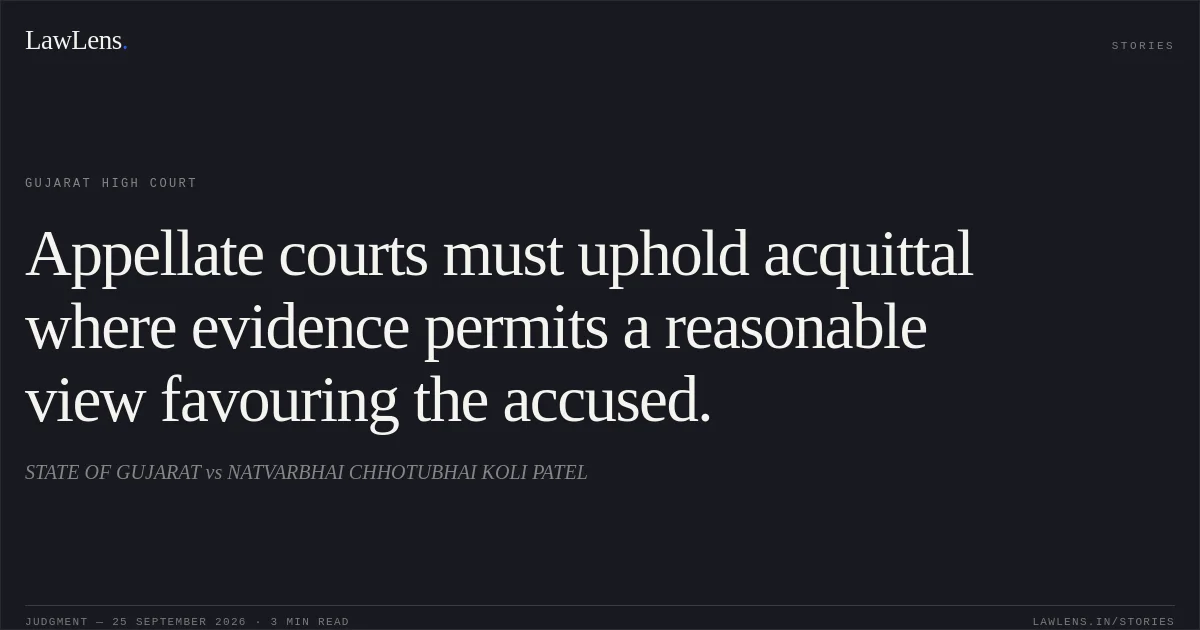
Source reference: para. 1The High Court applied the settled principles governing appeals against acquittal: an appellate court may fully review and reappreciate the evidence, but an acquitted accused benefits from a reinforced or “double” presumption of innocence, and where two reasonable views are possible, the view favouring acquittal should ordinarily be maintained.
Source reference: paras. 23–24, 27These principles were drawn principally from Chandrappa v. State of Karnataka, (2007) 4 SCC 415; Rajesh Prasad v. State of Bihar, (2022) 3 SCC 471; Babu Sahebagouda Rudragoudar v. State of Karnataka, (2024) 8 SCC 149; and Ramesh v. State of Karnataka, (2024) 9 SCC 169.
Source reference: paras. 25–27Interference is justified only where the Trial Court’s conclusion is manifestly illegal, perverse, or such that no reasonable person could have reached it.
Source reference: paras. 23–27Reasoning
The High Court found that the prosecution evidence contained material contradictions and improvements.
Source reference: para. 8Several panch and other witnesses did not support the prosecution.
Source reference: para. 8The complainant’s account differed from the FIR regarding the place of lodging of the complaint and included material facts not stated initially.
Source reference: paras. 8, 14The complainant did not mention his mother’s presence or alleged injuries, although she later projected herself as an injured eyewitness; no medical evidence supported her alleged injury.
Source reference: para. 9The medical evidence also failed to fully corroborate the alleged roles and weapons: the doctor accepted that the complainant’s rib injury could have resulted from a fall and that, if all six accused had assaulted the deceased with their respective weapons, more injuries might ordinarily have been expected.
Source reference: paras. 10–11The post-mortem examination disclosed six injuries, whereas only two appeared in the inquest panchnama, without satisfactory explanation.
Source reference: para. 12Further, the incident occurred at night in darkness, from a distance of approximately 50 metres, making reliable identification of each accused and the weapons allegedly carried doubtful.
Source reference: para. 20These discrepancies undermined the prosecution’s proof of individual participation, common object and the manner and genesis of the occurrence.
Source reference: paras. 15–19, 22–29Since the Trial Court’s assessment was a reasonable view of the evidence and was supported by recorded reasons, the High Court held that the heightened standard for reversal of an acquittal was not met.
Source reference: paras. 15–19, 22–29Holding
The High Court answered the issues against the State and held that the prosecution had failed to establish the guilt of the accused beyond reasonable doubt.
The Trial Court had neither committed an error of law nor perversely appreciated the evidence.
Source reference: paras. 28–30The State’s appeal was therefore dismissed, the judgment of acquittal dated 21 October 1997 was confirmed, the bail bonds were cancelled, and the record and proceedings were directed to be returned to the Trial Court.
Source reference: paras. 28–30Acts & Sections Cited
8 provisions across 2 statutes referred to in this judgment. Each provision opens on LawLens.
Code of Criminal Procedure, 19732
Indian Penal Code, 18606
Original Court PDF
STATE OF GUJARATvsNATVARBHAI CHHOTUBHAI KOLI PATEL
Click to open original judgment
Original judgment, available to read, download and summarize on LawLens.in