Facts
On January 14, 2018, the complainant, Mandeep Sharma, apprehended the respondent, Dinesh, alleging that the respondent robbed him of a Vivo V7+ mobile phone at knifepoint while boarding a bus
Source reference: p. 1-2The police filed a charge-sheet under Sections 392 (robbery), 397 (robbery with attempt to cause death/grievous hurt), and 411 (dishonestly receiving stolen property) of the IPC
Source reference: p. 2On July 29, 2019, the Additional Sessions Judge (ASJ) acquitted the respondent by extending the benefit of doubt
Source reference: p. 1The State filed the present Leave Petition to appeal the acquittal, arguing that the ASJ failed to appreciate the complainant's identification of the accused and recovery of the phone at the spot
Source reference: p. 2Issues
1. Whether the findings of the Trial Court were so perverse, arbitrary, or illegal as to warrant interference by an Appellate Court against an order of acquittal
Source reference: p. 3, para. 72. Whether the non-joining of public witnesses and minor inconsistencies in the prosecution's story were fatal to the case
Source reference: p. 2, para. 3.3; p. 4, para. 8Law Applied
The Court applied the principles governing appeals against acquittal as established in Chandrappa & Ors. v. State of Karnataka, which dictates that there is a double presumption of innocence in favor of an acquitted accused, and if two reasonable conclusions are possible, the appellate court should not disturb the acquittal
Source reference: p. 3-4, para. 6The Court cited Ratheesh v. State of Kerala & Ors., holding that a mere difference of opinion on facts is insufficient for interference if the lower court's conclusion is not perverse
Source reference: p. 3, para. 5Regarding Section 397 of the IPC, the Court acknowledged Ashfaq v. State (Govt. of NCT of Delhi), which clarifies that being armed with a visible deadly weapon is sufficient to constitute the offense, but emphasized this rule applies only after foundational facts are proven beyond reasonable doubt
Source reference: p. 4, para. 9Reasoning
The Court observed that the Trial Court had duly considered the evidence, including the complainant’s testimony and the lack of independent public witnesses, before granting the benefit of doubt to the respondent
Source reference: p. 4, para. 8The High Court held that the State’s grounds for appeal—primarily seeking a re-appreciation of evidence—did not meet the high threshold for overturning an acquittal
Source reference: p. 4, para. 7The Court reasoned that since the Trial Court found the prosecution failed to establish foundational facts beyond a reasonable doubt, the settled legal propositions regarding Section 397 IPC or the visibility of weapons were not applicable
Source reference: p. 4, para. 9The Court found no perversity or manifest illegality in the Trial Court's appreciation of the inconsistencies in the prosecution’s case
Source reference: p. 4, para. 10Holding
The Court answered the issues in the negative, holding that there was no infirmity or perversity in the Trial Court's judgment
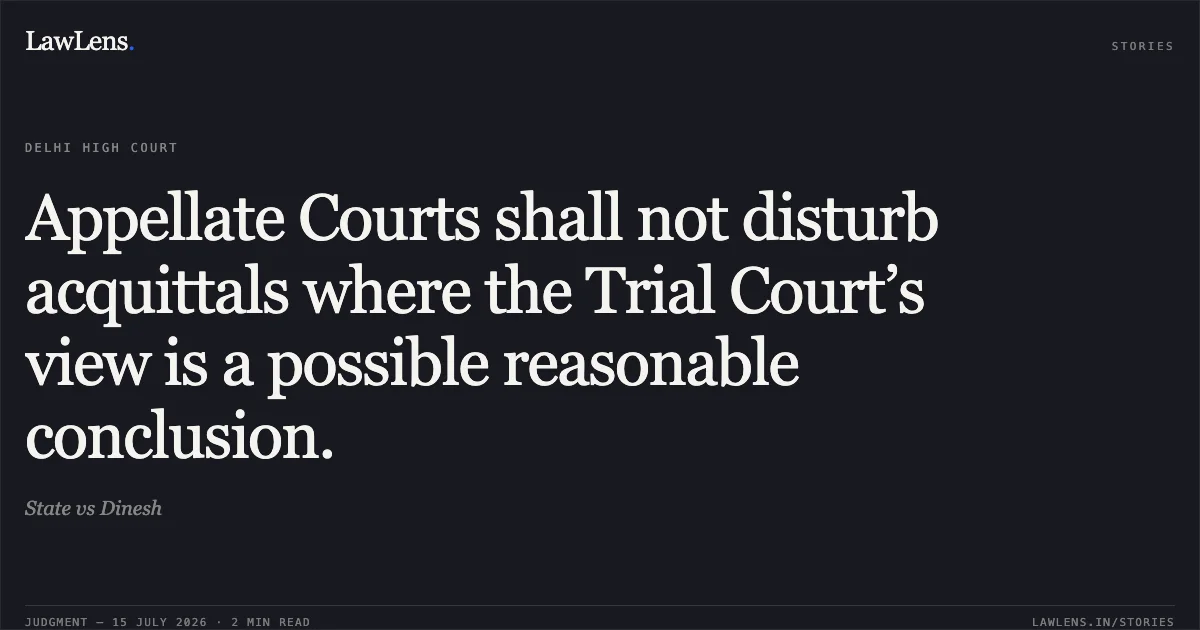
The High Court dismissed the petition seeking leave to appeal, affirming the acquittal of the respondent and maintaining that the appellate court should not substitute its own view for a reasonable view taken by the trial court
Source reference: p. 5, para. 11Acts & Sections Cited
3 provisions across 1 statute referred to in this judgment. Each provision opens on LawLens.
Indian Penal Code, 18603
Original Court PDF
StatevsDinesh
Click to open original judgment
Original judgment, available to read, download and summarize on LawLens.in


