Facts
The appellant challenged only the costs portion of the decree dated 23 December 2025 in Title Suit No. 1119 of 2018.
Source reference: para. 1The Trial Court awarded Rs. 50,000, whereas the appellant claimed to have incurred Rs. 38,95,099 in litigation costs, allegedly arising in significant part from numerous applications and appeals pursued by the respondent.
Source reference: para. 2The appellant argued that the award did not account for court fees, lawyers’ fees, or incidental expenses.
Source reference: para. 3The respondent, despite notice, was unrepresented in the appeal.
Source reference: para. 3Issues
Whether the Trial Court’s award of Rs. 50,000 in costs was an improper exercise of its discretion warranting appellate interference.
Source reference: paras. 2–3, 7–8Whether the costs award was irrational, perverse, or contrary to law in light of the appellant’s claimed litigation expenses.
Source reference: paras. 3, 7–9Law Applied
Section 35 of the Code of Civil Procedure, 1908, places the costs of and incidental to suits within the Court’s discretion, including the determination of the amount payable; that discretion remains subject to the Code and applicable rules.
Source reference: paras. 4–5Tirumalachetti Rajaram v. Tirumalachetti Radhakrishnayya Chetty, AIR 1961 SC 1795, and Ashok Kumar Mittal v. Ram Kumar Gupta, (2009) 2 SCC 656, affirm that costs are discretionary.
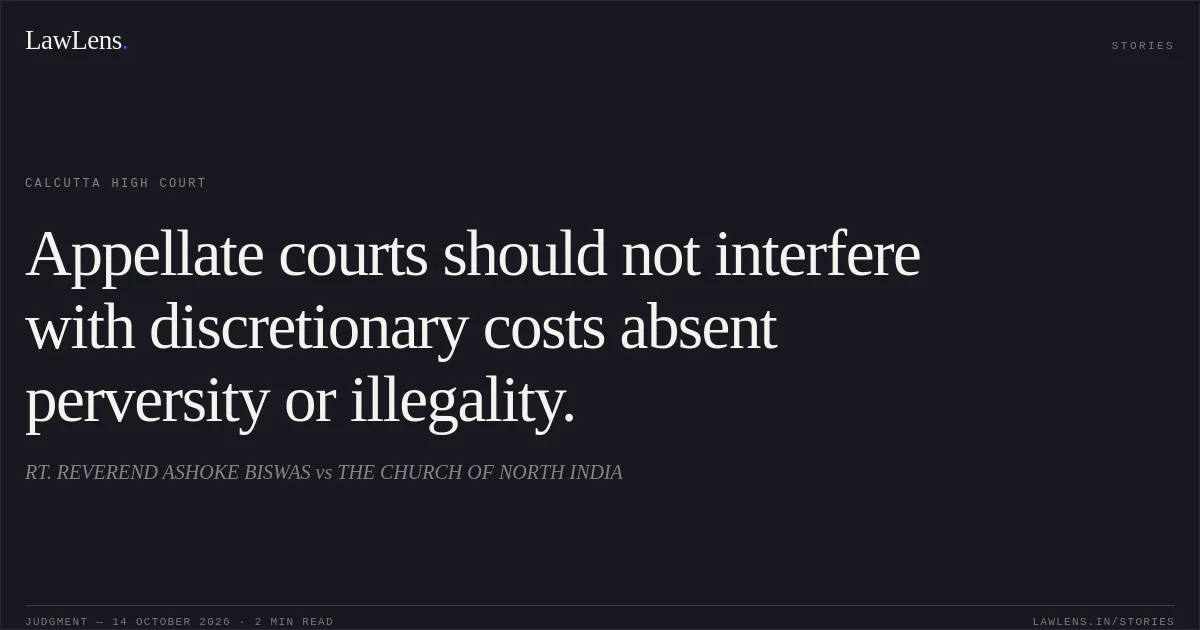
Source reference: para. 6An appellate court ordinarily will not substitute its assessment merely because a different amount could have been awarded; interference is warranted where the discretion was exercised irrationally, perversely, illegally, or otherwise improperly.
Source reference: paras. 7–8Ramrameshwari Devi v. Nirmala Devi, (2011) 8 SCC 249, and Dnyandeo Sabaji Naik v. Pradnya Prakash Khadkar, (2017) 5 SCC 496, concerned abuse of process and were distinguished on that basis.
Source reference: para. 9Reasoning
The Court treated the amount of costs as a matter entrusted to the Trial Court’s discretion, which must be assessed in light of the circumstances of the particular case rather than by a uniform mathematical formula.
Source reference: paras. 5–6The appellant’s claimed expenditure and allegations concerning the respondent’s applications and appeals did not establish that the Trial Court’s award was irrational, perverse, or contrary to law.
Source reference: paras. 7–9The Court therefore found no basis to replace the Trial Court’s assessment.
Source reference: paras. 7–9The authorities concerning abuse of process did not assist the appellant because the circumstances found in those cases were distinguishable.
Source reference: para. 9Holding
The Court answered the issues against the appellant, holding that no improper exercise of discretion or other ground for appellate interference had been made out.
The appeal was dismissed, and FAT 239 of 2026 was disposed of; the Trial Court’s award of Rs. 50,000 in costs remained undisturbed.
Source reference: para. 10Acts & Sections Cited
1 provisions across 1 statute referred to in this judgment. Each provision opens on LawLens.
Code of Civil Procedure, 19081
Original Court PDF
RT. REVEREND ASHOKE BISWASvsTHE CHURCH OF NORTH INDIA
Click to open original judgment
Original judgment, available to read, download and summarize on LawLens.in


