Facts
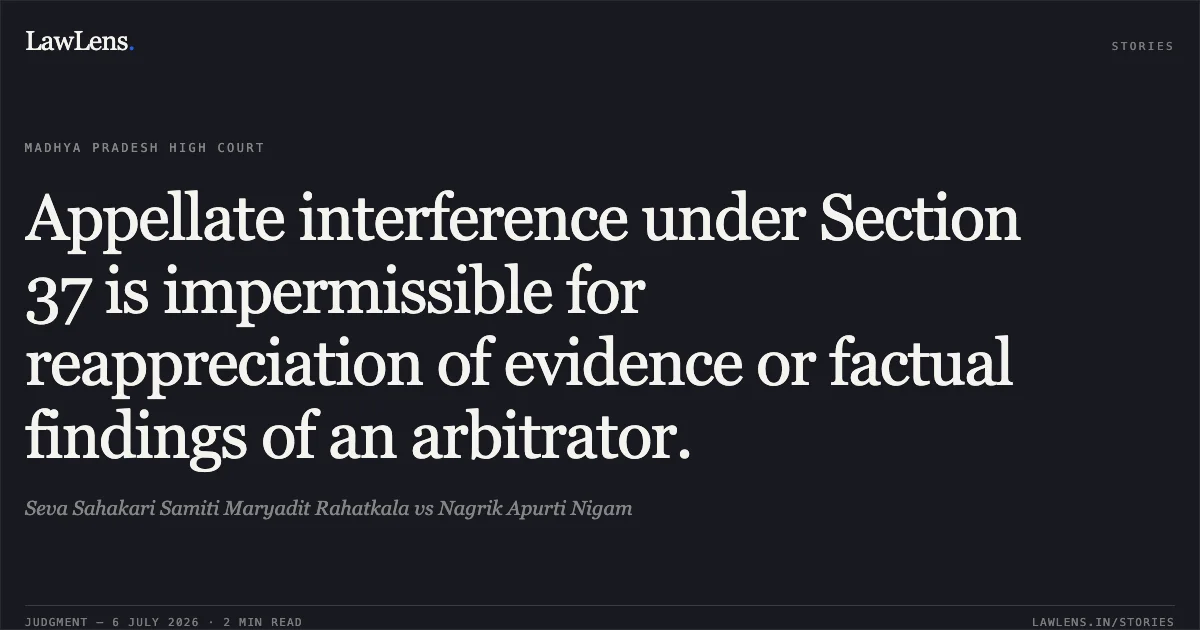
The appellant, a registered Co-operative Society, entered into an agreement with the respondent for the procurement and transportation of wheat during the 2015-16 season.
Source reference: para. 2The appellant claimed that despite supplying 73,867.04 quintals of wheat, the respondent failed to pay an outstanding amount of ₹16,44,920.50/-.
Source reference: para. 2The appellant initiated proceedings before the Collector, Harda, acting as an Arbitrator, who dismissed the claim on 13.02.2020 due to discrepancies in supply records and a failure by the appellant to provide cogent evidence despite multiple notices.
Source reference: para. 3The appellant challenged this via an application under Section 34 of the Arbitration and Conciliation Act, 1996, before the Principal District Judge, Harda, which was dismissed on 01.07.2022 on the grounds that the appellant was merely seeking a re-appreciation of evidence.
Source reference: para. 4Issues
1. Whether the findings of the Arbitrator and the Section 34 Court were perverse or illegal so as to warrant interference under the limited scope of Section 37 of the Arbitration and Conciliation Act, 1996.
Source reference: para. 6, 72. Whether an appellate court under Section 37 can undertake an independent re-assessment of facts and evidence already adjudicated upon in an arbitral award.
Source reference: para. 9, 11Law Applied
The court applied the Arbitration and Conciliation Act, 1996, specifically Sections 34 and 37 regarding the limited scope of judicial interference in arbitral awards.
Source reference: para. 1, 6The court relied on McDermott International Inc. v. Burn Standard Co. Ltd., establishing that the court’s role is supervisory and limited to ensuring fairness, not correcting errors of the arbitrator.
Source reference: para. 8The court cited MMTC Limited v. Vedanta Limited and Dyna Technology Pvt. Ltd. v. Crompton Greaves Ltd. to reiterate that courts must respect the finality of awards and cannot interfere merely because an alternative view of facts exists.
Source reference: para. 9, 11The court applied Punjab State Civil Supplies Corp. Ltd. v. Sanman Rice Mills, which clarifies that Section 37 jurisdiction is "more akin to superintendence" than a regular civil appeal.
Source reference: para. 12Reasoning
The High Court observed that the scope of Section 37 is extremely restrictive and conditioned by the limitations of Section 34.
Source reference: para. 6, 9The Court noted that the Collector (Arbitrator) had thoroughly examined the documentary evidence, including weighment slips, bilties, and correspondence, and found that the appellant failed to provide a satisfactory explanation for shortages.
Source reference: para. 3The Section 34 Court correctly identified that the appellant's grounds for challenge essentially demanded a re-appreciation of evidence—a process prohibited under the Act's statutory framework.
Source reference: para. 4, 7-12The High Court found that the appellant could not point to any patent illegality, violation of natural justice, or conflict with public policy, and since the Arbitrator's view was a "possible view" based on the record, it must prevail.
Source reference: para. 7, 10-13Holding
The Court answered the issues in the negative, holding that the appellant failed to meet the statutory threshold for interference under Sections 34 or 37 as the High Court cannot substitute its own view for that of the Arbitrator on factual merits.
The appeal was dismissed, and the orders of the Principal District Judge and the Collector were affirmed with no order as to costs.
Source reference: para. 14Acts & Sections Cited
2 provisions across 1 statute referred to in this judgment. Each provision opens on LawLens.
Arbitration and Conciliation Act, 19962
Original Court PDF
Seva Sahakari Samiti Maryadit RahatkalavsNagrik Apurti Nigam
Click to open original judgment
Original judgment, available to read, download and summarize on LawLens.in