Facts
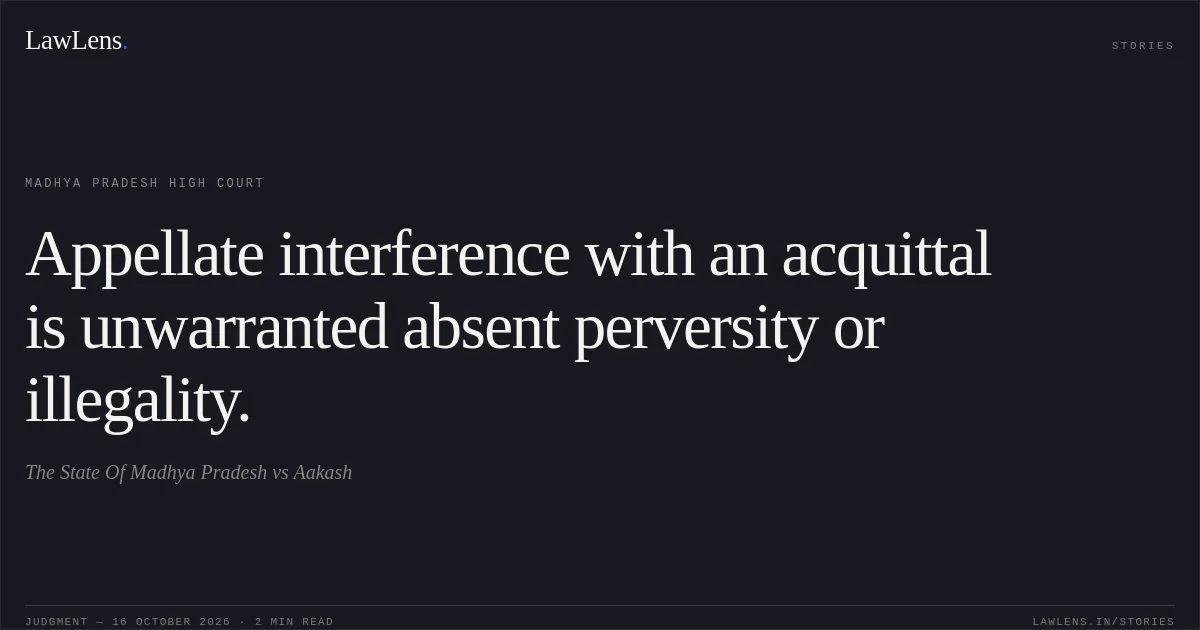
The State sought leave to appeal under Section 378(III) read with Section 378(1) of the CrPC against the judgment dated 12 January 2019, by which the Sessions Court acquitted Aakash of offences under Sections 354-D(1) read with 354-D(2) and 509 of the IPC, and Sections 11(i)/12 of the POCSO Act, 2012.
Source reference: para. 1–2The State argued that the victim’s testimony was corroborated by her parents and that the trial court had wrongly relied on omissions and contradictions.
Source reference: para. 1–2The trial court had found that the parents were hearsay witnesses and that the prosecution evidence did not prove the case beyond reasonable doubt.
Source reference: para. 1–2Issues
Whether the trial court’s acquittal disclosed an error, perversity or other infirmity warranting appellate interference
Source reference: para. 4, 8Whether the State’s petition seeking leave to appeal against the acquittal should be accepted
Source reference: para. 9Law Applied
Section 378 of the CrPC governs appeals against acquittal.
Source reference: para. 5Under Ramesh Babulal Doshi v. State of Gujarat, (1996) 9 SCC 225, an appellate court should first determine whether the acquittal is palpably wrong, manifestly erroneous or demonstrably unsustainable; only if it is may the court reappraise the evidence.
Source reference: para. 5Ajit Savant Majagvai v. State of Karnataka, (1997) 7 SCC 110, recognises the appellate court’s power to review the evidence while requiring it to account for the reinforced presumption of innocence and to adopt a reasonable view favouring the accused.
Source reference: para. 6Nikhil Chandra Mondal v. State of W.B., (2023) 6 SCC 605, reiterates that an acquittal should not be disturbed unless it is perverse, illegal or impossible, and that where two reasonable conclusions are available, the acquittal should stand.
Source reference: para. 7Reasoning
The High Court considered the State’s challenge and found that the trial court had examined and appreciated the victim’s and other witnesses’ testimony in detail.
Source reference: paras. 4, 8It held that the trial court’s findings were proper and justified, and that no illegality or perversity was apparent in the acquittal.
Source reference: paras. 4, 8Applying the principles governing appellate review of acquittals, the Court found no basis to interfere with the trial court’s assessment of the evidence.
Source reference: paras. 4, 8Holding
The High Court declined to grant the State’s petition seeking leave to appeal
and dismissed it, leaving the trial court’s acquittal undisturbed.
Source reference: para. 9Acts & Sections Cited
4 provisions across 3 statutes referred to in this judgment. Each provision opens on LawLens.
Indian Penal Code, 18601
Protection of Children from Sexual Offences Act, 20122
Code of Criminal Procedure, 19731
Original Court PDF
The State Of Madhya PradeshvsAakash
Click to open original judgment
Original judgment, available to read, download and summarize on LawLens.in