01Facts
The plaintiff, proprietor of Maruti Enterprise, a film distributor, entered into an agreement dated 25 March 2003 with Shivani Films for distribution of the Hindi film Ek Hindustani in the Saurashtra region.
¶ 3–3.1 · pp. 2–3The plaintiff paid ₹10,00,000 to the defendants in four instalments of ₹2,50,000 each, supported by receipts.
¶ 3–3.1 · pp. 2–3The defendants allegedly failed to provide the film reels and, in February 2006, informed the plaintiff that the film would not be supplied. The plaintiff therefore sought refund of the advance with interest.
¶ 3.1 · p. 2The defendants disputed the agreement, receipts, liability, and the territorial jurisdiction of the Porbandar court, relying in appeal on a contractual clause conferring jurisdiction on courts in Mumbai.
¶ 3.3 · p. 3 · ¶ 4–4.1 · p. 4The trial court partly decreed the suit and awarded ₹10,00,000 with interest at 6% per annum from the date of filing until realization.
¶ 1 · p. 1The defendants preferred the present first appeal under Section 96 read with Order XLI of the Code of Civil Procedure, 1908.
¶ 1 · p. 102Issues
i.Whether the defendants could raise an objection to the territorial jurisdiction of the Porbandar court for the first time, or effectively, at the appellate stage, having regard to Section 21(1) CPC.
¶ 6, Issue 1 · p. 6ii.Whether the decree passed by the Principal Senior Civil Judge, Porbandar resulted in inconvenience, prejudice, or failure of justice to the defendants.
¶ 6, Issue 2 · p. 6iii.Whether Clause 18 of the agreement exclusively vested jurisdiction in the courts of Mumbai City and consequently deprived the Porbandar court of jurisdiction.
¶ 10–11, 20–21 · pp. 8–9, 19–20iv.Whether the trial court erred in decreeing the plaintiff’s claim for refund of ₹10,00,000.
¶ 6, Issue 3 · p. 603Law Applied
The court applied Section 20(c) CPC, under which a suit may be instituted where the cause of action wholly or partly arises, and Section 21(1) CPC, which bars an appellate or revisional court from entertaining an objection to the place of suing unless it was raised at the earliest opportunity, before or at settlement of issues, and there was a consequent failure of justice.
¶ 12–13, 21 · pp. 9, 19–20It distinguished inherent or subject-matter jurisdiction, where an order may be a nullity, from territorial and pecuniary jurisdiction, where the decree is ordinarily only voidable and is subject to the statutory requirements of Section 21 CPC.
¶ 15–16 · pp. 10–11Relying on Subhash Mahadevasa Habib v. Nemasa Ambasa Dharmadas, (2017) 13 SCC 650; Sneh Lata Goel v. Pushplata, (2019) 3 SCC 594; Hiralal v. Kalinath, AIR 1962 SC 199; Harshad Chiman Lal Modi v. DLF Universal Ltd., (2005) 7 SCC 791; Hasham Abbas Sayyad v. Usman Abbas Sayyad, (2007) 2 SCC 355; Mantoo Sarkar v. Oriental Insurance Co. Ltd., (2009) 2 SCC 244; and Punjab National Bank v. Atin Arora, the court held that territorial objections must be timely and must establish prejudice or failure of justice.
¶ 16–19 · pp. 10–18It also applied the principle that an exclusive-jurisdiction clause is effective only within the scope of disputes covered by its language and cannot oust the jurisdiction of a court otherwise competent under Section 20(c) CPC.
¶ 20–21 · pp. 19–20Provisions in the judgment · 8 · Linked ones open on LawLens
Code of Civil Procedure, 1908 Section 20Section 21Section 96Section 99Section 578Section 41
Suits Valuation Act, 1887 Section 11
Indian Contract Act, 1872 Section 28
04Reasoning
The defendants’ written statement contained only general objections that the Porbandar court lacked jurisdiction and did not specifically invoke or explain Clause 18; no effective jurisdictional challenge was pursued before settlement of issues.
¶ 11–13 · pp. 8–9Further, the defendants failed to show how trial at Porbandar, rather than Mumbai, caused prejudice or failure of justice, and their counsel could not identify any such prejudice when questioned by the court.
¶ 14 · p. 10The court also held that Clause 18 covered disputes concerning the interpretation or implementation of the agreement, whereas the present action was principally for recovery of money paid in advance.
¶ 21 · pp. 19–20Since the payments were made at Porbandar, part of the cause of action arose there and the Porbandar court had jurisdiction under Section 20(c) CPC.
¶ 21 · pp. 19–20On the merits, the plaintiff’s four receipts established payment of ₹10,00,000; the defendants neither effectively impeached the receipts in cross-examination nor produced evidence of repayment or justification for retaining the advance.
¶ 22 · p. 20The plaintiff was also entitled to sue because the agreement was in favour of Maruti Enterprise, whose proprietorship devolved upon him after his father’s death.
¶ 23 · p. 20The defendants’ failure to supply the film constituted breach, making them liable to restore the amount received.
¶ 24 · p. 2005Holding
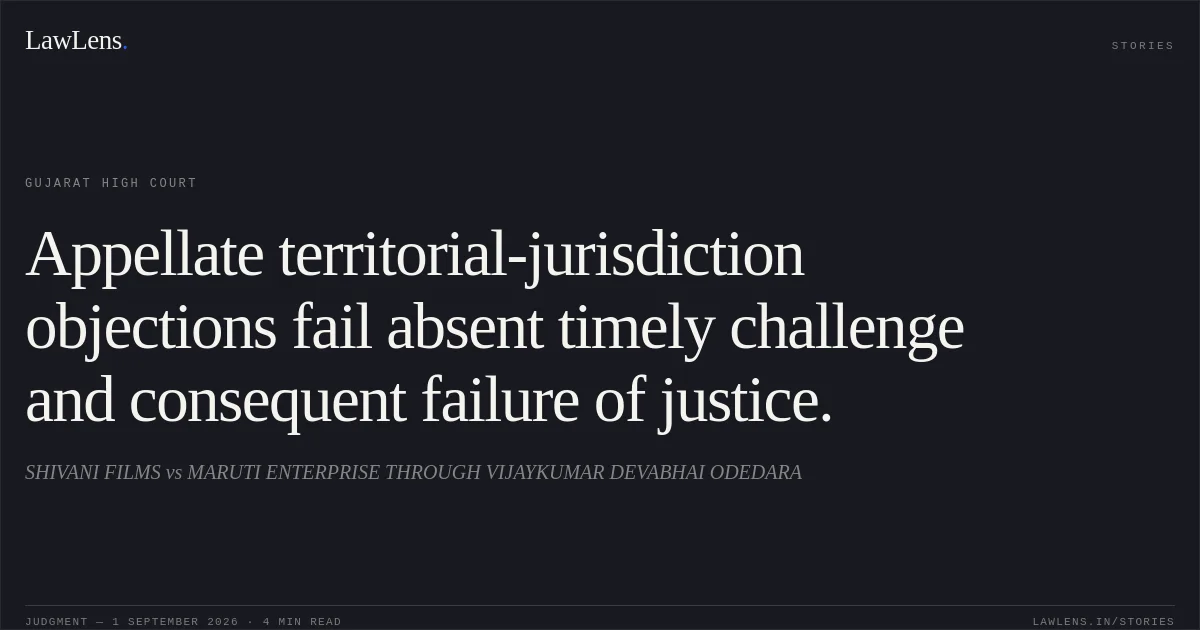
The High Court held that the defendants could not successfully challenge the Porbandar court’s territorial jurisdiction at the appellate stage because the objection was neither properly raised at the earliest opportunity nor accompanied by proof of failure of justice.
¶ 13–19 · pp. 9–19It further held that Clause 18 did not apply to the plaintiff’s recovery claim and did not exclude Porbandar’s jurisdiction.
¶ 21 · pp. 19–20Finding no error in the trial court’s assessment of the agreement, receipts, payment, and breach, the court dismissed the appeal and affirmed the decree for ₹10,00,000 with running interest at 6% per annum from the date of filing of the suit until realization.
¶ 24–27 · pp. 20–21Any interim relief stood vacated, and the record and proceedings were directed to be returned to the concerned court.
¶ 24–27 · pp. 20–21Original Court PDF
SHIVANI FILMSvsMARUTI ENTERPRISE THROUGH VIJAYKUMAR DEVABHAI ODEDARA
Click to open original judgment
Original judgment, available to read, download and summarize on LawLens.in