Facts
The applicant, Dr. Sushree Swarupa Tripathy, a Senior Principal Scientist at National Physical Laboratory (NPL) since 2007, was appointed Head of the Chemical and Food Section (Division 5.03) on October 29, 2020.
Source reference: para. 3Having an outstanding performance record and receiving an accelerated merit-based promotion in 2024, she was reverted from her headship and placed under the direct supervision of Respondent No. 6, a junior, less qualified, and less experienced Principal Scientist, via an Office Memorandum (O.M.) dated April 30, 2025.
Source reference: para. 3.1, 3.2This O.M., along with Circular No. 4-38/2002-E-II(PD) dated March 7, 2013, which mandates the rotation of headship, is challenged by the applicant.
Source reference: para. 1The applicant claims the actions are arbitrary, punitive, vindictive, and a violation of principles of natural justice, citing her domain expertise and superior merit/seniority.
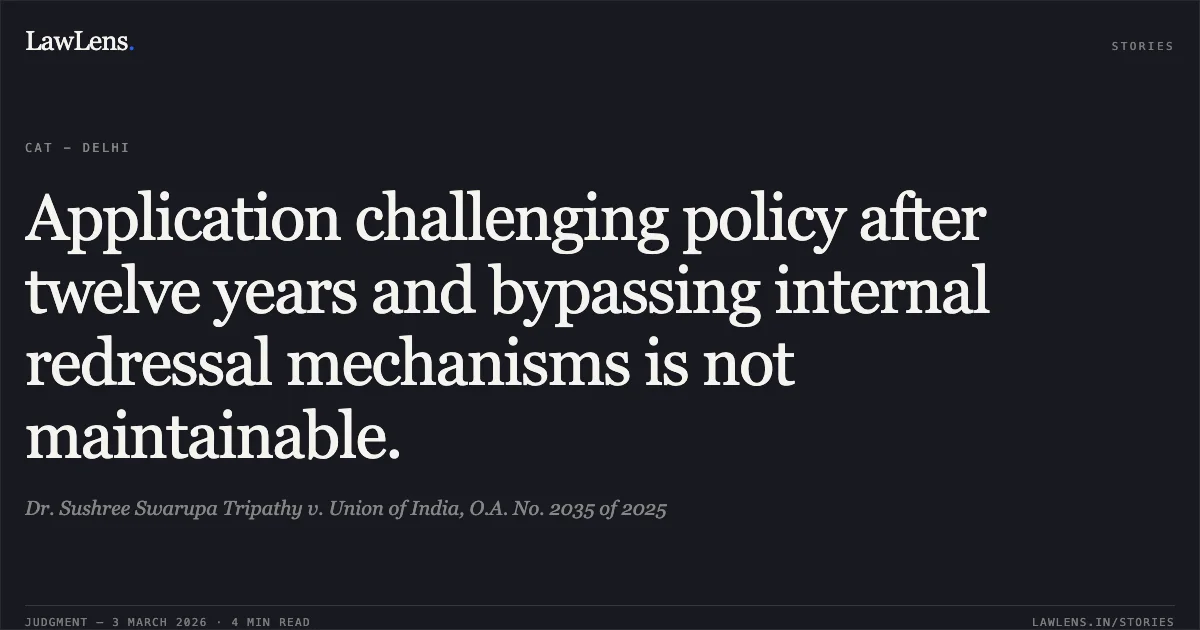
Source reference: para. 3.2, 3.3, 3.9The respondents contended that the O.M. is a routine functional arrangement based on long-standing CSIR policies and that the OA is not maintainable due to inordinate delay in challenging the 2013 Circular (12 years) and non-exhaustion of internal grievance redressal mechanisms.
Source reference: para. 4.1They further argued that headship is a functional assignment, not a vested right or promotional post, and the applicant's substantive rank, pay, and seniority remain unaffected.
Source reference: para. 4.1(iv), 11Issues
1. Whether the Original Application is barred by limitation under Section 21 of the Administrative Tribunals Act, 1985, insofar as it challenges Circular dated March 7, 2013?
Source reference: para. 7(i), 92. Whether the applicant has exhausted the alternative remedy as enumerated under Section 20 of the Administrative Tribunals Act, 1985?
Source reference: para. 7(ii), 103. Whether withdrawal/rotation of functional headship amounts to a civil consequence or reduction in rank?
Source reference: para. 7(iii), 114. Whether executive circular dated March 7, 2013, can validly regulate rotational headship without violating Recruitment Rules?
Source reference: para. 7(iv), 125. Whether alleged violation of seniority principle renders the administrative decision illegal?
Source reference: para. 7(v), 136. Whether absence of show cause notice vitiates the impugned action?
Source reference: para. 7(vi), 14Law Applied
The tribunal applied Section 21 of the Administrative Tribunals Act, 1985, which mandates a one-year limitation period for applications.
Source reference: para. 9Section 20 of the Administrative Tribunals Act, 1985, requiring the exhaustion of available departmental remedies before approaching the tribunal.
Source reference: para. 10The Supreme Court's ruling in *D.C.S. Negi v. Union of India, (2018) 16 SCC 721*, emphasizing that statutory time limits are mandatory and non-compliance renders an application incompetent, even if the objection is not raised by the respondent.
Source reference: para. 9.1The principle that stale claims cannot be revived was drawn from *Union of India v. M.K. Sarkar, 2010 (2) SCC 59*.
Source reference: para. 9.2For the requirement of exhausting alternative remedies, *S.S. Rathore v. State of Madhya Pradesh, (1989) 4 SCC 582*, was referenced, stating that the cause of action arises only after departmental remedies are disposed of.
Source reference: para. 10.1The Supreme Court's decision in *Union of India v. T.R. Varma, 1957 AIR SUPREME COURT 882*, reinforced that parties should ordinarily exhaust available statutory remedies before invoking the special jurisdiction of the High Court or Tribunal.
Source reference: para. 10.3Regarding administrative discretion and arbitrariness, the Constitutional Bench decision in *E.P. Royappa v. State of Tamil Nadu, (1974) 4 SCC 3*, clarified that administrative discretion is permissible if not arbitrary or mala fide, and that Articles 14 and 16 strike at arbitrariness in State action.
Source reference: para. 13.1The tribunal referred to *Union of India v. Tulsiram Patel, (1985) 3 SCC 398*, to state that natural justice requirements depend on context, and rotation of functional duty may not require a pre-decisional hearing if no civil consequences occur.
Source reference: para. 14.1Reasoning
The tribunal found the challenge to the 2013 Circular time-barred under Section 21 of the Administrative Tribunals Act, 1985, as it was made after more than twelve years without adequate explanation for delay, and the applicant had previously benefited from its provisions.
Source reference: para. 9, 9.3It also concluded that the OA was premature due to the applicant's failure to exhaust the internal grievance redressal mechanisms available within NPL, as mandated by Section 20 of the Act and precedents like *S.S. Rathore* and *T.R. Varma*.
Source reference: para. 10, 10.1, 10.2The tribunal determined that the rotation of functional headship did not amount to a civil consequence or reduction in rank, as the applicant's substantive post, pay, seniority, and promotional avenues remained unaffected, distinguishing it from a demotion.
Source reference: para. 11The 2013 Circular was held to be a valid administrative instruction regulating internal functioning and rotational headship, not overriding Recruitment Rules, which govern cadre hierarchy and promotions.
Source reference: para. 12, 12.1The tribunal concluded that the seniority principle was not violated in the context of rotational functional headship, as it's an internal allocation of duties, not a promotional post.
Source reference: para. 13The respondents demonstrated that the rotation was part of an institutional policy applied uniformly, negating allegations of mala fides, consistent with *E.P. Royappa*.
Source reference: para. 13.1Finally, the absence of a show cause notice did not vitiate the action, as no civil consequences (demotion, adverse entry, pay reduction) occurred, aligning with *Tulsiram Patel*, which clarifies that natural justice depends on context.
Source reference: para. 14, 14.1Holding
The Original Application was dismissed.
The tribunal held that the challenge to the 2013 Circular was barred by limitation due to inordinate delay.
Source reference: para. 15It was further held that the OA was premature due to the non-exhaustion of statutory remedies.
Source reference: para. 15The tribunal found no civil consequence or reduction in rank established, that the executive circular did not override Recruitment Rules, and that administrative discretion was exercised uniformly.
Source reference: para. 15The court also found the reliance on *Vice Chancellor, L.N. Mithila University vs. Dayanand Jha* to be distinguishable and irrelevant.
Source reference: para. 16No order as to costs was made.
Source reference: para. 18Acts & Sections Cited
3 provisions across 1 statute referred to in this judgment. Each provision opens on LawLens.
Administrative Tribunals Act, 19853
Original Court PDF
Dr. Sushree Swarupa Tripathy v. Union of India, O.A. No. 2035 of 2025
Click to open original judgment
Original judgment, available to read, download and summarize on LawLens.in