Facts
The administration of Sree Thirumandhamkunnu Bhagavathy Temple is governed by a 1966 Scheme.
Source reference: para 5Following the death of the hereditary trustee in 2013, the Malabar Devaswom Board appointed an Executive Officer under Section 20 of the Madras Hindu Religious and Charitable Endowments Act, 1951, as a "stop-gap" measure to avoid an administrative vacuum.
Source reference: para 13, 59The hereditary trustee challenged this, arguing it divested the family of its rights under the Scheme.
Source reference: para 10The Board had refused to approve their appointments, citing that they were made to non-sanctioned posts without a fair selection process, creating a financial burden.
Source reference: para 29-30The State Government, in revision, upheld the termination of 27 employees appointed beyond the sanctioned strength of 73 positions.
Source reference: para 32, 91Issues
1. Whether the Commissioner has the power to appoint an Executive Officer for an indefinite period, thereby displacing the hereditary trustee.
Source reference: para 48, 532. Whether the hereditary trustee has absolute power to appoint employees regardless of sanctioned posts and Board approval.
Source reference: para 70-713. Whether the State Government, as a revisional authority under Section 99, has the power to remit a matter back to the original authority.
Source reference: para 70, 96Law Applied
The Court applied Section 20 of the Madras HR & CE Act, 1951, which grants the Commissioner powers of general superintendence and control, but does not allow for the usurpation of a trustee's powers.
Source reference: para 53, 62It relied on Edamana Vasudevan Namboothiri v. Malabar Devaswom Board, which established that "superintendence" assumes two distinct authorities and does not permit an indirect takeover of duties.
Source reference: para 53Regarding appointments, the Court applied Section 48(1) (trustee’s power to fill vacancies) and Section 23 (trustee's duty to obey Board orders), read with Rule 10 of the Rules under Section 100(2)(y), which mandates that pay and emoluments must conform to a schedule of establishment approved by the Board.
Source reference: para 82, 84, 87-88Section 99 was applied regarding the State’s power to remit cases for reconsideration.
Source reference: para 96Reasoning
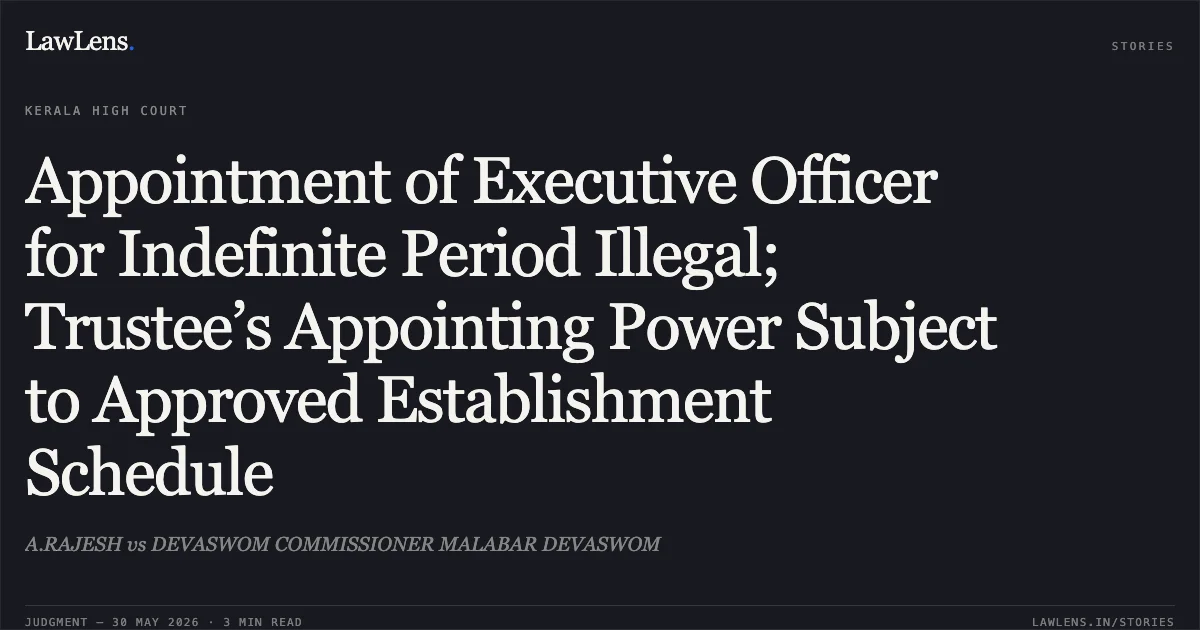
The Court found that while the Commissioner can appoint an Executive Officer to prevent administrative standstill, such an appointment cannot be for an indefinite period (nearly 13 years in this case) without periodic review, as it effectively eclipses the hereditary trustee's rights.
Source reference: para 62On the issue of staffing, the Court reasoned that the trustee’s power under Section 48(1) is not unfettered; it is restricted by Rule 10, which prevents the creation of new posts or alterations to the establishment schedule without prior Board sanction.
Source reference: para 87-89Consequently, appointments made to non-sanctioned posts are illegal, and such employees cannot claim regularisation.
Source reference: para 90The Court analyzed Section 99, determining that the Government acted within its "revisional jurisdiction" by remitting the matter to the Commissioner, as the statute expressly permits the authority to "remit the matter for reconsideration".
Source reference: para 96Holding
The Court allowed WP(C) No. 13541/2013, quashing the indefinite appointment of the Executive Officer and directing the appointment of a new hereditary trustee within one month.
The Court dismissed the petitions of those appointed to non-sanctioned posts, upholding the State's order.
Source reference: para 101The Court directed the Board to frame a new, transparent administration scheme within three months to replace the obsolete 1966 Scheme, and ordered that the Executive Officer shall remain in charge only until the new hereditary trustee is appointed.
Source reference: para 101Acts & Sections Cited
11 provisions across 1 statute referred to in this judgment. Linked provisions open on LawLens.
Madras Hindu Religious and Charitable Endowments Act, 1951
Original Court PDF
A.RAJESHvsDEVASWOM COMMISSIONER MALABAR DEVASWOM
Click to open original judgment
Original judgment, available to read, download and summarize on LawLens.in