Facts
The Petitioner is the Successful Resolution Applicant (SRA) for the Corporate Debtor (CD), M/s. Abhirama Steels Limited. In 2008, the CD purchased the subject immovable property and subsequently mortgaged it to Indian Bank
Source reference: para 2On 19.03.2016, the State of Maharashtra attached the property under the MPID Act following an FIR against a different entity, Birla Power Solutions Ltd.; notably, the CD was neither a "financial establishment" nor an accused in that case
Source reference: para 3Following insolvency proceedings initiated in 2021, the NCLT Hyderabad approved a resolution plan on 17.09.2024, which the Petitioner implemented by settling bank dues
Source reference: para 5-6The Petitioner sought quashing of the MPID attachment, arguing immunity under Section 32A of the Insolvency and Bankruptcy Code (IBC). The State opposed this, claiming the property had already "vested" in the State upon attachment
Source reference: para 14-15Issues
1. Whether the liability of a corporate debtor and the attachment of its property cease upon the approval of a resolution plan under the IBC, despite proceedings under the MPID Act.
Source reference: para 9, 162. Whether an attachment order under Section 4 of the MPID Act results in absolute vesting of the property in the State, thereby excluded it from the CIRP.
Source reference: para 24-25Law Applied
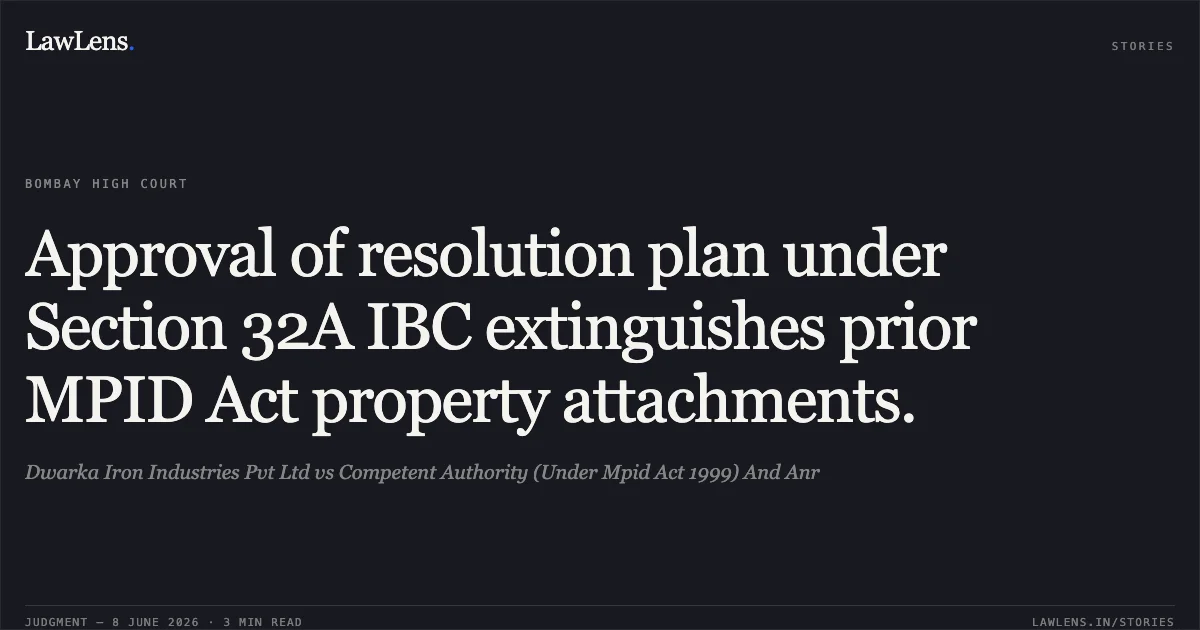
The Court primarily applied Section 32A of the IBC, which provides that the liability of a corporate debtor for prior offences ceases, and no action (including attachment or seizure) shall be taken against its property once a resolution plan is approved and management changes hands
Source reference: para 17, 19The Court relied on Manish Kumar v. Union of India, which established that Section 32A offers a "protective umbrella" to ensure the CD starts on a "clean slate"
Source reference: para 20Ghanashyam Mishra and Sons v. Edelweiss Asset Reconstruction, which affirmed the clean slate doctrine
Source reference: para 21It also considered Sections 4 and 7 of the MPID Act, distinguishing between an interim attachment and an absolute vesting order
Source reference: para 18Reasoning
The Court reasoned that Section 32A(2) of the IBC contains a non-obstante clause that explicitly prohibits taking or continuing any action against the property of a CD covered under an approved resolution plan
Source reference: para 19The Court rejected the State's argument that the property had "vested" in the Competent Authority upon attachment under Section 4 of the MPID Act. It clarified that under the MPID Act's scheme, vesting under Section 4(2) is merely "inchoate" and "pending further orders," only reaching finality when the Designated Court makes the attachment absolute under Section 7
Source reference: para 25Since no Section 7 order was passed, the property remained the CD's asset and was subject to the IBC. Furthermore, since the CD was never an accused in the MPID FIR and the resolution plan changed the management to a clean third party, all conditions for immunity under Section 32A were satisfied
Source reference: para 28Holding
The Court held that the Petitioner was entitled to the full protection of Section 32A of the IBC. It ruled that the MPID attachment could not continue after the approval of the resolution plan
The Court allowed the Writ Petition, quashed the notification dated 19.03.2016 regarding the subject property, and directed the Registry to return the bank guarantee of Rs. 74.24 lakhs previously furnished by the Petitioner
Source reference: para 29-30Acts & Sections Cited
11 provisions across 6 statutes referred to in this judgment. Each provision opens on LawLens.
Insolvency and Bankruptcy Code, 2016.3
Maharashtra Protection of Interest of Depositors (in Financial Establishments) Act, 19994
Securitisation and Reconstruction of Financial Assets and Enforcement of Security Interest Act, 20021
Companies Act, 20131
Limited Liability Partnership Act, 20081
Code of Civil Procedure, 19081
Original Court PDF
Dwarka Iron Industries Pvt LtdvsCompetent Authority (Under Mpid Act 1999) And Anr
Click to open original judgment
Original judgment, available to read, download and summarize on LawLens.in