Facts
The petitioners, who had been appointed as Deputy Registrars through direct recruitment, challenged disciplinary charge memoranda issued against them under Rule 14 of the CCS (CCA) Rules, 1965, and the Board of Management’s resolution authorising disciplinary proceedings.
Source reference: para. 5–10The proceedings arose from an inquiry into allegations concerning their eligibility for appointment.
Source reference: para. 5–10During the writ proceedings, the Enquiry Officer submitted a report finding the charges established; the petitioners also challenged that report.
Source reference: para. 5–10The petitioners contended that the Board of Management, their disciplinary authority, had not separately approved the charge memoranda before their issuance.
Source reference: para. 11–14Issues
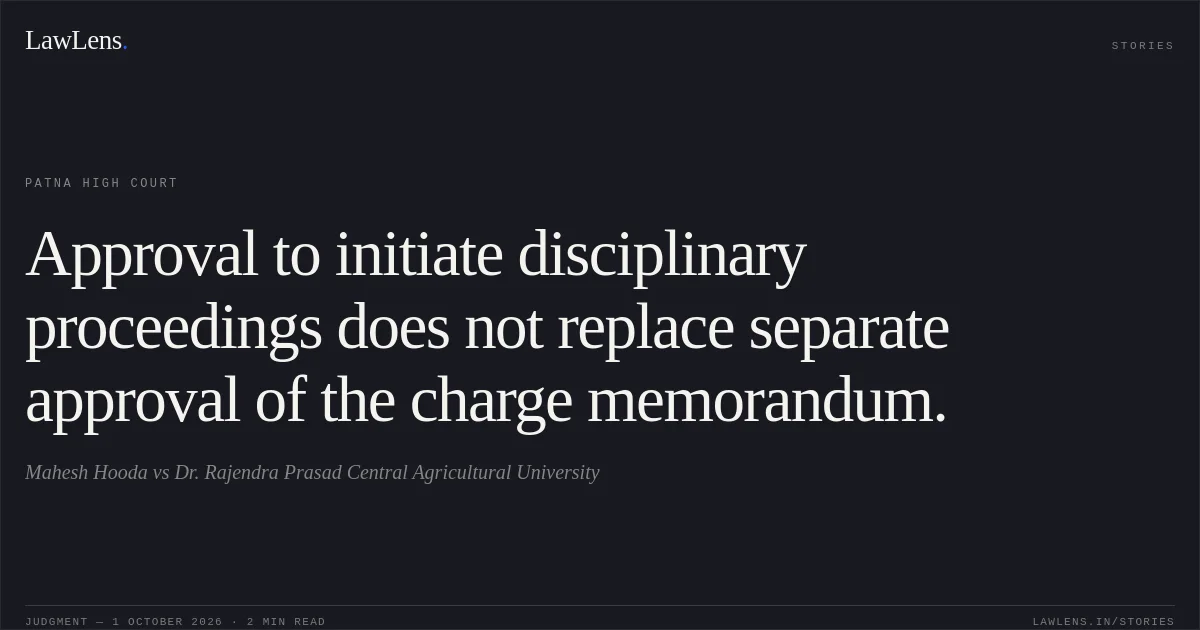
1. Whether approval by the Board of Management to initiate disciplinary proceedings also satisfied the requirement for approval of the charge memoranda under Rule 14(3) of the CCS (CCA) Rules, 1965.
Source reference: para. 20–212. Whether the charge memoranda and subsequent disciplinary proceedings could stand in the absence of the disciplinary authority’s approval of the memoranda before their issuance.
Source reference: para. 27–29Law Applied
Rule 14(3) of the CCS (CCA) Rules, 1965 requires the disciplinary authority to draw up, or cause to be drawn up, the charges; the proposed charges must be finalised with that authority’s approval.
Source reference: para. 21Rule 14(4) requires delivery of the charge articles, imputations and supporting materials to the government servant.
Source reference: para. 21In Union of India v. B.V. Gopinath, (2014) 1 SCC 351, the Supreme Court held that approval to initiate disciplinary proceedings is distinct from approval of the charge memorandum; the latter is independently required.
Source reference: para. 22–24Sunny Abraham v. Union of India, (2021) 20 SCC 12, held that a charge memorandum issued without the required approval is fundamentally defective and cannot be validated retrospectively.
Source reference: para. 25–26The Court also referred to the protections under Article 311(1) and (2) of the Constitution.
Source reference: para. 22, 28Reasoning
The Board’s resolution authorised initiation of the proceedings and empowered the Vice-Chancellor to issue the charge sheets and manage specified steps in the inquiry. But the Court treated that authorisation as distinct from the disciplinary authority’s required approval of the charge memoranda themselves.
Source reference: para. 27–28On examining the record and the University’s affidavit, the Court found that the Board’s approval had not been obtained when the memoranda were issued.
Source reference: para. 27–28Applying B.V. Gopinath and Sunny Abraham, the Court held that approval at the initiation stage could not substitute for independent approval of the charge memoranda, and that the defect invalidated the memoranda and the proceedings founded on them.
Source reference: para. 24, 26–29Holding
The Court allowed both writ petitions and set aside the departmental proceedings, including the charge memoranda and the Enquiry Officer’s report dated 2 February 2026.
It left the Disciplinary Authority at liberty to issue fresh charge memoranda after obtaining the Board of Management’s requisite approval in accordance with law.
Source reference: para. 29–32The parties were directed to bear their own costs.
Source reference: para. 29–32Acts & Sections Cited
1 provisions across 1 statute referred to in this judgment. Each provision opens on LawLens.
Dr. Rajendra Prasad Central Agricultural University Act, 2016.1
Original Court PDF
Mahesh HoodavsDr. Rajendra Prasad Central Agricultural University
Click to open original judgment
Original judgment, available to read, download and summarize on LawLens.in