Facts
The Petitioner (Indian Oil Corporation) challenged an Arbitral Award dated 20.11.2014, specifically regarding Claim No. 2.
Source reference: para. 1The dispute arose from a contract dated 26.07.2006 for construction works, where the Petitioner had imposed a "price discount" (liquidated damages) of ₹91,59,654 due to project delays.
Source reference: para. 19Clauses 4.3.5.0 to 4.3.6.0 of the General Conditions of Contract (GCC) established a structured mechanism for time extensions, stipulating that the Petitioner’s decision on such extensions would be "final and binding".
Source reference: para. 3The Respondent argued the Petitioner failed to follow this procedure.
Source reference: para. 9The Sole Arbitrator allowed the Respondent's claim, directing a refund of the price discount with 9% interest, primarily finding that the Petitioner’s rejection of delay justifications was arbitrary and lacked application of mind.
Source reference: para. 10, 17Issues
1. Whether the Arbitral Award was ex-facie contrary to the express terms of the Contract and the finality of decisions under GCC Clauses 4.3.5.0–4.3.6.0.
Source reference: para. 3, 52. Whether the Arbitral Award was vitiated by "patent illegality" or "perversity" due to a lack of intelligible and adequate reasoning as mandated by Section 31(3) of the Act.
Source reference: para. 17, 24Law Applied
The Court applied Section 34 of the Arbitration and Conciliation Act, 1996, which limits judicial interference to grounds of public policy, patent illegality, and perversity.
Source reference: para. 15It relied on OPG Power Generation (P) Ltd. v. Enexio Power Cooling Solutions (2025) to define "patent illegality" as an award contrary to substantive law or the terms of the contract.
Source reference: para. 15Under Section 31(3), the Court emphasized the mandate for a "reasoned award," citing Dyna Technologies (P) Ltd. v. Crompton Greaves Ltd. (2019), which requires reasons to be proper, intelligible, and adequate.
Source reference: para. 22-23It further referenced Mitra Guha Builders v. ONGC (2020) and IOCL v. NCC Limited (2023) regarding party autonomy and the finality of contractually agreed adjudicatory mechanisms.
Source reference: para. 6-7Reasoning
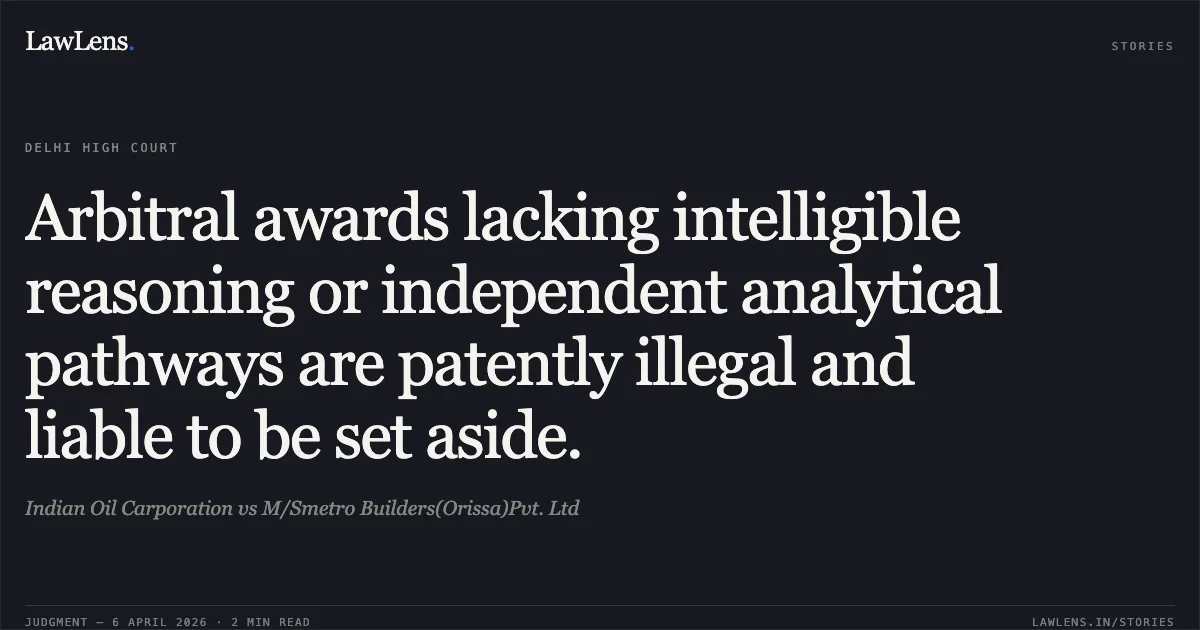
The Court found that the Arbitrator failed to provide independent adjudicatory analysis. Instead of explaining the "why" behind the decision, the Arbitrator merely reproduced the Respondent’s submissions and factual assertions, leading to an "acute reasoning deficit".
Source reference: para. 17, 20The Court observed that while the Arbitrator noted the Petitioner did not follow the contractual procedure, there was no analytical linkage between this observation and the final conclusion to refund the price discount.
Source reference: para. 18Under the Dyna Technologies standard, the Court held that the Award was "unintelligible," which is legally equivalent to providing no reasons at all.
Source reference: para. 23-24Furthermore, by disregarding the "final and binding" nature of the Petitioner’s decision under the GCC without cogent analysis, the Arbitrator acted contrary to the terms of the contract, satisfying the criteria for patent illegality.
Source reference: para. 5, 21, 26Holding
The Court held that the Impugned Award suffered from a fundamental infirmity of unintelligibility and lacked the statutory mandate of reasoning under Section 31(3).
Consequently, the Court allowed the Petition and set aside the Arbitral Award dated 20.11.2014.
Source reference: para. 28No order as to costs was made.
Source reference: para. 30Acts & Sections Cited
6 provisions across 2 statutes referred to in this judgment. Each provision opens on LawLens.
Arbitration and Conciliation Act, 19965
Indian Contract Act, 18721
Original Court PDF
Indian Oil CarporationvsM/Smetro Builders(Orissa)Pvt. Ltd
Click to open original judgment
Original judgment, available to read, download and summarize on LawLens.in


![Subsequent exoneration does not retrospectively invalidate a finalized promotion select list.. UNNIKRISHNAN M vs M/o Environment And Forests. CAT - ['Ernakulam']. LawLens](/stories/thumbnails/subsequent-exoneration-does-not-retrospectively-invalidate-a-finalized-promotion-select-li-ce80a0e84f2f4887857271e8b4341c42.webp)