Facts
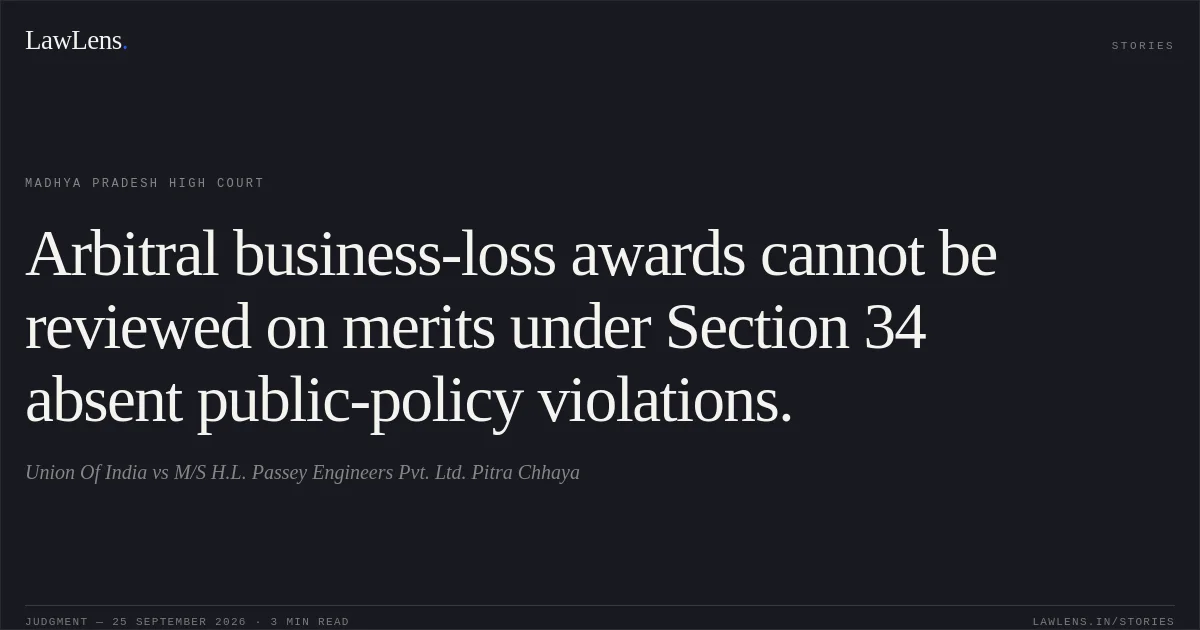
The appellants, Union of India and others, challenged the order dated 15 March 2016 passed by the Fifth Additional District Judge, Jabalpur, in M.J.C. No. 05/2008, whereby their application under Section 34 of the Arbitration and Conciliation Act, 1996 was rejected.
Source reference: para. 1The arbitral tribunal consisted of three arbitrators; the majority awarded compensation to the respondent-contractor under the head of “Business Loss with cascading effect due to non-issuance of certificate of completion,” while one arbitrator dissented.
Source reference: paras. 1, 4The contract was executed on 25 February 2003 with an original completion period of six months, ending on 30 July 2003. Three extensions were thereafter granted, with the final extension up to 30 April 2004.
Source reference: para. 4The majority found that completion was delayed due to defaults attributable to the Railway authorities, including non-availability of approved drawings for certain works. The claimant also extended the bank guarantee twice at the respondents’ request, up to 5 February 2005 and 5 August 2005.
Source reference: para. 5Issues
Whether the majority award granting compensation for business loss or loss of profit was liable to be set aside under Section 34 of the Arbitration and Conciliation Act, 1996 merely because the award was based on a majority opinion and was allegedly unsupported by adequate proof?
Source reference: paras. 1–6, 11Whether the appellants established any ground under Section 34(2)(b)(i) or Section 34(2)(b)(ii), read with Explanation 1, warranting interference with the arbitral award?
Source reference: paras. 3, 7–11Whether the High Court, in proceedings under Section 37, could reappreciate the merits or evidence underlying the arbitral tribunal’s determination?
Source reference: paras. 8–10Law Applied
The Court applied Section 34(2)(b)(i) and (ii) of the Arbitration and Conciliation Act, 1996, under which an arbitral award may be set aside if the subject matter is not arbitrable or if the award conflicts with the public policy of India.
Source reference: para. 7Explanation 1 limits conflict with public policy to circumstances involving fraud or corruption or violation of Sections 75 or 81, contravention of the fundamental policy of Indian law, or conflict with the most basic notions of morality or justice.
Source reference: para. 7Explanation 2 expressly provides that determining contravention of the fundamental policy of Indian law does not permit a review on the merits of the dispute.
Source reference: paras. 7, 10The Court also considered the principle stated in Unibros v. All India Radio, 2023 SCC OnLine SC 1366, that loss of profit cannot be awarded merely by applying a structured formula and must be supported by proof of the relevant facts.
Source reference: para. 2Reasoning
The Court found that the majority arbitrators had relied on the contractual history and material before them, including the repeated extensions, the delay attributable to the Railway authorities, the non-availability of approved drawings, and the documentary evidence produced by the claimant.
Source reference: paras. 4–6, 11On these facts, the award of compensation for business loss was considered justified.
Source reference: paras. 4–6, 11Although the appellants challenged the award of loss of profit and relied on Unibros, they did not establish that the award was based solely on an impermissible formula or that it suffered from fraud, corruption, violation of fundamental legal policy, or conflict with basic notions of morality or justice.
Source reference: paras. 2, 8–11The Court held that the grounds under Section 34(2)(b)(i) and (ii) had neither been properly pleaded nor proved. In view of Explanation 2, the Court declined to undertake a merits-based reassessment of the tribunal’s factual conclusions.
Source reference: paras. 8–10It further observed that the appellants’ failure to properly contest the claim before the arbitral tribunal did not justify an appeal on frivolous grounds.
Source reference: para. 11Holding
The High Court held that no ground under Section 34(2)(b)(i) or (ii) of the Arbitration and Conciliation Act, 1996 was made out.
The majority award granting compensation for business loss was not shown to be contrary to the public policy of India, and the Court could not reappreciate the merits of the arbitral tribunal’s findings in the Section 37 proceedings.
Source reference: paras. 8–11The arbitration appeal was accordingly dismissed.
Source reference: para. 12Acts & Sections Cited
4 provisions across 1 statute referred to in this judgment. Each provision opens on LawLens.
Arbitration and Conciliation Act, 19964
Original Court PDF
Union Of IndiavsM/S H.L. Passey Engineers Pvt. Ltd. Pitra Chhaya
Click to open original judgment
Original judgment, available to read, download and summarize on LawLens.in