Facts
The Petitioner, a distributor (C&F agent), entered into a distributorship agreement with the Respondent in 2003 for eye care products in Kolkata.
Source reference: p.1-2The Petitioner alleged that the Respondent induced it to increase investments to over ₹1.10 Crores based on projected sales targets that remained unfulfilled, leading to financial distress and unsold inventory.
Source reference: p.3-4The Petitioner invoked arbitration in 2007, claiming loss of profits and litigation costs.
Source reference: p.4The Sole Arbitrator passed an Award on 27.09.2021 dismissing the claims.
Source reference: p.1The Petitioner challenged the Award under Section 34 of the Arbitration and Conciliation Act, 1996, primarily contesting the Arbitrator's rejection of an application to lead additional evidence (witness CW-3/accountant) at a late stage and the adoption of CPC-like procedures in an ad-hoc arbitration.
Source reference: p.5-6Issues
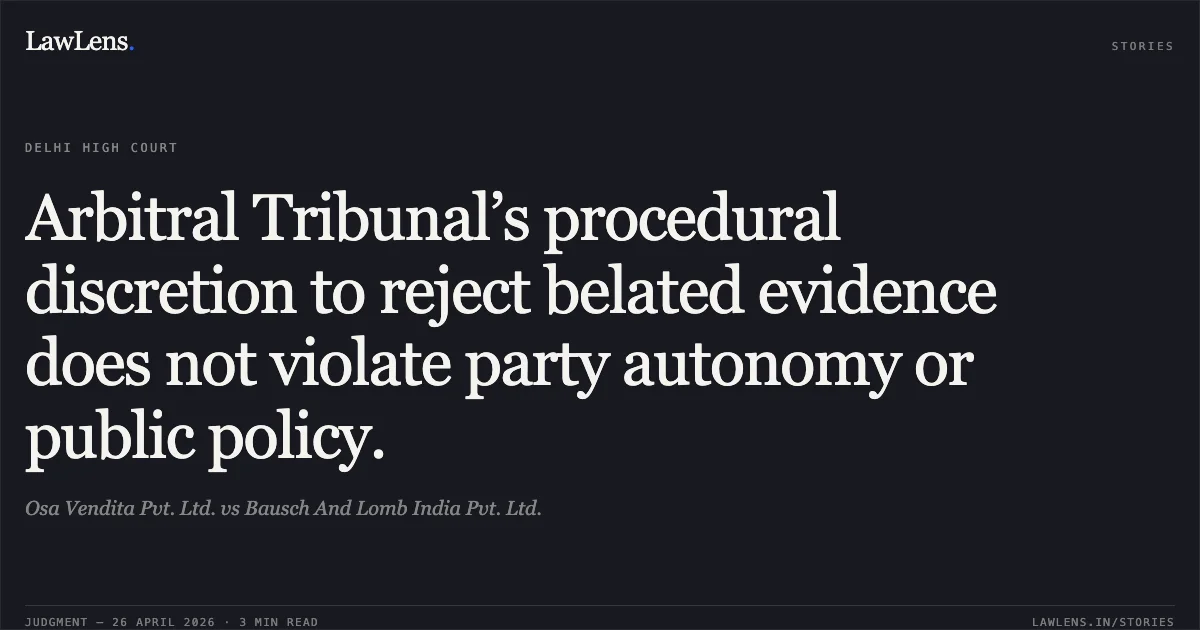
1. Whether the Arbitral Tribunal’s rejection of the Petitioner’s application to adduce additional evidence at a belated stage constituted a violation of the principles of natural justice or fundamental policy of Indian law.
Source reference: p.9-10 / para. 27-282. Whether the Arbitrator’s adoption of procedures similar to the CPC and Evidence Act in an ad-hoc arbitration, without a specific declarative order, violated party autonomy under Section 19 or Article 14 of the Constitution.
Source reference: p.11-12 / para. 32-353. Whether the Respondent was contractually obligated to indemnify the Petitioner for business losses arising from unsold inventory.
Source reference: p.23-24 / para. 41-43Law Applied
Section 19 of the Arbitration and Conciliation Act, 1996, which clarifies that tribunals are not bound by the CPC or Evidence Act but may determine their own procedure failing party agreement.
Source reference: p.11Section 2(1)(a) to affirm that the Act applies equally to ad-hoc and institutional arbitrations.
Source reference: p.12Union of India v. U.P. State Bridge Corpn. Ltd. for the "speedy trial" pillar of arbitration.
Source reference: p.21Ramesh Kumar Jain v. BALCO and Consolidated Construction Consortium Ltd. v. STPI to underscore the limited scope of Section 34, which prohibits re-appraisal of evidence or interference unless the award is patently illegal or shocks the conscience.
Source reference: p.24-26Reasoning
The Court found that the Arbitrator provided multiple opportunities to the Petitioner to file evidence between 2018 and 2019.
Source reference: p.7-8The Petitioner sought to introduce CW-3 and new documents only after the closure of its evidence and after the Respondent had filed its own evidence.
Source reference: p.8, 10The Court held that the Arbitrator's refusal to allow "dilatory tactics" that would reset the trial was a "plausible and reasonable view".
Source reference: p.10, 22It rejected the argument that ad-hoc arbitrations require different procedural standardizations, noting that the Petitioner consented to the schedule at the inception.
Source reference: p.12On merits, the Court observed that Clause 10.3 of the Agreement explicitly stated the Respondent would not take back products (even if expired/defective), and Clause 2.5 established an arm's length relationship, negating any claim for "guaranteed sales".
Source reference: p.23-24The Petitioner failed to prove any oral assurances through credible ledgers or audited books.
Source reference: p.27Holding
The Court held that the Arbitrator’s conduct was consistent with the fundamental policy of Indian law and that an Arbitrator has the power to regulate procedure and enforce timelines to ensure efficiency.
The Court dismissed the Section 34 petition, concluding that the Petitioner failed to demonstrate any prejudice or procedural irregularity that met the high threshold for setting aside an award under Section 34(2)(a)(iii) or 34(2)(b)(ii), with no order as to costs.
Source reference: p.27, para. 50-51Acts & Sections Cited
7 provisions across 2 statutes referred to in this judgment. Each provision opens on LawLens.
Arbitration and Conciliation Act, 19964
Code of Civil Procedure, 19083
Original Court PDF
Osa Vendita Pvt. Ltd.vsBausch And Lomb India Pvt. Ltd.
Click to open original judgment
Original judgment, available to read, download and summarize on LawLens.in