Facts
The Petitioners (a Co-operative society and its director) entered into a registered Development Agreement with Respondent No. 1 (landowner) on 06.01.2022 for a construction project
Source reference: para. 3-4A tripartite agreement was later signed on 09.11.2022 involving Respondent No. 2 as an investor, though Respondent No. 2 subsequently exited the project
Source reference: para. 5Disputes arose regarding accounting of sale proceeds, excess remittances, and Respondent No. 1’s unilateral revocation of a registered Power of Attorney on 18.06.2025
Source reference: para. 9The Petitioners invoked the arbitration clause in the 2022 Agreement via a Section 21 notice
Source reference: para. 10Respondents failed to appoint an arbitrator, leading the Petitioners to approach the High Court under Section 11 of the Arbitration and Conciliation Act, 1996
Source reference: para. 12Respondent No. 1 challenged maintainability citing statutory bars under the West Bengal Co-operative Societies Act, 1961
Source reference: para. 18Issues
1. Whether the dispute is non-arbitrable due to the statutory bar under Sections 108 and 109 of the West Bengal Co-operative Societies Act, 1961
Source reference: para. 18-21; 262. Whether Respondent No. 2, a non-signatory to the original Development Agreement, can be compelled to join the arbitration proceedings
Source reference: para. 22-24; 29Law Applied
Section 11(6) of the Arbitration and Conciliation Act, 1996, regarding the appointment of auditors
Source reference: para. 1, 17Vidya Drolia v. Durga Trading Corporation (2021) 2 SCC 1, which defines the limited scope of judicial interference at the referral stage and the categories of non-arbitrable disputes
Source reference: para. 16, 31Jaipur Zila Dugdh Utpadak Sahakari Sangh Ltd. v. Ajay Sales & Supplies (2021) 17 SCC 248, and Sri Ramakrishna House Building Co-operative Society v. M/s Skilltech Engineers & Contractors Pvt. Ltd., which establish that commercial disputes between a society and third parties are arbitrable
Source reference: para. 14, 27Gujarat Urja Vikas Nigam Ltd. v. Essar Power Ltd. (2008) 4 SCC 755, clarifying that special statutory forums only exclude arbitration if the dispute arises directly under that specific statute
Source reference: para. 20, 28Reasoning
The Court rejected Respondent No. 1's maintainability objection, noting that the dispute did not touch upon the "constitution, management, or business" of a Co-operative Society, but was a purely commercial contractual dispute between the Petitioners and Respondent No. 1 in his individual capacity as a landowner
Source reference: para. 26-27The Court held that the West Bengal Co-operative Societies Act does not bar arbitration for commercial transactions with third parties
Source reference: para. 27-28Regarding Respondent No. 2, the Court found that the tripartite agreement did not incorporate the original arbitration clause
Source reference: para. 29The Court determined that Respondent No. 2 was not a necessary party because the dispute (accounting and POA revocation) was personal to the Petitioners and Respondent No. 1 and did not meet the "composite transaction" test where performance is inextricably linked
Source reference: para. 30Holding
The Court held that a valid arbitration agreement exists between the Petitioners and Respondent No. 1 and that the dispute is prima facie arbitrable
The Court allowed the petition against Respondent No. 1 and dismissed it against Respondent No. 2; Justice Pranab Kumar Chattopadhyay (Retd.) was appointed as the Sole Arbitrator
Source reference: para. 32, 33, 37The petition against Respondent No. 2 failed due to the absence of an arbitration agreement and the lack of a valid Section 21 notice addressed to it
Source reference: para. 32Acts & Sections Cited
6 provisions across 2 statutes referred to in this judgment. Each provision opens on LawLens.
Arbitration and Conciliation Act, 19964
West Bengal Societies Registration Act, 19612
Original Court PDF
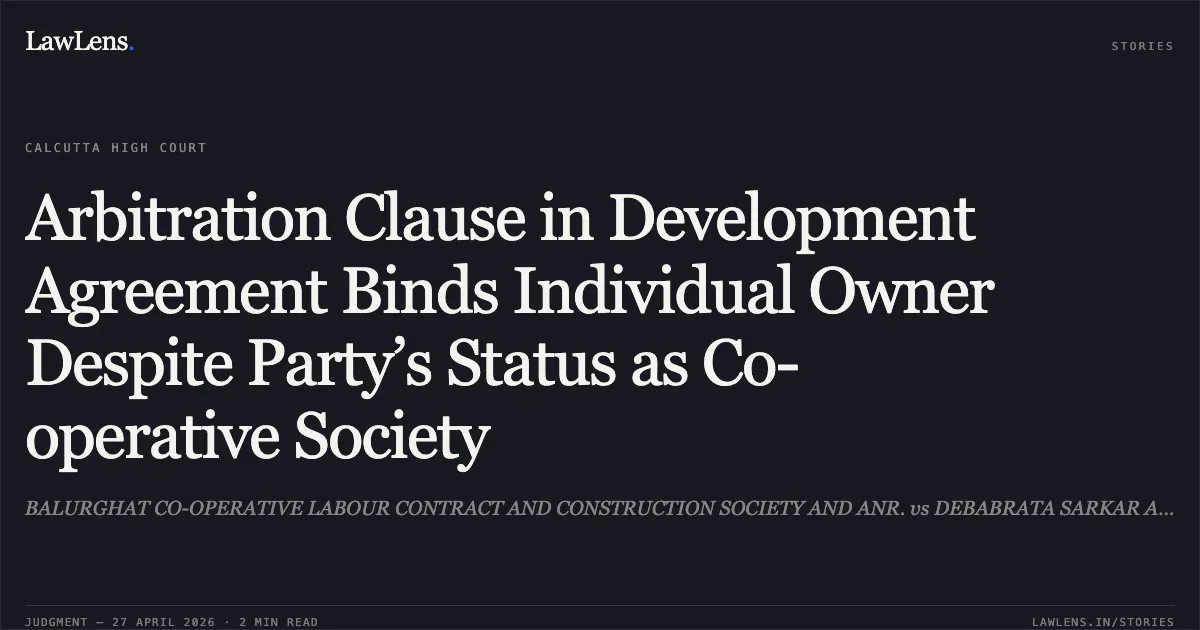
BALURGHAT CO-OPERATIVE LABOUR CONTRACT AND CONSTRUCTION SOCIETY AND ANR.vsDEBABRATA SARKAR AND ANR.
Click to open original judgment
Original judgment, available to read, download and summarize on LawLens.in