Facts
The appellant, a member of the respondent housing society, was allotted Flat No. 232 and entered into an agreement on 27.02.2004.
Source reference: para 5.1, 5.2In 2005, the appellant filed a complaint before the District Consumer Forum alleging deficiency in service due to a delay in handing over possession.
Source reference: para 5.3The respondent moved an application under Section 8 of the Arbitration and Conciliation Act, 1996, seeking to refer the matter to arbitration based on a clause in the agreement.
Source reference: para 5.4After a series of litigations reaching the High Court and Supreme Court on procedural grounds, the District Forum eventually allowed the Section 8 application and referred the parties to arbitration on 27.07.2009.
Source reference: para 5.8This order was upheld by the State Commission and subsequently by the National Consumer Disputes Redressal Commission (NCDRC).
Source reference: para 5.9, 5.10The NCDRC further held that the appellant was not a "consumer" as he had taken possession of the flat without protest.
Source reference: para 24Issues
1. Whether a consumer complaint can be referred to arbitration solely on the basis of an arbitration clause in an agreement, especially after the complaint has been admitted.
Source reference: para 9, 152. Whether the NCDRC was justified in holding that the appellant ceased to be a "consumer" upon taking possession of the flat.
Source reference: para 9, 24Law Applied
Section 3 of the Consumer Protection Act, 1986, which stipulates that the Act is in addition to and not in derogation of any other law.
Source reference: para 13Proviso to Section 12(4) of the 1986 Act, which prohibits the transfer of an admitted complaint to any other court or authority.
Source reference: para 14The existence of an arbitration clause does not oust the jurisdiction of consumer fora as they provide a special, additional remedy, as established in Fair Air Engineers Pvt. Ltd. v. N.K. Modi and Emaar MGF Land Ltd. v. Aftab Singh.
Source reference: para 17, 18Definitions of "consumer" and "service" under Sections 2(1)(d) and 2(1)(o) were central to determining the nature of the grievance.
Source reference: para 11, 12Reasoning
The Court reasoned that the 1986 Act is beneficial legislation intended for expeditious remedies, and Section 3 explicitly preserves the consumer’s right to seek redressal despite alternative forums.
Source reference: para 16Regarding Section 12(4), the Court noted a "statutory sequence": once a complaint is admitted, the proviso acts as a legislative restraint, preventing the forum from transferring the case to another authority, including an arbitral tribunal.
Source reference: para 20, 22The Court found that a private contractual arbitration clause cannot defeat a statutory remedy.
Source reference: para 21The Court held that the grievance was for compensation for delay in possession, not just delivery; therefore, accepting possession does not automatically extinguish a claim for damages incurred during the period of delay.
Source reference: para 25Such factual determinations regarding waiver or deficiency must be decided on merits, not used to non-suit a party at the threshold.
Source reference: para 26Holding
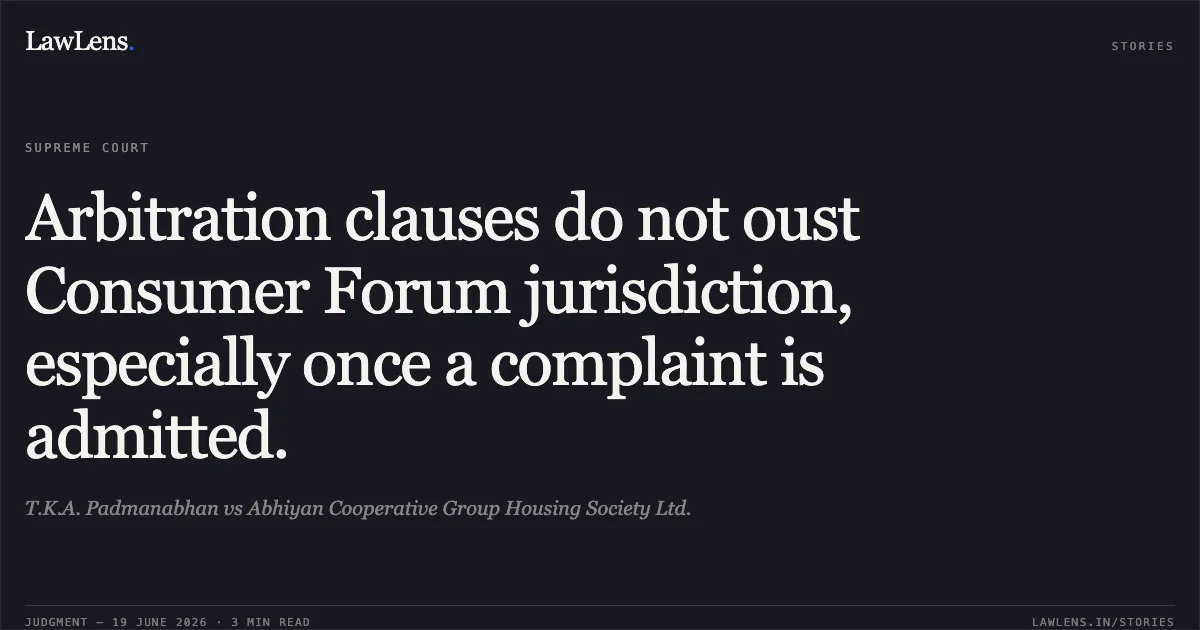
An arbitration clause does not displace the statutory jurisdiction of consumer fora and the appellant did not cease to be a consumer merely by taking possession.
The Supreme Court allowed the appeal and set aside the orders of the NCDRC, State Commission, and District Forum, restored Consumer Complaint No. 579 of 2005, and directed the District Consumer Disputes Redressal Commission, Dwarka, to decide the matter on merits within one year.
Source reference: para 29, 30, 31, 33Acts & Sections Cited
3 provisions across 1 statute referred to in this judgment. Linked provisions open on LawLens.
Consumer Protection Act, 19863
Original Court PDF
T.K.A. PadmanabhanvsAbhiyan Cooperative Group Housing Society Ltd.
Click to open original judgment
Original judgment, available to read, download and summarize on LawLens.in


