Facts
The Appellants and Respondents entered into a Partnership Deed on April 1, 2012, to carry on business as "M/s Srishaila and Co."
Source reference: para. 4This deed contained an arbitration clause (Clause 18) for disputes arising during the continuance or after the firm's dissolution
Source reference: para. 4Prior to this, Appellant No. 1 operated the entity as a proprietorship and had acquired "Schedule B" property (Plots 74 & 75) from KIADB via a lease-cum-sale agreement in 2010
Source reference: para. 21-23Following disputes, the parties executed a "Settlement Deed" on September 10, 2012, which purported to divide properties allegedly purchased with firm funds
Source reference: para. 6, 36The Respondents initiated arbitration seeking the execution of registered documents for these properties based on the Settlement Deed
Source reference: para. 6The Arbitral Tribunal awarded Respondent No. 1 a half-share in the subject property
Source reference: para. 7-8The Appellants challenged the award under Section 34 of the Arbitration and Conciliation Act, 1996, but the District Court dismissed the petition on January 31, 2025
Source reference: para. 1-2The Appellants subsequently filed this appeal under Section 37(1)(c)
Source reference: para. 1Issues
1. Whether the claim regarding property acquired prior to the execution of the Partnership Deed fell within the scope of the arbitration agreement
Source reference: para. 15, 292. Whether an arbitration clause in an original contract survives to govern disputes arising out of a subsequent Settlement Deed that novates the original agreement and lacks its own arbitration clause
Source reference: para. 42, 48Law Applied
The court applied Section 37 of the Arbitration and Conciliation Act, 1996, regarding the appealability of orders setting aside or refusing to set aside awards
Source reference: para. 1It referenced Section 6 of the Partnership Act, 1932, regarding the determination of the existence of a partnership
Source reference: para. 31The court relied heavily on the doctrine of novation under Section 62 of the Indian Contract Act, 1872, which states that if parties substitute a new contract for an old one, the original contract need not be performed
Source reference: para. 49It followed the precedent in Young Achievers v. IMS Learning Resources Private Limited, holding that an arbitration clause perishes if the contract is superseded by a subsequent settlement that does not contain an arbitration clause
Source reference: para. 45It further cited Damodar Valley Corporation v. K.K. Kar to affirm that an arbitrator's jurisdiction depends on the continued existence of the arbitration clause
Source reference: para. 49Reasoning
The court observed that the Partnership Deed explicitly intended the firm to commence on April 1, 2012, and the recitals acknowledged Appellant No. 1’s prior sole proprietorship
Source reference: para. 24-25Consequently, the arbitration clause was limited to disputes arising from the partnership formed on that date and did not extend to properties acquired by the proprietorship in 2010
Source reference: para. 29-30The court found that the Respondents’ claims were essentially for the implementation of the Settlement Deed dated September 10, 2012
Source reference: para. 44However, the Settlement Deed was an independent agreement that redistributed assets in a manner different from the Partnership Deed
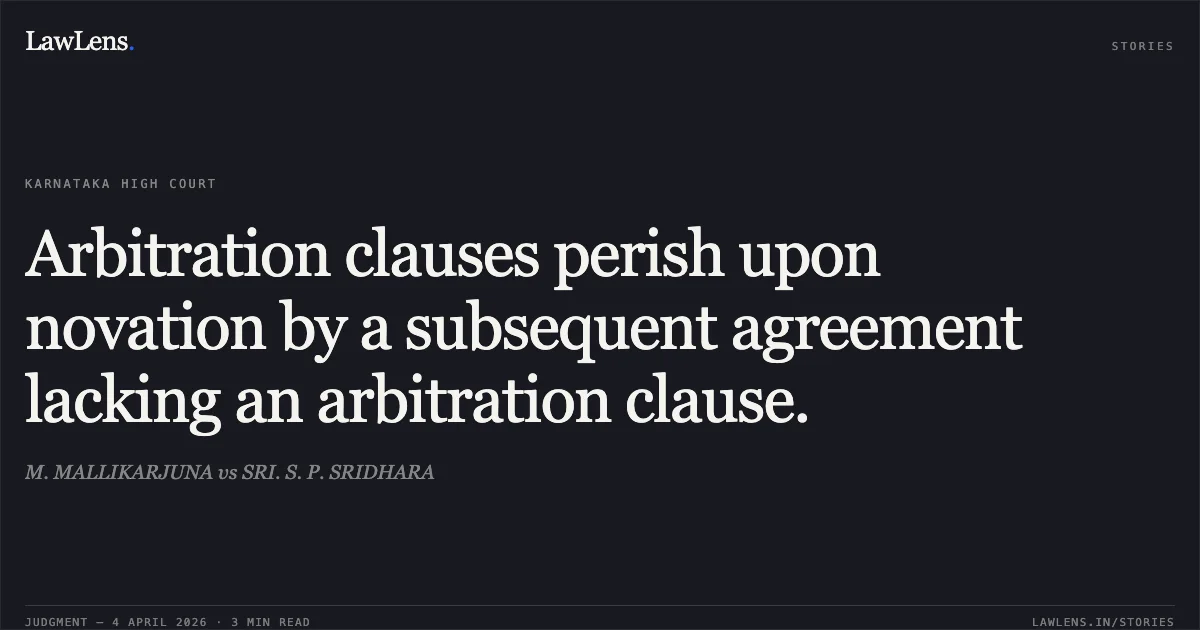
Source reference: para. 46Applying Young Achievers, the court reasoned that the Settlement Deed constituted a novation of the original contract; since the Settlement Deed lacked an arbitration clause, the Arbitral Tribunal lacked jurisdiction to adjudicate disputes arising from it
Source reference: para. 47, 50The court concluded that the arbitration clause from the superseded Partnership Deed could not be invoked to enforce the new settlement
Source reference: para. 50Holding
The High Court allowed the appeal and set aside both the District Court's order and the arbitral award
The court held that the subject property was not a firm asset under the 2012 Partnership Deed as it was acquired prior to the firm's constitution
Source reference: para. 47It further held that the Settlement Deed was a novation that did not include an arbitration agreement, rendering the dispute non-arbitrable
Source reference: para. 50The Arbitral Tribunal's jurisdiction was confined to the 2012 Partnership, which did not cover the settlement of prior assets
Source reference: para. 39, 41Acts & Sections Cited
6 provisions across 3 statutes referred to in this judgment. Each provision opens on LawLens.
Arbitration and Conciliation Act, 19964
Indian Partnership Act, 19321
Indian Contract Act, 18721
Original Court PDF
M. MALLIKARJUNAvsSRI. S. P. SRIDHARA
Click to open original judgment
Original judgment, available to read, download and summarize on LawLens.in


![Subsequent exoneration does not retrospectively invalidate a finalized promotion select list.. UNNIKRISHNAN M vs M/o Environment And Forests. CAT - ['Ernakulam']. LawLens](/stories/thumbnails/subsequent-exoneration-does-not-retrospectively-invalidate-a-finalized-promotion-select-li-ce80a0e84f2f4887857271e8b4341c42.webp)