Facts
The Petitioner, Lifewell Diagnostics, and the Respondent, Micron Laboratory, entered into a Revenue Sharing Agreement dated September 1, 2023, regarding the operation of a pathology lab in New Delhi
Source reference: para. 1The Petitioner alleged that the Respondent defaulted on payment obligations amounting to Rs. 23,93,916/-, prompting the invocation of the dispute resolution clause (Clause 29) of the Agreement
Source reference: paras. 2-3The Respondent resisted the appointment of an arbitrator on two grounds: first, that the Agreement was mutually terminated on May 3, 2024, with a settlement of accounts leaving no surviving disputes
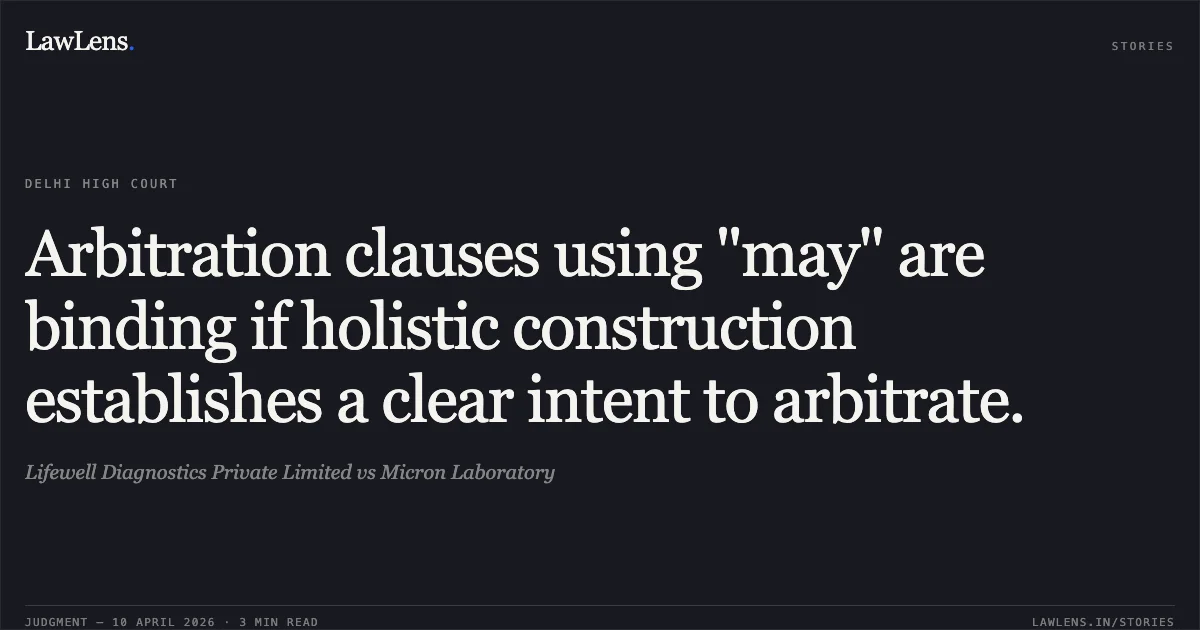
Source reference: para. 4second, that Clause 29 was non-binding as it used the permissive word "may" ("disputes may be referred to arbitration"), indicating a lack of clear intention to mandate arbitration
Source reference: para. 5Issues
Whether Clause 29 of the Agreement constitutes a valid and binding arbitration agreement under Section 7 of the Arbitration and Conciliation Act, 1996, despite the use of the word "may"
Source reference: para. 13Whether the Court should appoint an arbitrator under Section 11 of the Arbitration Act given the Respondent’s plea of mutual termination and settlement
Source reference: paras. 26-27Law Applied
The Court primarily applied Section 7 of the Arbitration and Conciliation Act, 1996, which defines an arbitration agreement as a written intent by parties to submit disputes to a private tribunal
Source reference: paras. 7-8It relied on Bihar State Mineral Development Corporation v. ENCON Builders (I) (P) Ltd. regarding the essential elements of an arbitration agreement, including the requirement that parties be consensus ad idem
Source reference: para. 9Following South Delhi Municipal Corporation v. SMS Limited (2026) and Babanrao Rajaram Pund v. Samarth Builders (2022), the Court held that a clear intent to arbitrate and a binding adjudicatory process are paramount, and inartistic drafting or the absence of words like "final and binding" cannot annul a clause if the intent is palpable
Source reference: paras. 10, 12Furthermore, per Enercon (India) Ltd. v. Enercon GMBH, the Court must adopt a pragmatic, "common sense" approach to make arbitration clauses workable
Source reference: para. 21the court noted that pre-arbitral mechanisms like "amicable discussion" are directory rather than mandatory (Hindustan Unilever Limited v. Jagdeesh Kumar)
Source reference: para. 25Reasoning
The Court conducted a holistic reading of Clause 29. While the clause used the word "may," the Court observed that sub-clause (d) detailed a specific, binding procedure: it stipulated that the arbitral award would be "final and binding," defined the seat and venue, and outlined the language and cost-sharing of the proceedings
Source reference: paras. 14-17The Court reasoned that the prefix "may," when followed by such a detailed and mandatory adjudicatory mechanism, does not render the clause optional; rather, it reflects a clear intent to refer unresolved disputes to arbitration
Source reference: para. 18Regarding the Respondent's claim that the contract was terminated and accounts settled, the Court held that such issues involve the merits of the dispute or the "arbitrability" of claims, which are to be decided by the arbitrator, not the Court at the Section 11 stage
Source reference: paras. 23, 27(v)The Court emphasized that commercial documents must be interpreted to give effect to the parties' intentions rather than invalidating them on technicalities or semantic analysis
Source reference: paras. 20, 22Holding
The Court held that Clause 29 is a valid and binding arbitration agreement
It ruled that the mandatory nature of the arbitration was evident from the elaborate procedural terms agreed upon by the parties
Source reference: para. 17The petition was allowed, and the Court appointed Mr. Amrit Pal Gambhir, Advocate, as the Sole Arbitrator
Source reference: para. 27(i)The Court clarified that all rights and contentions, including the Respondent’s plea regarding mutual termination and the arbitrability of claims, remain open for adjudication by the learned Arbitrator
Source reference: para. 27(v)Acts & Sections Cited
7 provisions across 1 statute referred to in this judgment. Each provision opens on LawLens.
Arbitration and Conciliation Act, 19967
Original Court PDF
Lifewell Diagnostics Private LimitedvsMicron Laboratory
Click to open original judgment
Original judgment, available to read, download and summarize on LawLens.in


![Subsequent exoneration does not retrospectively invalidate a finalized promotion select list.. UNNIKRISHNAN M vs M/o Environment And Forests. CAT - ['Ernakulam']. LawLens](/stories/thumbnails/subsequent-exoneration-does-not-retrospectively-invalidate-a-finalized-promotion-select-li-ce80a0e84f2f4887857271e8b4341c42.webp)