Facts
The Petitioner (School) and Respondent (Service Provider) entered into a "Curriculum Services Provider Agreement" (CSP Agreement) in 2015 and an ICT Education Agreement (ICT-E Agreement) in 2016 for setting up smart classes and science labs
Source reference: para 3Following disputes over unpaid dues, the High Court, vide order dated 30.05.2022, appointed a Sole Arbitrator to adjudicate disputes arising from the CSP Agreement
Source reference: para 2The Arbitrator passed an award on 16.04.2025, allowing the Respondent’s claims to the extent of ₹1,30,66,989 plus 9% interest, while rejecting a claim for loss of business opportunity
Source reference: para 1The Petitioner challenged this award under Section 34 of the Arbitration and Conciliation Act, 1996, on grounds that the Arbitrator exceeded the scope of reference by including ICT-E Agreement disputes, wrongly rejected additional documents at the final argument stage, and ignored the impossibility of performance caused by the COVID-19 pandemic
Source reference: para 4-8Issues
1. Whether the Arbitral Tribunal exceeded its jurisdiction by adjudicating disputes involving the ICT-E Agreement, which was allegedly not part of the Section 11 reference order
Source reference: para 4, 132. Whether the Arbitrator’s refusal to permit the Petitioner to file additional ledger documents at the stage of final arguments constitutes a violation of natural justice or patent illegality
Source reference: para 5, 183. Whether the Arbitral Award is vitiated by patent illegality for relying solely on ledger accounts without primary supporting invoices
Source reference: para 7, 344. Whether the contractual obligations were frustrated or became impossible to perform under Section 56 of the Indian Contract Act due to COVID-19 and government directions regarding school fees
Source reference: para 8, 42Law Applied
The Court applied Section 34 of the Arbitration and Conciliation Act, 1996, which limits judicial intervention to specific grounds such as "patent illegality" and "conflict with the public policy of India"
Source reference: para 1, 10It heavily relied on the three-judge bench precedent in OPG Power Generation (P) Ltd. v. Enexio Power Cooling Solutions (India) (P) Ltd. (2025), which clarifies that courts cannot reappreciate evidence or set aside awards for mere erroneous application of law
Source reference: para 10The Court also invoked Section 19 of the A&C Act, which stipulates that the Tribunal is not bound by the Code of Civil Procedure or the Indian Evidence Act, and Section 18, which mandates equal treatment of parties
Source reference: para 22-23, 37Principles regarding "frustration of contract" under Section 56 of the Indian Contract Act, 1872, were also considered
Source reference: para 44Reasoning
The Court determined that the Petitioner’s objection regarding the "scope of reference" was an afterthought, as the Petitioner never raised this jurisdictional plea during the arbitral proceedings or in its pleadings
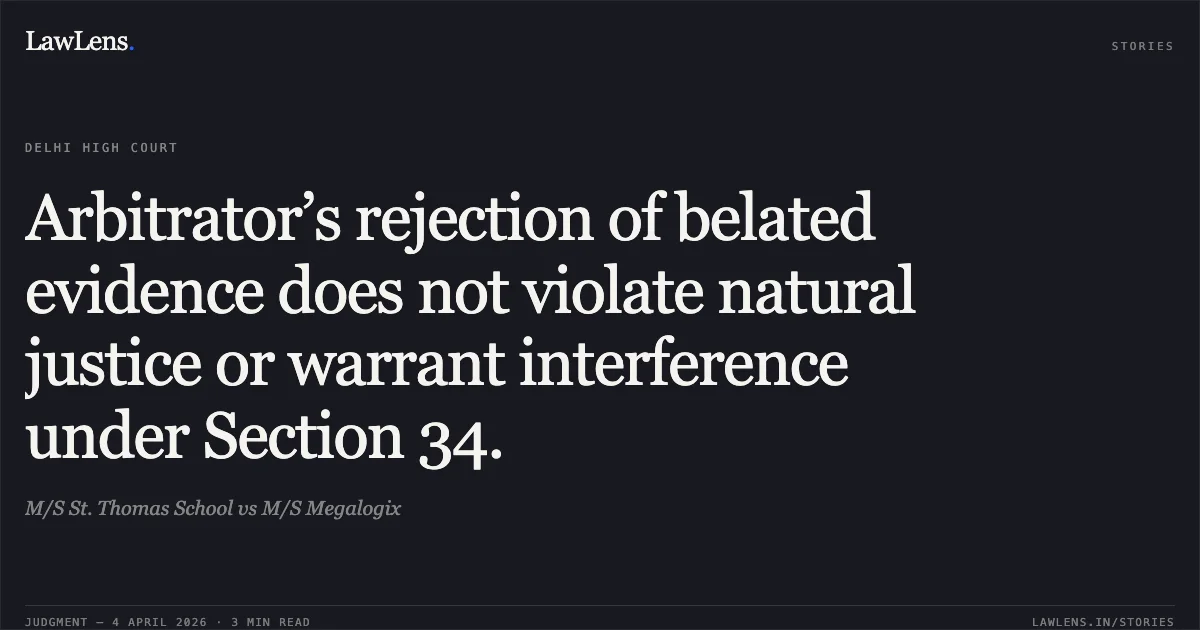
Source reference: para 16, 31-32Regarding the rejection of additional documents, the Court found no procedural infirmity because the Petitioner had possession of the documents throughout the trial but sought to introduce them only on the final day of arguments without a valid explanation
Source reference: para 19-20The Court noted that "full opportunity" under Section 18 does not permit dilatory or negligent conduct that prejudices the other party
Source reference: para 22On the evidentiary challenge, the Court held that the Arbitrator is the "ultimate master" of the quantity and quality of evidence; thus, relying on ledger accounts—which the Petitioner failed to effectively rebut—did not constitute perversity
Source reference: para 36-38, 40Finally, on the issue of COVID-19, the Court upheld the Arbitrator’s finding that the Haryana Government’s directions only deferred certain fees rather than waiving them
Source reference: para 40, 43Furthermore, since the Petitioner defaulted on several invoices prior to the pandemic (2016–2019), the plea of frustration was factually unsustainable
Source reference: para 43-44Holding
The Court dismissed the petition, affirming the Arbitral Award dated 16.04.2025
It held that the Arbitrator acted within the bounds of his jurisdiction and that the award did not suffer from patent illegality or perversity
Source reference: para 44-45The Court concluded that: (i) jurisdictional objections not raised before the Tribunal cannot be raised for the first time under Section 34; (ii) rejection of belated evidence at the final stage is a valid exercise of procedural discretion; and (iii) fee deferment orders during COVID-19 do not equate to a frustration of commercial contracts with service providers
Source reference: para 21, 32, 43All pending applications were dismissed
Source reference: para 46Acts & Sections Cited
10 provisions across 2 statutes referred to in this judgment. Each provision opens on LawLens.
Arbitration and Conciliation Act, 19968
Indian Contract Act, 18722
Original Court PDF
M/S St. Thomas SchoolvsM/S Megalogix
Click to open original judgment
Original judgment, available to read, download and summarize on LawLens.in