Facts
The petitioners (an outgoing Mukhiya and a Panchayat Secretary) sought to quash an order dated 02.02.2017 passed by the A.C.J.M., Sherghati, taking cognizance of offences under Sections 409 and 420 of the Indian Penal Code.
Source reference: para. 2The F.I.R. alleged they unauthorizedly withdrew ₹6,49,000/- from the 14th Finance Commission funds for solar light installation.
Source reference: para. 3The petitioners argued the work was completed per Aam Sabha resolutions.
Source reference: para. 4-5The prosecution highlighted that Petitioner No. 1 signed two cheques totaling over ₹9,00,000/- on 01.07.2016—two days after the newly elected Mukhiya had taken oath on 29.06.2016.
Source reference: para. 6Issues
1. Whether the act of signing and issuing cheques from public funds by an outgoing Mukhiya after demitting office constitutes a prima facie case of criminal breach of trust and cheating.
Source reference: para. 72. Whether the completion of the underlying public work serves as a sufficient ground to quash a cognizance order when the financial transaction was unauthorized.
Source reference: para. 7-8Law Applied
The Court applied Section 409 (Criminal breach of trust by public servant) and Section 420 (Cheating and dishonestly inducing delivery of property) of the Indian Penal Code.
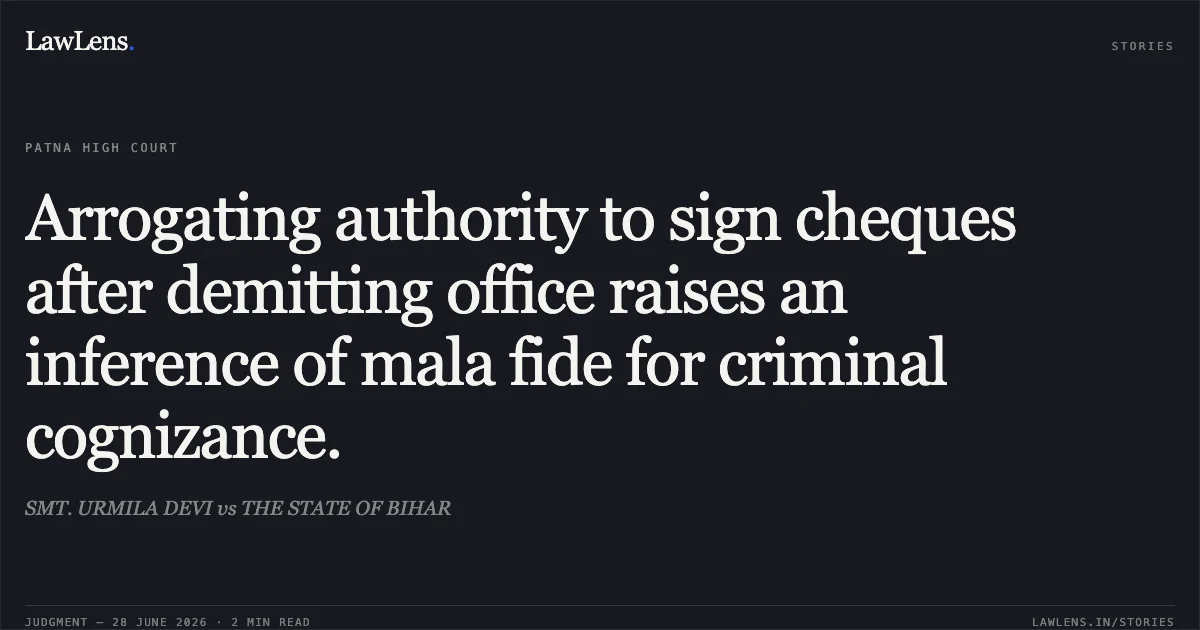
Source reference: para. 2The core legal principle applied is that the "arrogation of authority" to discharge financial duties after the cessation of legal tenure raises a rebuttable presumption of mala fide intent and collusion, necessitating a trial.
Source reference: para. 7Reasoning
The Court observed that even if the solar lights were installed as per the spot enquiry report, this fact does not validate the unauthorized financial conduct of the petitioners.
Source reference: para. 7The critical factor was the timeline: Petitioner No. 1 ceased to hold office on 29.06.2016, yet proceeded to issue cheques on 01.07.2016.
Source reference: para. 6The Court reasoned that if the work was bona fide, the outgoing Mukhiya should have left the disbursement to the newly elected successor.
Source reference: para. 7By bypassing this legal transition, the petitioners' actions created a reasonable inference of collusion. Since a prima facie case was established regarding the unauthorized exercise of power over public funds, the Court found no merit in exercising its inherent powers to quash the proceedings at the cognizance stage.
Source reference: para. 7-8Holding
The Court answered the issues in the negative and dismissed the petition.
It held that the signing of cheques by a person no longer in office is sufficient to sustain an order of cognizance for criminal offences.
Source reference: para. 7The Court directed that the proceedings before the learned Magistrate shall continue in accordance with the law.
Source reference: para. 8Acts & Sections Cited
2 provisions across 1 statute referred to in this judgment. Each provision opens on LawLens.
Indian Penal Code, 18602
Original Court PDF
SMT. URMILA DEVIvsTHE STATE OF BIHAR
Click to open original judgment
Original judgment, available to read, download and summarize on LawLens.in