Facts
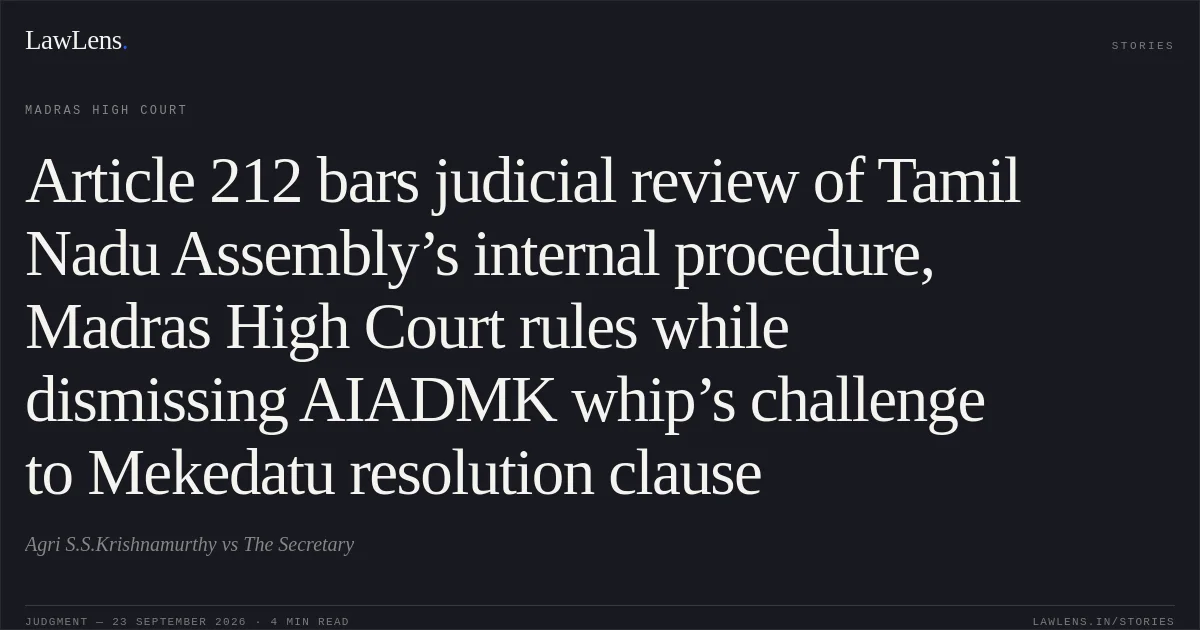
The petitioner, the AIADMK Official Whip, challenged Resolution No.2/2026 of the Tamil Nadu Legislative Assembly concerning the proposed Mekedatu Dam.
Source reference: paras. 2.1–2.2; pp. 3–4The resolution originally circulated to Members on 18.06.2026 opposed the project and sought withholding of requisite clearances, but did not contain a request for constitution of a fresh tribunal under Section 4 of the Inter-State River Water Disputes Act, 1956.
Source reference: paras. 2.1–2.2; pp. 3–4During the Assembly debate on 19.06.2026, the Leader of the Opposition suggested inclusion of such a tribunal clause. The Chief Minister requested the Speaker to incorporate the suggestion, and the Speaker put the resolution, as amended, to a voice vote. It was declared unanimously carried and communicated to the Union Government.
Source reference: para. 3.2; pp. 5–6The petitioner contended that the amendment had not been separately moved, seconded, debated or voted upon as allegedly required by Rule 104 of the Tamil Nadu Legislative Assembly Rules, and that the amended communication did not represent a valid decision of the House.
Source reference: paras. 2.1–2.2; pp. 3–4The Assembly Secretary maintained that the Chief Minister had proposed the addition during the debate, that no Member objected when the amended resolution was put to vote, and that the Speaker had subsequently ruled on 07.08.2026 that no illegality had occurred.
Source reference: para. 3.2; pp. 5–6Issues
1. Whether the writ petition challenging the manner in which the tribunal clause was introduced into and adopted as part of the Assembly resolution was barred by Article 212 of the Constitution as a challenge to an alleged procedural irregularity in legislative proceedings.
Source reference: para. 6(i); p. 72. Whether, notwithstanding Article 212, the incorporation and communication of the tribunal clause involved a legally reviewable illegality rather than a mere procedural irregularity.
Source reference: para. 6(ii); p. 7Law Applied
Article 212(1) of the Constitution bars courts from questioning the validity of proceedings in a State Legislature on the ground of an alleged irregularity of procedure, while Article 212(2) protects officers and Members exercising procedural powers from judicial scrutiny.
Source reference: paras. 7–9; pp. 8–9Article 194, concerning legislative privileges and internal autonomy, was read conjointly with Article 212.
Source reference: paras. 9–10.2; pp. 8–10Under the principles in Pandit M.S.M. Sharma v. Dr. Shree Krishna Sinha, mere non-compliance with legislative procedure does not justify judicial intervention; the distinction is between want of jurisdiction, which may be reviewable, and irregular exercise of jurisdiction, which is protected by Article 212.
Source reference: paras. 11.1–11.3; pp. 10–12In re: Under Article 143, Constitution of India (Special Reference No. 1 of 1964) recognised that procedural irregularity is immune from review, whereas substantive illegality may remain open to scrutiny.
Source reference: para. 12; p. 12Ramdas Athawale v. Union of India reaffirmed that internal legislative procedure and decisions of the Speaker regulating House business are not ordinarily justiciable.
Source reference: paras. 15.1–15.3; pp. 14–16The Court also relied on Rule 286 of the Tamil Nadu Legislative Assembly Rules, which empowers the Speaker to decide questions of procedure arising in the House.
Source reference: paras. 17, 20; pp. 19–21The principles in Dr. Sunil Kumar Singh v. Bihar Legislative Council were distinguished as relating to review of an administrative or disciplinary decision affecting constitutional rights, rather than internal legislative proceedings.
Source reference: paras. 16.1–16.3; pp. 17–19Reasoning
The Court held that the petitioner’s challenge concerned only the process by which the tribunal clause was incorporated into the resolution—namely, the alleged absence of a separate motion, seconding, debate and vote—and therefore constituted a complaint about internal legislative procedure falling within Article 212.
Source reference: paras. 10.2, 13–14; pp. 9–13The Assembly unquestionably possessed the power to pass a resolution concerning the Mekedatu project and to urge the Union Government to constitute a tribunal; hence, the case involved no want of jurisdiction, constitutional prohibition, fraud or mala fides.
Source reference: paras. 11.3, 13, 27; pp. 11–13, 25On the merits, the Court found that the Chief Minister proposed the addition during his reply, the Speaker accepted it, the amended resolution was placed before the House, and no Member sought a separate vote or recorded opposition before the voice vote.
Source reference: paras. 20–23; pp. 20–23In view of Rule 286, the Speaker’s acceptance of the oral modification was treated as an exercise of the authority to regulate procedure.
Source reference: paras. 17, 20; pp. 19–21The Court further held that a voice vote on the resolution in its amended form was sufficient, since the House had been informed that the resolution stood amended and had an opportunity to object.
Source reference: para. 23; p. 23The subsequent ruling of the Speaker on 07.08.2026, together with the Members’ failure to object at the relevant time, reinforced the conclusion that no reviewable illegality or demonstrable prejudice had been established.
Source reference: paras. 24–25; pp. 23–24Holding
The Court answered both issues against the petitioner.
The challenge was barred by Article 212 because it sought judicial examination of an alleged irregularity in the internal procedure of the Legislative Assembly.
Source reference: para. 18; p. 20Independently, the Court held that the tribunal clause had been validly incorporated through the Speaker’s procedural control, followed by a voice vote on the amended resolution, and that no want of jurisdiction, substantive illegality, mala fides or constitutional violation was shown.
Source reference: paras. 21–28; pp. 21–25The writ petition was dismissed, with no order as to costs, and the connected miscellaneous petitions were closed.
Source reference: para. 28; p. 25Acts & Sections Cited
1 provisions across 1 statute referred to in this judgment. Each provision opens on LawLens.
Inter-State River Water Disputes Act, 19561
Original Court PDF
Agri S.S.KrishnamurthyvsThe Secretary
Click to open original judgment
Original judgment, available to read, download and summarize on LawLens.in