Facts
The petitioner challenged governmental, municipal and NBSTC actions concerning approximately 7,327.13 sq. metres of land originally leased by the Kolkata Improvement Trust/KMDA to NBSTC for a bus terminus. After NBSTC decided to commercially exploit the property, a tender was conducted and the petitioner’s bid of approximately ₹24.81 crores was accepted. An Agreement to Lease was executed on 22 February 2002, possession was delivered on 17 April 2002, and a Power of Attorney was executed on 21 August 2002.
Source reference: paras. 197–203The petitioner made substantial payments towards the premium, municipal dues and other project expenses. A registered lease deed was subsequently executed on 23 April 2010, allegedly pursuant to NBSTC’s communication permitting registration under the earlier Power of Attorney.
Source reference: paras. 204–210The project required KMDA’s NOC and sanction of a building plan by the Kolkata Municipal Corporation. Although earlier correspondence contemplated commercial utilisation upon payment of ₹2 crores and recorded approval of the building plan, the Transport Department subsequently directed KMDA not to issue the NOC and KMC not to sanction the plan through memoranda dated 13 and 20 August 2010. NBSTC thereafter requested KMC not to sanction the building plan.
Source reference: paras. 211–221The petitioner repeatedly tendered the ₹2-crore payment, but KMDA returned it on the ground that the petitioner was not a party to the principal lease and that the Transport Department had directed that no NOC be issued. KMC ultimately rejected the building-plan application on 24 September 2011. NBSTC’s Board later resolved to terminate the arrangement, which was communicated to the petitioner on 31 May 2017.
Source reference: paras. 212–219, 224–229The petitioner filed three writ petitions seeking, inter alia, quashing of the governmental memoranda and termination communication, enforcement of the lease arrangement, issuance of the NOC, sanction of the building plan, reconciliation of accounts and acceptance of the balance premium.
Source reference: paras. 330–341, 625–642Issues
1. Whether the writ petitions were maintainable under Article 226 despite the contractual relationship, disputed contractual rights and the existence of an arbitration clause?
Source reference: paras. 306–3482. Whether the unregistered Agreement to Lease dated 22 February 2002 created any legally enforceable leasehold or proprietary interest in favour of the petitioner?
Source reference: paras. 349–3873. Whether the registered instrument dated 23 April 2010 validly created or perfected a leasehold interest in favour of the petitioner?
Source reference: paras. 388–4184. Whether the Power of Attorney dated 21 August 2002 authorised execution and registration of the document dated 23 April 2010?
Source reference: paras. 419–4485. Whether NBSTC possessed authority under the principal lease dated 22 November 1995 to induct the petitioner as developer and execute the Agreement to Lease without KMDA’s prior written consent?
Source reference: paras. 461–4976. Whether the Cabinet Memorandum dated 16 February 2001 and Cabinet decision dated 28 February 2001 created enforceable rights in favour of the petitioner or dispensed with the restrictions contained in the principal lease?
Source reference: paras. 498–5367. Whether the State Government had lawful authority to issue the memoranda dated 13 and 20 August 2010, and whether those memoranda were constitutionally or statutorily invalid?
Source reference: paras. 537–5998. Whether NBSTC’s communication dated 31 May 2017 rescinding the Agreement to Lease and allied arrangements was legally sustainable?
Source reference: paras. 600–623Law Applied
The Court applied Article 226 of the Constitution, distinguishing judicial review of arbitrary public action from enforcement of purely contractual rights.
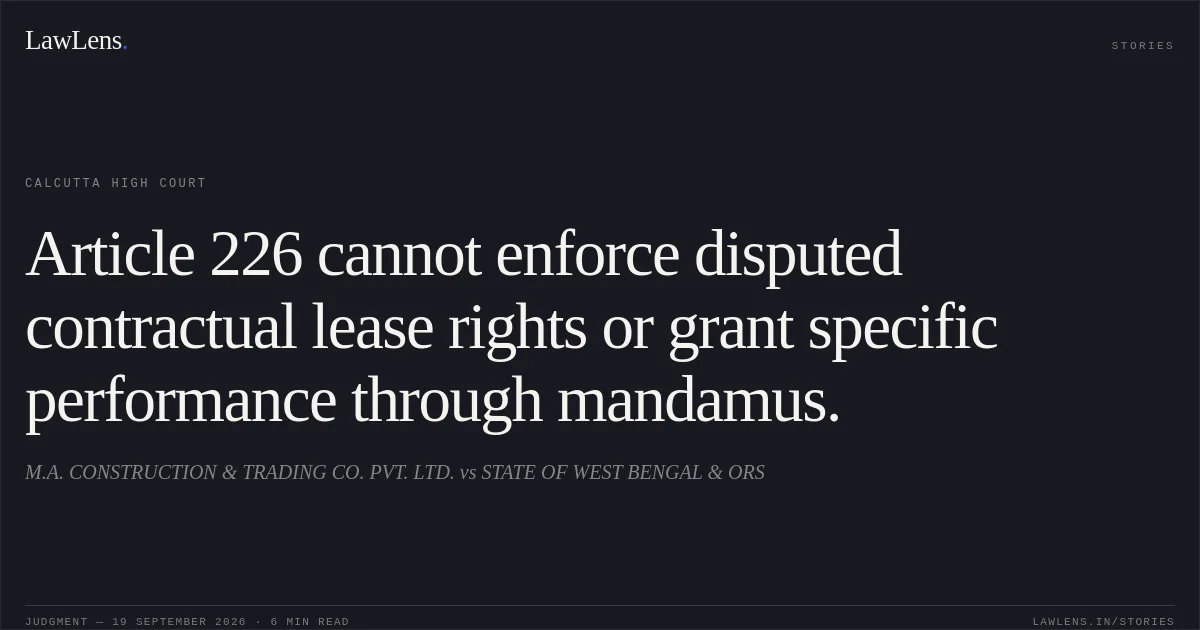
Source reference: paras. 311–348, 637–656It relied on ABL International Ltd. v. ECGC, Mahabir Auto Stores v. IOC, Dwarkadas Marfatia & Sons v. Board of Trustees of the Port of Bombay, Kumari Shrilekha Vidyarthi v. State of U.P., Unitech Ltd. v. Telangana State Industrial Infrastructure Corp. and Subodh Kumar Singh Rathour v. CEO, holding that contractual disputes involving State instrumentalities may be examined under Article 226 where arbitrariness, unfairness, breach of natural justice or an independent public-law element is shown, but writ jurisdiction ordinarily cannot be used to grant specific performance or adjudicate complex contractual disputes.
Source reference: paras. 311–348, 637–656Under Sections 105 and 107 of the Transfer of Property Act, 1882, a lease exceeding one year must be created by a registered instrument; Sections 17 and 49 of the Registration Act, 1908 render compulsory registration essential and restrict the use of an unregistered instrument to specified collateral purposes.
Source reference: paras. 351–386, 626–631Section 53A of the Transfer of Property Act cannot create title contrary to statutory registration requirements.
Source reference: paras. 351–386, 626–631The Court further applied Section 111 of the Transfer of Property Act concerning determination of leases, the principle that a power of attorney must be strictly construed, as stated in Church of Christ Charitable Trust v. Ponniamman Educational Trust, and the principle that a transferee cannot acquire a better interest than the transferor possesses.
Source reference: paras. 423–445, 487–497Sections 19 and 34 of the Road Transport Corporations Act, 1950 were read as conferring power upon NBSTC to deal with property subject to the principal lease and governmental supervision, but not as overriding contractual restrictions or creating proprietary rights in derogation of the lessor’s rights.
Source reference: paras. 487–497, 549–561Reasoning
The Court held that the central controversy could not be resolved merely by examining whether the impugned memoranda were arbitrary; it first required determination of the petitioner’s asserted contractual and proprietary rights.
Source reference: paras. 637–652The Agreement to Lease dated 22 February 2002 was unregistered and therefore could not, by itself, create a lease exceeding one year or affect the immovable property under Sections 107 of the Transfer of Property Act and 17/49 of the Registration Act. Possession, payment of consideration and expenditure could establish contractual conduct or support civil remedies, but could not substitute for statutory registration.
Source reference: paras. 356–386The later registered instrument of 23 April 2010 could not automatically operate retrospectively or cure defects relating to authority, the Power of Attorney or the absence of KMDA’s prior written consent.
Source reference: paras. 388–448The Court found that the principal lease contained restrictions on change of user, assignment, subletting and creation of third-party interests, and that NBSTC could not enlarge its own leasehold estate without complying with those restrictions.
Source reference: paras. 450–497The Cabinet decision was treated as an administrative policy decision relating initially to Samcon Developers; it did not itself create proprietary rights in favour of the petitioner or replace KMDA’s contractual consent.
Source reference: paras. 498–536At the same time, the Court found that the State authorities’ conduct—accepting the petitioner’s participation, permitting possession and substantial expenditure, and later obstructing the project without adequate procedural fairness—displayed arbitrariness and attracted Article 14 scrutiny.
Source reference: paras. 637–652However, that finding did not establish the petitioner’s disputed leasehold rights. Since the reliefs sought would require recognition of the lease, interpretation of multiple instruments, determination of authority, reconciliation of accounts and enforcement of reciprocal obligations, granting the relief would effectively amount to decreeing specific performance through writ jurisdiction.
Source reference: paras. 639–649The Court therefore declined to quash the memoranda or direct issuance of the NOC and building sanction in the present proceedings.
Source reference: paras. 639–649Holding
The writ petitions were held maintainable only to the limited extent that the Court could examine the legality and constitutional propriety of the impugned executive actions; the existence of an arbitration clause was not an absolute bar.
However, the Court declined to grant relief requiring enforcement of the disputed lease arrangement or specific performance.
Source reference: paras. 640–649It held that the unregistered 2002 Agreement to Lease did not itself create a legally enforceable leasehold estate, that registration of the 2010 document did not automatically cure defects of authority or consent, and that the petitioner’s asserted contractual and proprietary rights required adjudication before the competent civil or arbitral forum.
Source reference: paras. 387, 448, 497, 536, 640–649The Court did not find sufficient grounds to annul the memoranda dated 13 and 20 August 2010 or the termination communication dated 31 May 2017 in writ jurisdiction.
Source reference: paras. 599, 623The petitions were accordingly dismissed without costs, while the petitioner was left at liberty to pursue civil or arbitral remedies for specific performance, refund, restitution, interest, damages or compensation. All such questions were left open for determination by the competent forum.
Source reference: paras. 653–664Acts & Sections Cited
29 provisions across 9 statutes referred to in this judgment. Each provision opens on LawLens.
Road Transport Corporations Act, 19502
Transfer of Property Act, 18826
Registration Act, 19084
Indian Stamp Act, 18991
Indian Contract Act, 18724
Powers-of Attorney Act, 18821
Specific Relief Act, 19635
Arbitration and Conciliation Act, 19965
Code of Civil Procedure, 19081
Original Court PDF
M.A. CONSTRUCTION & TRADING CO. PVT. LTD.vsSTATE OF WEST BENGAL & ORS
Click to open original judgment
Original judgment, available to read, download and summarize on LawLens.in