Facts
The writ petitioner claimed to occupy the premises as a tenant under a sublet agreement dated 26 August 2011 and alleged that the private respondents, in collusion with the licensing authority, were seeking a bar licence for the premises despite an injunction in a pending civil suit.
Source reference: para. 2–4The Single Judge restrained the licensing authority from granting a fresh bar-cum-restaurant licence to respondent no. 6.
Source reference: para. 2During the appeal, the parties informed the Court that the civil appellate court had set aside the temporary injunction and directed the parties to maintain status quo as to the premises’ nature, character, and possession pending the suit.
Source reference: para. 8The appellants challenged the Single Judge’s order; the writ petitioner defended it on the basis of his claimed tenancy, the alleged collusion, and the pending injunction proceedings.
Source reference: para. 5–6Issues
1. Whether the writ petitioner could invoke Article 226 to obtain relief concerning premises where his asserted tenancy and right to possession were pending determination in a civil suit.
Source reference: para. 10–11, 202. Whether the allegation of collusion between the private respondents and the licensing authority, as pleaded, justified invoking writ jurisdiction.
Source reference: para. 12–14Law Applied
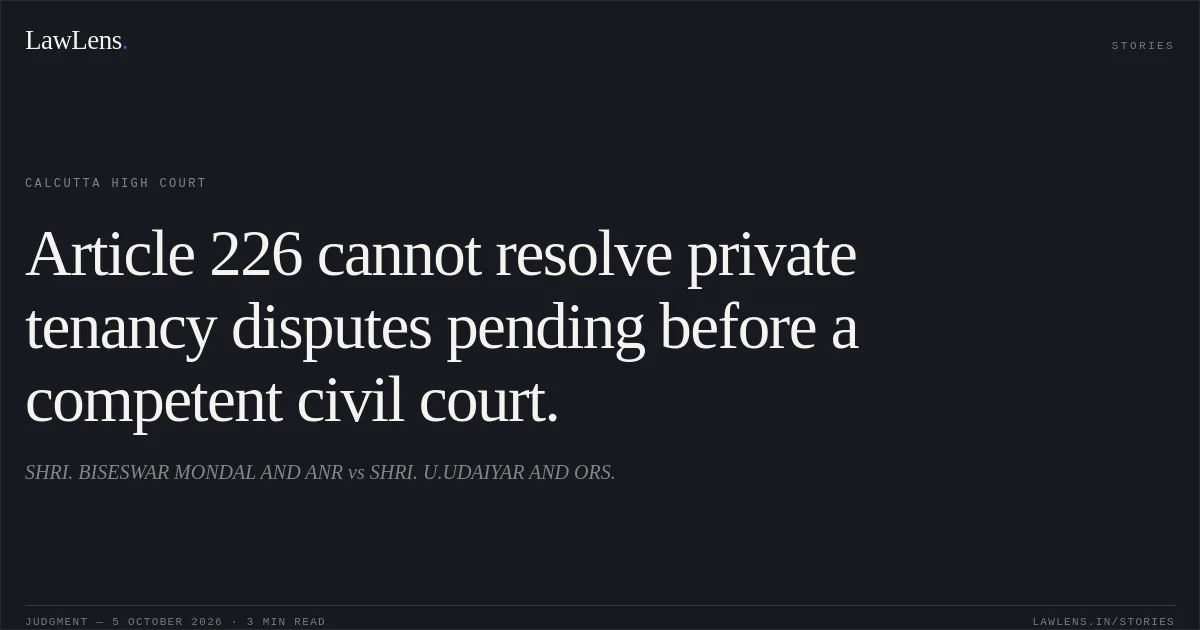
Article 226 confers extraordinary jurisdiction, but a writ petition is generally not the appropriate forum to adjudicate private property, title, possession, or landlord–tenant disputes, particularly where the asserted rights are pending before a competent civil court.
Source reference: no citationThe Court relied on Shalini Shyam Shetty v. Rajendra Shankar Patil, which states that writ jurisdiction is not meant to declare private rights or resolve property disputes and disapproves its use in a dispute between landlord and tenant where the grievance is substantially against a private party.
Source reference: para. 15It distinguished Adi Saiva Sivachariyargal Nala Sangam v. Government of Tamil Nadu, in which a well-founded apprehension of prejudice from government action could provide a cause of action before that action was implemented; the decision did not establish that a bare allegation of collusion sustains a writ petition.
Source reference: para. 16–19A bald claim of collusion, unsupported by factual particulars, does not by itself justify Article 226 intervention.
Source reference: para. 12–14Reasoning
The writ petitioner’s claim depended on establishing his tenancy and right to occupy the premises—matters already pending for adjudication on evidence in the civil suit.
Source reference: para. 10–11The Court held that the petitioner should seek any necessary relief in that proceeding or before another competent forum, rather than use Article 226 to resolve the substantially private dispute.
Source reference: para. 20–21The collusion allegation did not alter that conclusion: it lacked supporting factual details, and the individual incumbent in the licensing authority’s office had not been impleaded.
Source reference: para. 12–14The cited Supreme Court decisions did not assist the petitioner because their principles and factual contexts did not support writ intervention on these facts.
Source reference: para. 15–19Holding
The Court held that the writ petition was not maintainable as a means of resolving the petitioner’s disputed tenancy and possession claims, and that the unsupported collusion allegation did not justify writ relief.
It allowed the appeal, set aside the Single Judge’s order, and dismissed the writ petition, while reserving the petitioner’s liberty to pursue appropriate remedies in the pending suit or before another competent forum.
Source reference: para. 22–23The Court clarified that its observations were limited to disposal of the writ petition and were not to be relied upon in the pending suit.
Source reference: para. 24Original Court PDF
SHRI. BISESWAR MONDAL AND ANRvsSHRI. U.UDAIYAR AND ORS.
Click to open original judgment
Original judgment, available to read, download and summarize on LawLens.in