Facts
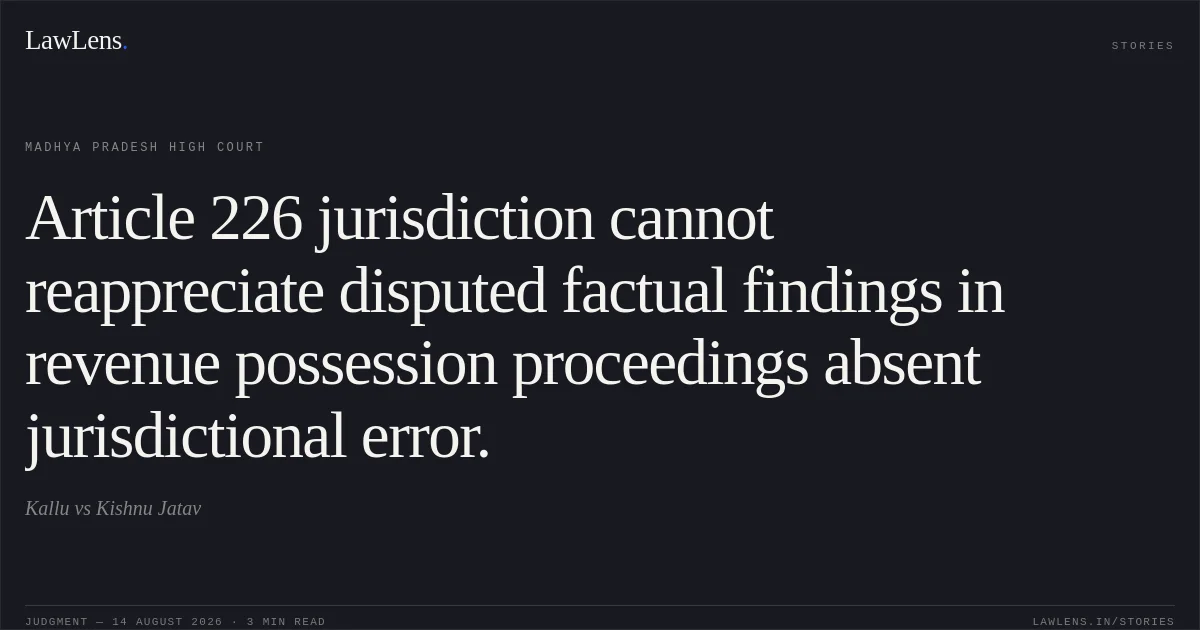
Respondent No. 1 initiated proceedings under Section 250 of the Madhya Pradesh Land Revenue Code, 1959 before the Tehsildar, Bairad, seeking possession of land bearing Survey No. 1289, admeasuring 0.04 hectares, situated at Cham Todha, District Shivpuri.
Source reference: p.1He alleged that, after demarcation on 1 January 2015, the petitioners removed boundary marks and forcibly occupied the land.
Source reference: p.1The Tehsildar, by order dated 30 September 2015, directed the petitioners’ eviction and imposed a penalty of Rs.18,000/-
Source reference: p.1The petitioners filed an appeal before the Sub-Divisional Officer with an application for condonation of a 93-day delay. The delay was not condoned and the appeal was dismissed as time-barred by order dated 18 August 2017.
Source reference: p.1Their second appeal before the Additional Commissioner, Gwalior Division, was dismissed on 27 May 2019. The petitioners thereafter invoked the writ jurisdiction of the High Court under Article 226 of the Constitution.
Source reference: p.1The petitioners challenged the proceedings on the grounds that the alleged date and circumstances of dispossession were not specified, the Patwari’s report did not establish the age or origin of the boundary construction, the demarcation was conducted without notice to them, and the Additional Commissioner’s order contained inconsistencies regarding dates and chronology.
Source reference: p.2Issues
Whether the High Court should interfere under Article 226 with the revenue authorities’ findings concerning possession, demarcation, identification of the land, construction, and alleged dispossession?
Source reference: p.2–3Whether the alleged absence of a specific date of dispossession and defects in the demarcation proceedings rendered the proceedings under Section 250 of the Madhya Pradesh Land Revenue Code without jurisdiction?
Source reference: p.2–3Whether the High Court should interfere with the Sub-Divisional Officer’s refusal to condone the 93-day delay in filing the first appeal?
Source reference: p.3Whether inconsistencies in the dates and chronology recorded in the Additional Commissioner’s order constituted a jurisdictional error or caused substantial prejudice warranting interference under Article 226?
Source reference: p.3–4Law Applied
The Court applied Section 250 of the Madhya Pradesh Land Revenue Code, 1959, which provides the statutory framework for proceedings concerning restoration of possession and eviction in the circumstances contemplated by that provision.
Source reference: p.1The Court reiterated that jurisdiction under Article 226 of the Constitution is supervisory and not appellate; interference is warranted only in cases of patent lack of jurisdiction, perversity, manifest illegality, or violation of natural justice resulting in substantial prejudice.
Source reference: p.3Pure questions of fact—such as possession, demarcation, identification of land, the existence and age of construction, and the circumstances of dispossession—are ordinarily to be determined by the competent revenue authorities and are not to be re-appreciated in writ proceedings.
Source reference: p.2–3The Court also recognised that an appellate authority’s discretionary decision on condonation of delay should not be disturbed absent sufficient or exceptional grounds.
Source reference: p.3Reasoning
The Court held that the petitioners’ objections primarily required re-appreciation of disputed factual matters, including the effect of the Patwari’s report, the location and age of the boundary construction, the validity of the demarcation, and the parties’ possession.
Source reference: p.2–3These matters were within the province of the revenue authorities and did not demonstrate a lack of jurisdiction.
Source reference: p.2–3The absence of a specific date of dispossession did not, by itself, invalidate the Section 250 proceedings, since compliance with the statutory requirements depended on an appreciation of the pleadings and evidence before the competent authority.
Source reference: p.3Similarly, the alleged defects in demarcation could be considered in evaluating the evidence but did not render the proceedings jurisdictionally void.
Source reference: p.3The Court treated the inconsistencies in the Additional Commissioner’s dates as inadvertent recording errors and found that no substantial prejudice or failure of justice had been shown.
Source reference: p.3–4Finally, the petitioners failed to establish sufficient or exceptional grounds for disturbing the refusal to condone the 93-day delay, particularly when the proposed challenge involved disputed factual issues.
Source reference: p.3Holding
The High Court answered the issues against the petitioners.
It found no patent lack of jurisdiction, perversity, manifest illegality, violation of natural justice, or substantial prejudice warranting interference under Article 226.
Source reference: p.3–4The writ petition was accordingly dismissed as devoid of merit.
Source reference: p.4The orders dated 18 August 2017 passed by the Sub-Divisional Officer and 27 May 2019 passed by the Additional Commissioner, Gwalior Division, were affirmed.
Source reference: p.4No order was made as to costs.
Source reference: p.4Acts & Sections Cited
1 provisions across 1 statute referred to in this judgment. Each provision opens on LawLens.
MP Land Revenue Code 19591
Original Court PDF
KalluvsKishnu Jatav
Click to open original judgment
Original judgment, available to read, download and summarize on LawLens.in