Facts
The petitioner, a sole proprietorship, held a lease for one Front Second Class Luggage Rake (FSLR-1) of Indian Railways for carriage of goods in Train No. 12904 between Mumbai Central and Amritsar from 14 November 2023 to 13 November 2025, and had deposited ₹5,49,873 as security.
Source reference: paras. 2.1–2.2; p. 2During a random inspection at Mumbai Central on 17 June 2024, four packages containing old laptops were found, whereas the consignment note described the goods as “Exports”; the packages were seized for allegedly having no proper declaration.
Source reference: para. 2.3; p. 2The petitioner pleaded guilty in proceedings under Section 163 of the Railways Act, 1989 and paid a fine of ₹500.
Source reference: para. 2.5; p. 3After considering the petitioner’s explanation and request for leniency, the Senior Divisional Commercial Manager, Firozpur, terminated the lease on 28 June 2024.
Source reference: paras. 2.6–2.7; p. 3The petitioner’s appeal was rejected on 12 July 2024, the leased FSLR-1 was auctioned, and the security deposit was subsequently forfeited on 28 August 2024.
Source reference: paras. 2.8–2.11; p. 3The petitioner challenged these actions before the Delhi High Court and sought, inter alia, restoration of the lease, refund of the security deposit, and compensation.
Source reference: para. 1; pp. 1–2During the proceedings, the respondents objected to the Court’s territorial jurisdiction.
Source reference: paras. 3–4; p. 4Issues
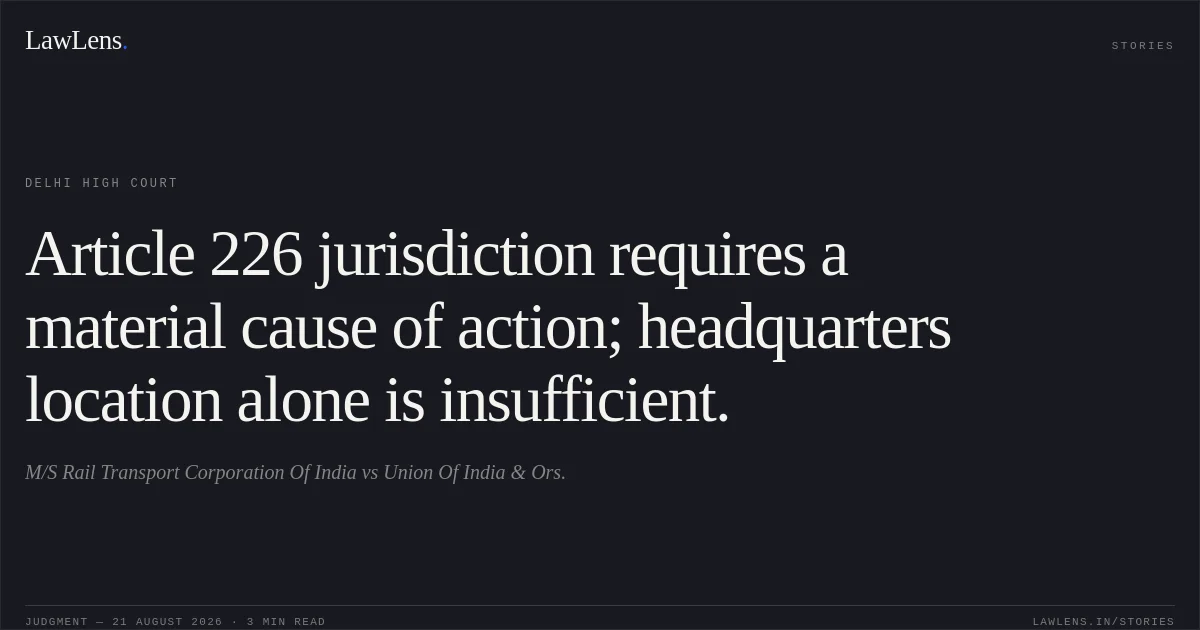
Whether the Delhi High Court had territorial jurisdiction under Article 226(2) of the Constitution to entertain the writ petition when the impugned notices, orders and communications were issued by authorities at Firozpur and the inspection giving rise to the proceedings occurred at Mumbai.
Source reference: paras. 5–8, 19–24; pp. 4–10Whether the location of the headquarters of Northern Railways and the offices of the Union of India in New Delhi, or the fact that policies applicable to the Firozpur Division were formulated in Delhi, constituted a part of the cause of action within Delhi.
Source reference: paras. 10–11, 25–27; pp. 5, 10–11Law Applied
Article 226(2) permits a High Court to exercise writ jurisdiction where the cause of action, wholly or in part, arises within its territorial jurisdiction.
Source reference: para. 13; p. 6Under Oil and Natural Gas Commission v. Utpal Kumar Basu, territorial jurisdiction must be determined on the basis of the pleadings, and the pleaded facts must disclose a real part of the cause of action.
Source reference: para. 14; pp. 6–7Alchemist Ltd. v. State Bank of Sikkim establishes that the relevant fact must be material, essential or integral to the cause of action; a mere fraction is sufficient, but “nothing less” than a part of the cause of action will suffice.
Source reference: para. 16; pp. 8–9Manjira Devi Ayurveda Medical College & Hospital v. Uttarakhand University of Ayurveda holds that the mere location of respondents’ offices in Delhi does not confer jurisdiction where no cause of action arose there.
Source reference: para. 17; pp. 8–9Under Kusum Ingots & Alloys Ltd. v. Union of India, the framing of a statute, rule, executive order or policy at a particular place does not, by itself, constitute a cause of action at that place.
Source reference: para. 26; pp. 10–11The Court distinguished Union of India v. Sri Ladulal Jain, which concerned civil-suit jurisdiction under Sections 20(a) and 20(b) of the CPC, rather than writ jurisdiction under Article 226(2).
Source reference: para. 28; p. 11Reasoning
The Court examined the material facts pleaded in the writ petition and found that the show-cause notice, lease-termination order, appellate rejection and forfeiture communication were all issued by authorities at Firozpur.
Source reference: paras. 19–22; pp. 9–10The factual event initiating the proceedings—the inspection and seizure of the packages—occurred at Mumbai Central, and the leased train operated between Mumbai and Amritsar.
Source reference: para. 23; p. 10No representation or communication concerning the dispute had been addressed to, or decided by, the Northern Railways’ headquarters in Delhi.
Source reference: para. 22; p. 10Applying ONGC, Alchemist, and Kusum Ingots, the Court held that the mere presence of the Union of India and Northern Railways’ offices in Delhi, or the formulation of policies in Delhi, did not constitute a material, essential or integral part of the cause of action.
Source reference: paras. 24–27; pp. 10–11The petitioner’s reliance on Ladulal Jain was rejected because that decision concerned the statutory basis for territorial jurisdiction in civil suits and did not govern Article 226(2) proceedings.
Source reference: para. 28; p. 11Holding
The Court answered the jurisdictional questions against the petitioner, holding that no part of the cause of action arose within Delhi under Article 226(2) of the Constitution.
The writ petition, including the challenges to the termination, appellate order and forfeiture of the security deposit, was dismissed on the ground of territorial jurisdiction; the pending application was also disposed of.
Source reference: paras. 30–31; p. 12Acts & Sections Cited
2 provisions across 2 statutes referred to in this judgment. Each provision opens on LawLens.
Railways Act, 19891
Code of Civil Procedure, 19081
Original Court PDF
M/S Rail Transport Corporation Of IndiavsUnion Of India & Ors.
Click to open original judgment
Original judgment, available to read, download and summarize on LawLens.in