Facts
The petitioner, a cooperative society licensed to manufacture AYUSH medicines, received a supply order dated 21 December 2017 from the office of the Chief Medical Officer, Allahabad, and supplied the medicines.
Source reference: p.2, para. 3.1–3.2It claimed payment of the contractual bills, including GST of approximately ₹2,00,000.
Source reference: p.2, para. 3.1–3.2In an earlier writ petition, the High Court directed the Chief Medical Officer to decide the petitioner’s pending representation.
Source reference: p.2, para. 3.3By order dated 8 October 2018, the Chief Medical Officer rejected the claim on grounds including non-compliance with procurement guidelines, absence of prior committee approval, lack of demand from AYUSH doctors, non-compliance with quality standards, procurement outside the prescribed contractual process, alleged financial irregularities, and failure to return medicines.
Source reference: p.2–3, para. 3.4The petitioner challenged the rejection and sought a mandamus directing payment of the bills with 18% interest.
Source reference: p.1–2, para. 2The State disputed the claim, relying on a three-member inquiry report, alleged sub-standard medicines, procurement irregularities, the petitioner’s absence from the relevant empanelled list, and returned communications addressed to the petitioner’s stated address.
Source reference: pp.5–7, paras. 14–20The petitioner contended that the medicines had been certified as satisfactory, that the inquiry report had not been supplied to it, and that any procurement irregularity was attributable to the departmental officers rather than the petitioner.
Source reference: pp.3–5, paras. 4–10Issues
Whether a writ petition under Article 226 of the Constitution is maintainable for recovery of alleged contractual dues where the entitlement to payment, quality and utilisation of the goods, procurement procedure, and other foundational facts are disputed?
Source reference: p.8, para. 22; p.12, para. 34Whether the petitioner was entitled to a mandamus directing payment of the bills for the AYUSH medicines supplied, together with interest?
Source reference: p.1–2, para. 2; p.13–14, paras. 37–39Law Applied
Under Hindustan Petroleum Corporation Ltd. v. Dolly Das, (1999) 4 SCC 450, writ proceedings do not ordinarily lie to enforce contractual obligations or claim money for breach of contract where no constitutional or statutory right is involved.
Source reference: p.10, para. 32Relying on Kerala State Electricity Board v. Kurien E. Kalathil, (2000) 6 SCC 293, the Court held that disputes concerning interpretation, performance, payment, or breach of a non-statutory contract are ordinarily matters for a civil court or arbitration.
Source reference: pp.11–12, para. 33The Court also relied on Sanjay Kumar Jha v. Prakash Chandra Chaudhary, (2019) 2 SCC 499, for the proposition that disputed questions of fact cannot ordinarily be adjudicated merely on rival affidavits under Article 226.
Source reference: p.13, para. 36However, writ jurisdiction may be exercised where contractual dues are admitted and no factual inquiry is necessary, consistent with ABL International Ltd. v. Export Credit Guarantee Corporation of India Ltd., (2004) 3 SCC 553.
Source reference: p.12–13, paras. 34–35Reasoning
The Court found that the petitioner’s claim was not for admitted dues. The State disputed both the petitioner’s entitlement and the underlying contractual obligation, relying on alleged violations of procurement policy and financial irregularities.
Source reference: p.9–10, paras. 23–24The identity and address of the petitioner’s firm, the alleged return of medicines, the quality of the medicines, their utilisation, and the competence of the Chief Pharmacist to certify them were all contested matters requiring evidence.
Source reference: p.8–9, paras. 25–27The petitioner’s assertion that other empanelled manufacturers lacked valid registration did not establish any enforceable right in its favour and would itself require a factual inquiry.
Source reference: p.9, para. 27The Court distinguished the authority concerning non-payment of admitted dues because neither the existence of liability nor the quantum payable had been admitted by the State.
Source reference: p.10, paras. 28–29It held that determining whether the medicines were sub-standard, whether the supply complied with procurement norms, whether the goods were utilised or returned, and whether payment was contractually due would require pleadings, evidence, examination, and cross-examination—matters unsuitable for adjudication in the present writ proceedings.
Source reference: p.13–14, paras. 36–38Holding
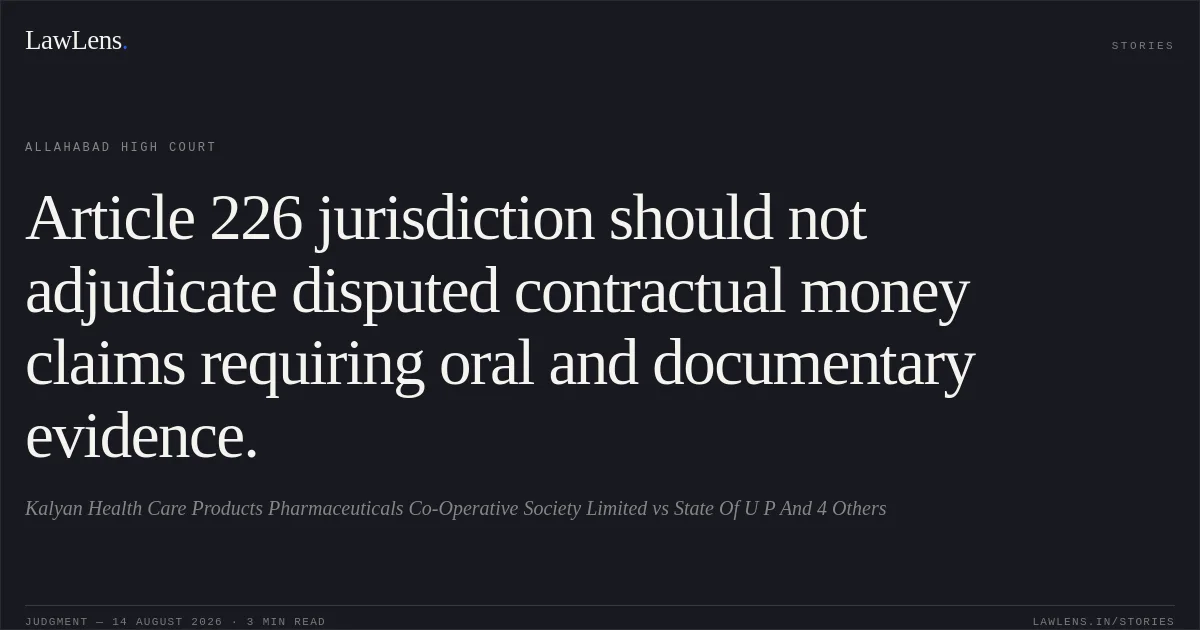
The Court declined to exercise its extraordinary jurisdiction under Article 226, holding that the petitioner’s monetary claim involved substantial and disputed questions of fact arising from a non-statutory contract.
The writ petition seeking payment of the medicine-supply bills and interest was accordingly dismissed, with the parties directed to bear their own costs.
Source reference: p.14, paras. 39–40The dismissal was clarified to be without prejudice to the petitioner’s right to pursue appropriate remedies before the Civil Court, any statutory forum, or an arbitral forum, if available.
Source reference: p.14, para. 41Acts & Sections Cited
1 provisions across 1 statute referred to in this judgment. Each provision opens on LawLens.
Code of Civil Procedure, 19081
Original Court PDF
Kalyan Health Care Products Pharmaceuticals Co-Operative Society LimitedvsState Of U P And 4 Others
Click to open original judgment
Original judgment, available to read, download and summarize on LawLens.in