Facts
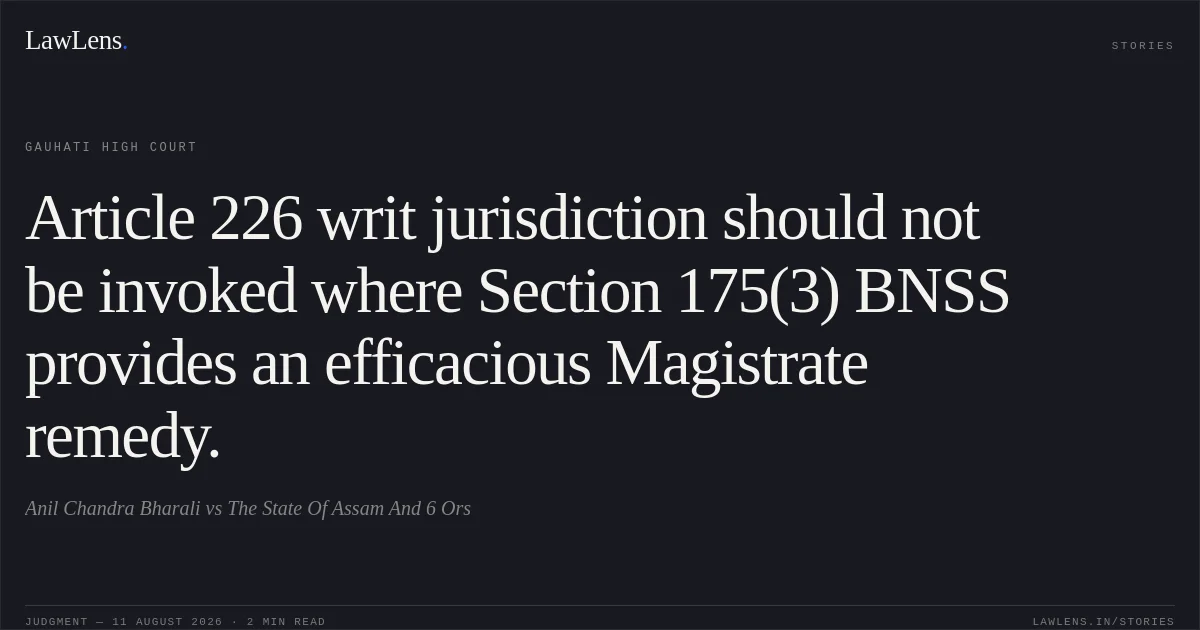
The petitioner alleged that, despite submitting a complaint/FIR dated 6 April 2026 before the Basistha Police Station, the police neither registered an FIR nor conducted an investigation, prompting him to invoke the writ jurisdiction of the Gauhati High Court under Article 226 of the Constitution.
Source reference: pp. 3–4, paras. 2, 6The police made GD Entry No. 49 dated 6 April 2026 and conducted a preliminary enquiry after obtaining approval from the competent superior authority under Section 175(3)(i) of the Bharatiya Nagarik Suraksha Sanhita, 2023 (BNSS).
Source reference: p. 3, para. 3The enquiry indicated that the dispute substantially concerned possession and rival claims over land, and that the allegations attracted Section 115(2) of the Bharatiya Nyaya Sanhita, 2023 (BNS), described by the police as a non-cognizable offence.
Source reference: p. 3, para. 3Accordingly, the Enquiry Officer filed an application dated 22 April 2026 before the Chief Judicial Magistrate, Kamrup (M), under Section 174(2) BNSS, and the application remained pending.
Source reference: p. 4, para. 4Issues
Whether the High Court should exercise its jurisdiction under Article 226 of the Constitution to direct registration of an FIR and investigation when the petitioner has an efficacious statutory remedy before the jurisdictional Magistrate under Section 175(3) BNSS.
Source reference: pp. 4–5, paras. 6–8Whether the police were entitled to await the Magistrate’s permission before investigating the alleged non-cognizable offence under Section 115(2) BNS.
Source reference: pp. 3–4, paras. 3–4Law Applied
Section 175(3) BNSS, which is stated to be pari materia with Section 156(3) of the Code of Criminal Procedure, 1973, provides a statutory remedy to a person aggrieved by the police’s failure to register or investigate an offence through an application to the jurisdictional Magistrate.
Source reference: p. 5, para. 7Under Section 174(2) BNSS, investigation of a non-cognizable offence requires the permission of the competent Magistrate.
Source reference: p. 4, para. 4The Court relied on Sakiri Vasu v. State of Uttar Pradesh, (2008) 2 SCC 409, which holds that the High Court ordinarily ought not to entertain a petition under Article 226 seeking directions for registration or investigation where the remedy under Section 156(3) CrPC is available.
Source reference: p. 5, para. 7Reasoning
The Court noted that the police had not simply ignored the petitioner’s complaint: a GD entry had been recorded, an enquiry had been conducted, and an application seeking the Magistrate’s permission to investigate had already been filed.
Source reference: pp. 3–4, paras. 3–4Since the allegations were found, at least at the enquiry stage, to relate substantially to a land-possession dispute and to disclose a non-cognizable offence under Section 115(2) BNS, the police could not proceed with investigation without the jurisdictional Magistrate’s permission.
Source reference: p. 3, para. 3; p. 4, para. 4In any event, the petitioner had an adequate statutory remedy under Section 175(3) BNSS. Applying the principle in Sakiri Vasu, the Court held that the writ petition was not an appropriate proceeding for directing registration of an FIR or investigation in these circumstances.
Source reference: p. 5, paras. 7–8Holding
The Court dismissed the writ petition as not fit for entertainment under Article 226, primarily because the petitioner had an efficacious statutory remedy before the jurisdictional Magistrate and the police had already sought the requisite permission to investigate.
The dismissal was expressly stated not to prejudice the petitioner in any future proceedings concerning the allegations, and he was granted liberty to approach the jurisdictional Magistrate, if so advised.
Source reference: p. 5, para. 9Acts & Sections Cited
4 provisions across 3 statutes referred to in this judgment. Each provision opens on LawLens.
Bharatiya Nagarik Suraksha Sanhita, 20232
Bharatiya Nyaya Sanhita, 20231
Code of Criminal Procedure, 19731
Original Court PDF
Anil Chandra BharalivsThe State Of Assam And 6 Ors
Click to open original judgment
Original judgment, available to read, download and summarize on LawLens.in