Facts
The petitioner, defendant in O.S. No.231 of 2009, had instituted O.S. Nos.207 and 347 of 1997 concerning the same properties; those proceedings were pending in second appeal. During their pendency, and while an interim injunction protecting the petitioner’s possession was operating, the respondents purchased the suit properties by sale deed dated 2 July 2008.
Source reference: pp.3–4, paras.3–4The respondents thereafter instituted O.S. No.231 of 2009 seeking permanent injunction, alleging that the petitioner had attempted to interfere with their possession. The petitioner contended that the suit disclosed no cause of action, was an abuse of process, and violated the injunction order dated 27 July 2005. He therefore invoked Article 227 of the Constitution seeking to strike off the plaint.
Source reference: pp.3–4, paras.3–4The High Court noted that the respondents had pleaded a cause of action and produced revenue records indicating possession. It further recorded that the suit had subsequently been transferred to the District Munsif Court, Avinashi, renumbered as O.S. No.750 of 2012, and dismissed for default on 10 January 2018, without any restoration application having been filed as of the record date.
Source reference: pp.4–5, paras.6–7Issues
Whether the plaint in O.S. No.231 of 2009 disclosed a cause of action and could be struck off under Article 227 of the Constitution on the ground that the suit was allegedly an abuse of process and not maintainable?
Source reference: pp.3–5, paras.3, 6–8Whether the petitioner’s objections regarding the respondents’ possession, bona fide purchase, pendente lite status, and alleged violation of the interim injunction could be determined in the revision proceeding or required adjudication at trial?
Source reference: pp.4–5, paras.4, 6Law Applied
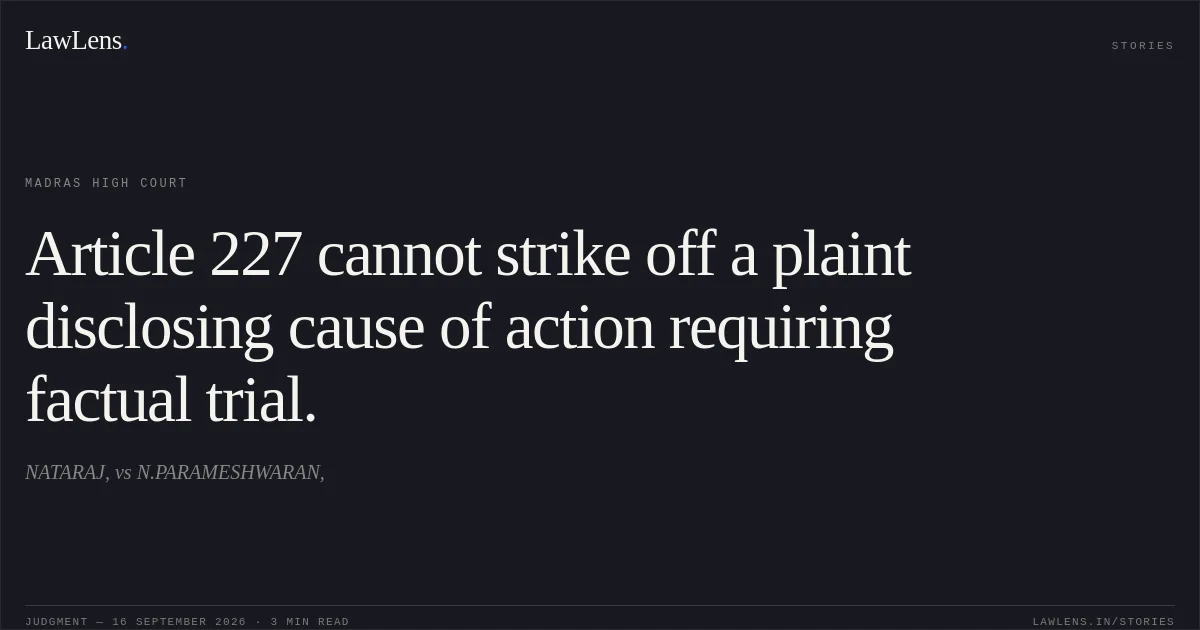
The Court applied the supervisory jurisdiction under Article 227 of the Constitution, holding that the power to strike off a plaint is extraordinary and should not be exercised where the plaint discloses a pleaded cause of action and the disputed matters involve questions of fact.
Source reference: p.5, para.6The Court also recognised the petitioner’s alternative remedy under Order VII Rule 11 of the Code of Civil Procedure, 1908, which permits rejection of a plaint on statutory grounds, including absence of a cause of action. Whether the alleged interference with possession actually occurred, however, is a factual matter requiring evidence and trial.
Source reference: p.5, para.6Reasoning
The respondents’ plaint specifically alleged interference by the petitioner with their possession and sought permanent injunction; therefore, it was not a plaint entirely lacking a cause of action on its face. The revenue records relied upon by the respondents also raised a factual controversy regarding possession.
Source reference: p.5, para.6The petitioner’s assertions that the respondents were pendente lite purchasers, that the suit violated the earlier injunction, and that the alleged interference was false concerned the merits of the dispute rather than the plaint’s inherent maintainability. Such matters could not appropriately be conclusively determined in proceedings under Article 227. The Court further observed that the petitioner had an alternative remedy under Order VII Rule 11 CPC. The subsequent dismissal of the suit for default did not provide a basis for granting the requested relief of striking off the plaint.
Source reference: p.5, paras.6–7Holding
The High Court held that this was not a fit case for exercising Article 227 jurisdiction to strike off the plaint, since the plaint disclosed a pleaded cause of action and the material disputes required factual adjudication.
The Civil Revision Petition was accordingly dismissed without costs, and the connected miscellaneous petitions were closed.
Source reference: p.6, para.8Original Court PDF
NATARAJ,vsN.PARAMESHWARAN,
Click to open original judgment
Original judgment, available to read, download and summarize on LawLens.in