Facts
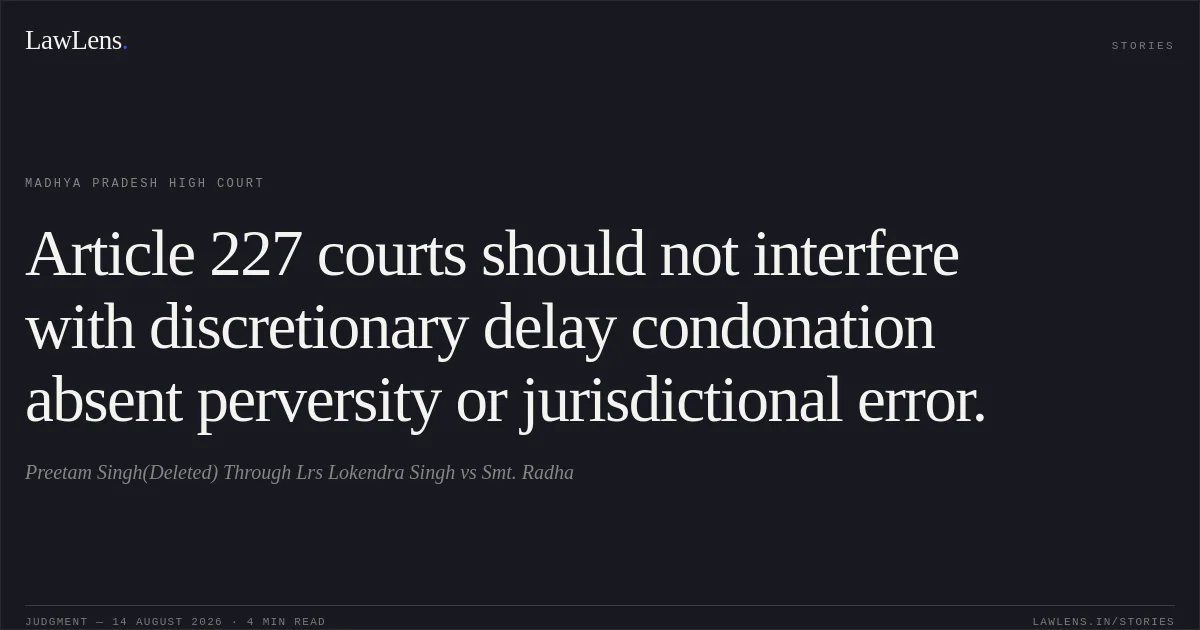
Preetam Singh instituted a civil suit seeking declaration and permanent injunction concerning the suit property, claiming to be a joint/co-owner.
Source reference: no citationHis application under Order XXXIX Rules 1 and 2 of the Code of Civil Procedure, 1908 was partly allowed by the Trial Court on 30 May 2024, restraining respondents 1–3 from alienating the suit land or creating third-party rights during pendency of the suit.
Source reference: para. 5Respondents 1–3 filed an appeal against the interlocutory injunction order with a delay of approximately 529 days and sought condonation under Section 5 of the Limitation Act, 1963.
Source reference: para. 6They alleged that the plaintiff had suppressed the acquisition of 0.857 hectares of his land by the Gwalior Development Authority and his receipt of compensation, thereby obtaining the injunction by fraud.
Source reference: paras. 18–19The XXII Additional District Judge, Gwalior condoned the delay by order dated 8 January 2026, imposing costs of Rs.5,000.
Source reference: paras. 21–24After Preetam Singh’s death, Lokendra Singh was substituted as petitioner and the other legal representatives were impleaded as respondents.
Source reference: para. 1The present petition under Article 227 challenged the order condoning delay.
Source reference: no citationIssues
1. Whether the petition under Article 227 of the Constitution was maintainable against the order condoning delay in an appeal arising from an interlocutory injunction order, or whether the appropriate remedy was a revision under Section 115 CPC.
Source reference: paras. 12–162. Whether the lower appellate court was justified in condoning the delay of approximately 529 days under Section 5 of the Limitation Act, 1963.
Source reference: para. 173. Whether the lower appellate court’s exercise of discretion in accepting the respondents’ explanation disclosed any palpable illegality, jurisdictional error, arbitrariness, or perversity warranting interference under Article 227.
Source reference: paras. 27–28Law Applied
The Court applied Section 5 of the Limitation Act, 1963, under which delay may be condoned where “sufficient cause” is established; the length of delay is not determinative, but the acceptability of the explanation is the principal criterion.
Source reference: no citationUnder Article 227 of the Constitution, interference with a discretionary order is limited and is justified only where the subordinate court acts without or in excess of jurisdiction, or its decision is arbitrary, perverse, or legally untenable.
Source reference: no citationThe Court relied on N. Balakrishnan v. M. Krishnamurthy, (1998) 7 SCC 123, holding that a superior court ordinarily should not disturb a positive exercise of discretion accepting sufficient cause unless it rests on wholly untenable or perverse grounds.
Source reference: para. 26K. Subbarayudu v. Special Deputy Collector (Land Acquisition), (2017) 12 SCC 840, adopting a similar approach.
Source reference: para. 27It also considered Basawaraj v. Special Land Acquisition Officer, AIR 2014 SC 74, and P.K. Ramachandran v. State of Kerala, AIR 1998 SC 2276, concerning the requirement of adequate explanation for delay.
Source reference: para. 25On maintainability, it followed Saval Singh v. Smt. Ramsakhi, 2003 (1) MPLJ 31, holding that revision under Section 115 CPC is unavailable where allowing it would not finally dispose of the suit or proceeding.
Source reference: paras. 15–16The scope of Article 227 was further guided by Shalini Shyam Shetty v. Rajendra Shankar Patil, (2010) 8 SCC 329.
Source reference: para. 28Reasoning
The Court rejected the objection that Section 115 CPC was the appropriate remedy because interference with the impugned order would not finally dispose of the pending suit or the entire proceeding.
Source reference: paras. 15–16On the merits, the lower appellate court had considered the respondents’ assertion that they learned later of the alleged acquisition and payment of compensation, and found that the allegation of suppression and fraud had not been specifically rebutted by the petitioner.
Source reference: paras. 19–23It also considered the respondents’ circumstances, including that respondents 1 and 2 were women and respondent 3 was approximately 50 years old, and found their explanation bona fide and not inherently impractical.
Source reference: para. 23Applying the principle that the acceptability of the explanation, rather than the mere duration of delay, is decisive, the Court held that the lower appellate court had exercised its discretion on legally sustainable grounds and had imposed costs while condoning the delay.
Source reference: para. 24The petitioner’s reliance on Basawaraj and P.K. Ramachandran did not assist him because the lower appellate court had considered the requirement of sufficient cause.
Source reference: para. 25Since the finding regarding suppression and fraud remained unrebutted and no palpable illegality, jurisdictional error, arbitrariness, or perversity was demonstrated, reappreciation of the discretionary determination was impermissible under Article 227.
Source reference: paras. 27–28Holding
The High Court held that the petition under Article 227 was maintainable, but no ground for interference was established.
The lower appellate court had properly exercised its discretion under Section 5 of the Limitation Act in condoning the 529-day delay, and its order did not suffer from any jurisdictional error or perversity.
Source reference: paras. 15–16, 27–28The Miscellaneous Petition was dismissed as meritless, and pending applications, if any, were also disposed of.
Source reference: para. 29Acts & Sections Cited
2 provisions across 2 statutes referred to in this judgment. Each provision opens on LawLens.
Limitation Act, 19631
Code of Civil Procedure, 19081
Original Court PDF
Preetam Singh(Deleted) Through Lrs Lokendra SinghvsSmt. Radha
Click to open original judgment
Original judgment, available to read, download and summarize on LawLens.in