Facts
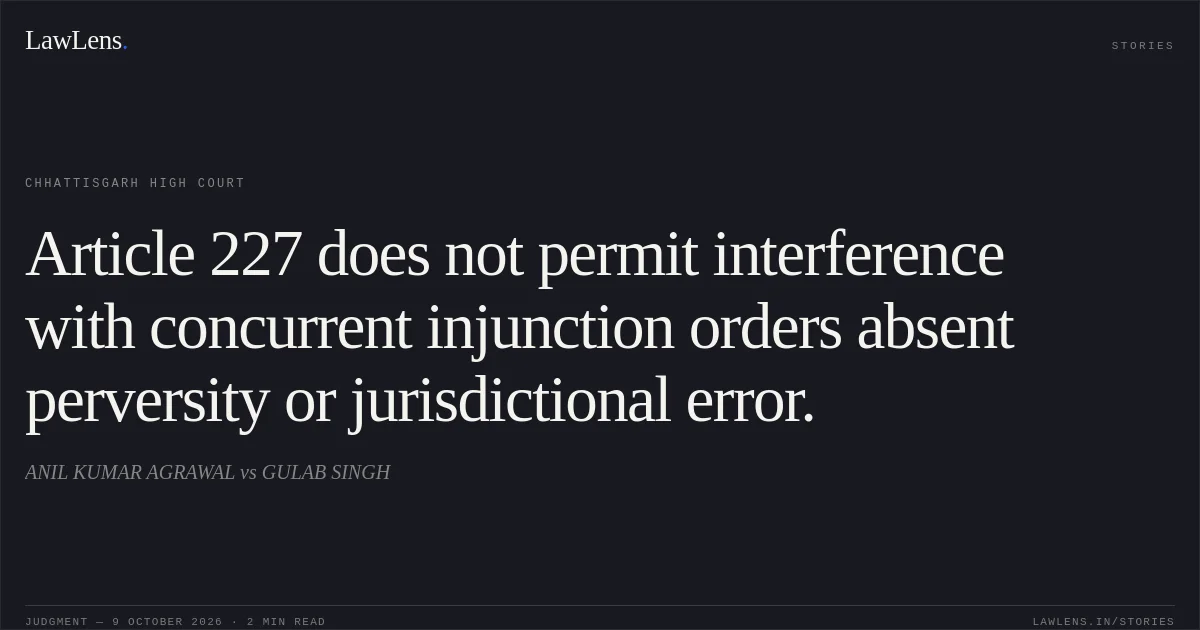
The respondents, as plaintiffs, filed a civil suit seeking eviction and permanent injunction concerning land at Kohka, Durg. They alleged that they had purchased the land in 1980, corrected a land-numbering error by a deed in 2009, and that petitioner No. 2 was asserting rights over the property and attempting to alienate it
Source reference: para. 3The trial court allowed the plaintiffs’ application under Order 39 Rules 1 and 2 CPC and restrained the defendants from alienating the suit property pending the suit or further orders
Source reference: paras. 3, 7The appellate court dismissed the petitioners’ appeal and affirmed the injunction
Source reference: para. 2The petitioners then challenged both orders under Article 227, arguing that the trial court had not adequately reasoned its findings on the requirements for temporary injunction
Source reference: para. 3Issues
1. Whether the trial court’s failure to give specific reasons for finding a prima facie case, balance of convenience, and irreparable injury warranted interference under Article 227
Source reference: paras. 3, 7–92. Whether the appellate court’s affirmance of the injunction disclosed jurisdictional error or perversity justifying supervisory intervention
Source reference: paras. 2, 6, 9Law Applied
Under Article 227 of the Constitution, the High Court exercises limited supervisory jurisdiction to keep subordinate courts within the bounds of their authority; it does not act as an appellate court to reappreciate evidence or correct every error. Intervention is warranted in cases of jurisdictional error, patent perversity, manifest illegality, or grave failure of justice
Source reference: paras. 5–6; Shalini Shyam Shetty v. Rajendra Shankar Patil, (2010) 8 SCC 329; Garment Craft v. Prakash Chand Goel, (2022) 4 SCC 181Under Order 39 Rules 1 and 2 CPC, a court considering temporary injunction must assess the relevant requirements, including prima facie case, balance of convenience, and irreparable injury
Source reference: paras. 3, 8Reasoning
The High Court acknowledged that a trial court should examine and discuss the evidence before granting or refusing temporary injunction
Source reference: para. 8It nevertheless concluded that the trial court had considered the parties’ pleadings and documents and had found the requirements for injunction satisfied, even though its reasoning on prima facie case was not specifically set out
Source reference: paras. 7–8The injunction was limited to preventing alienation of the property, and the appellate court had affirmed it by a detailed order after considering the material on record
Source reference: paras. 7–8In those circumstances, the High Court found no jurisdictional error or perversity meeting the threshold for Article 227 intervention
Source reference: para. 9Holding
The High Court held that the challenged orders did not warrant supervisory interference under Article 227.
It dismissed the writ petition, leaving in force the injunction restraining the petitioners from alienating the suit property pending the suit or further orders
Source reference: paras. 8–9Acts & Sections Cited
1 provisions across 1 statute referred to in this judgment. Each provision opens on LawLens.
Code of Civil Procedure, 19081
Original Court PDF
ANIL KUMAR AGRAWALvsGULAB SINGH
Click to open original judgment
Original judgment, available to read, download and summarize on LawLens.in