Facts
The petitioners claimed the disputed land under a Will executed in 2016 and had their names mutated.
Source reference: para. 3, 8Respondent No. 1 claimed to be the daughter and legal heir of the original owner, Punaji, and challenged the petitioners’ claim to the property
Source reference: para. 3, 8During the suit, the petitioners sought DNA testing to dispute her parentage; the trial court rejected their applications in 2017 and 2018, and those orders were not challenged
Source reference: para. 8After judgment and decree were entered against them, the petitioners sought to introduce DNA evidence in the first appeal under Order XLI Rule 27 CPC.
Source reference: para. 8The appellate court rejected the application, relying in part on a school certificate produced by the petitioners that named Punaji as Amruta Bai’s father
Source reference: para. 8The petitioners then challenged that rejection under Article 227 of the Constitution
Source reference: para. 1, 3–4Issues
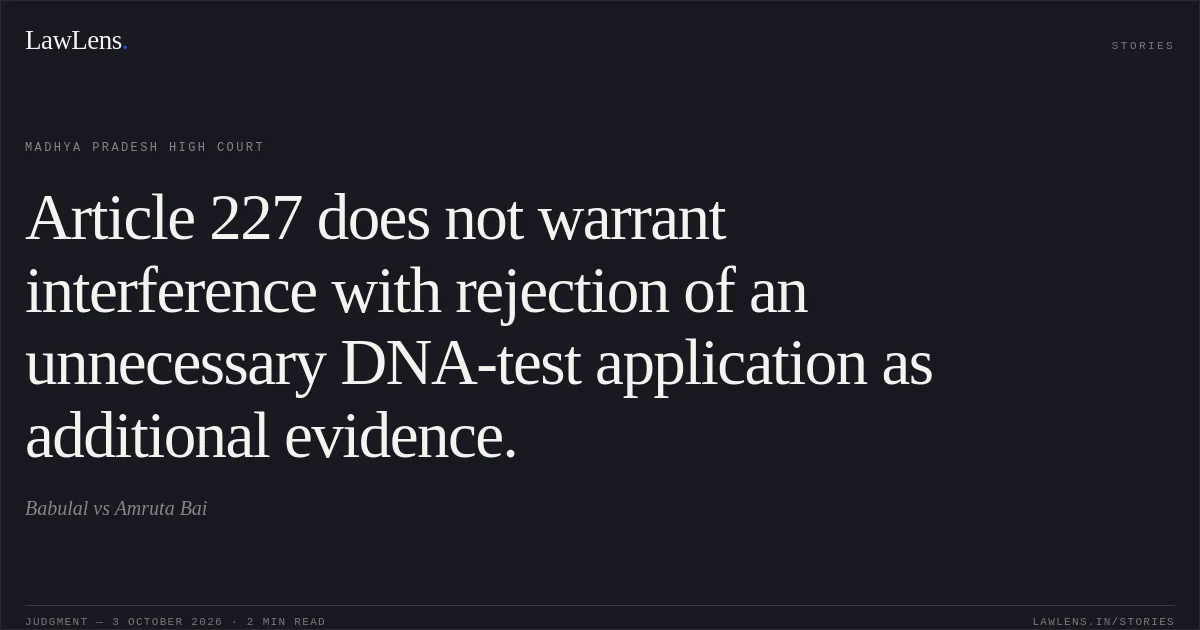
Whether the appellate court erred in rejecting the petitioners’ application under Order XLI Rule 27 CPC to obtain DNA evidence concerning Amruta Bai’s parentage
Source reference: para. 3–4, 8Whether the rejection disclosed an error warranting the High Court’s interference under its supervisory jurisdiction under Article 227
Source reference: para. 10–12Law Applied
Section 45 of the Evidence Act makes expert opinions relevant on specified matters, including science; it does not, by itself, entitle a party to obtain a DNA test
Source reference: para. 6Order XLI Rule 27 CPC permits additional evidence in appeal only in the specified circumstances, including where the trial court improperly refused evidence, the evidence could not despite due diligence have been produced earlier, or the appellate court requires it to decide the case or for another substantial cause
Source reference: para. 7Section 90 of the Evidence Act permits a court, in the prescribed circumstances, to presume due execution and authenticity of a document at least thirty years old produced from proper custody
Source reference: para. 9Under Article 227, supervisory intervention is limited; it is not an appellate review and is warranted in exceptional cases such as patent perversity, jurisdictional error, or manifest failure of justice.
Source reference: para. 11The Court relied on Shalini Shyam Shetty v. Rajendra Shankar Patil, (2010) 8 SCC 329
Source reference: para. 11Reasoning
The High Court found that the DNA applications had already been rejected by the trial court and those orders were not challenged; the petitioners’ subsequent request in appeal did not establish a basis for admitting additional evidence under Order XLI Rule 27 CPC
Source reference: para. 8The appellate court had considered the proposed test, the parties whose samples would be needed, and the school certificate naming Punaji as Amruta Bai’s father; it concluded that the requested test was unnecessary
Source reference: para. 8–10The High Court also considered the privacy implications of seeking testing involving a third party and held that the appellate court had properly exercised its discretion
Source reference: para. 10Applying the limited scope of Article 227, it found no patent perversity or other ground for supervisory intervention
Source reference: para. 11–12Holding
The High Court held that no case for interference under Article 227 had been made out and dismissed the petition.
The appellate court’s rejection of the application to introduce DNA evidence therefore remained undisturbed
Source reference: para. 12–13Acts & Sections Cited
2 provisions across 1 statute referred to in this judgment. Each provision opens on LawLens.
Code of Civil Procedure, 19082
Original Court PDF
BabulalvsAmruta Bai
Click to open original judgment
Original judgment, available to read, download and summarize on LawLens.in