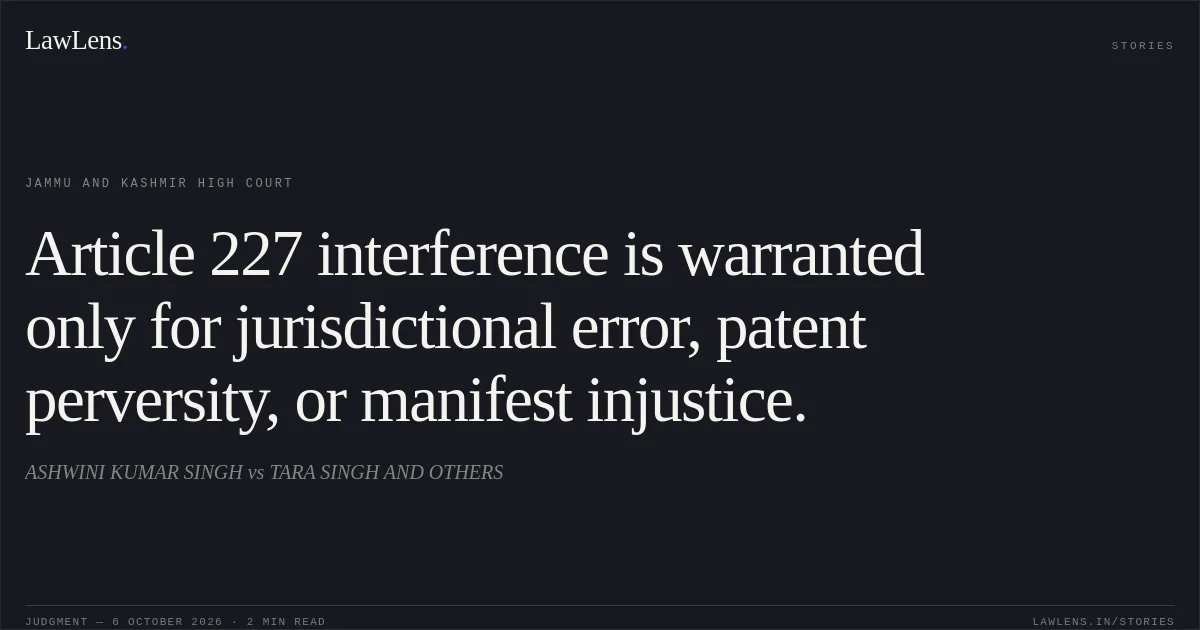
Facts
The petitioner sued in the Munsiff Court, Samba, seeking permanent and mandatory injunctions concerning two shops occupied by respondents 1 and 2, whom he alleged were licensees. The mandatory relief included a direction to vacate the shops and hand over vacant and peaceful possession.
Source reference: para. 2–6The respondents sought rejection of the plaint under Order VII Rule 11 CPC, contending that the suit was undervalued and the requisite court fee had not been paid. The Trial Court declined outright rejection but directed the petitioner to correct the valuation and pay the requisite court fee within 15 days. The petitioner challenged that direction under Article 227 of the Constitution.
Source reference: para. 1, 4, 10Issues
Whether the Trial Court’s direction to correct the suit valuation and pay the requisite court fee warranted interference under Article 227 of the Constitution
Source reference: para. 13–14, 18Whether the impugned order met the exceptional threshold for supervisory interference, such as jurisdictional error, patent perversity, or manifest failure of justice
Source reference: para. 15–18Law Applied
Order VII Rule 11(b) CPC provides for rejection of a plaint where the relief is undervalued and the plaintiff, after being directed to correct the valuation within a fixed time, fails to do so; Rule 11(c) applies where the plaint is insufficiently stamped and the plaintiff fails to supply the requisite stamp paper after being given an opportunity.
Source reference: para. 12Under Article 227, the High Court’s supervisory jurisdiction is to be exercised sparingly to keep subordinate courts within the bounds of their authority and to address patent perversity, jurisdictional failure, or manifest injustice; it is not an appellate power to correct mere errors or substitute another possible view. The Court relied on Shalini Shyam Shetty v. Rajendra Shankar Patil, 2010 AIR SCW 6387, and referred to Babubhai Jamnadas Patel v. State of Gujarat and Radhey Shyam v. Chhabi Nath.
Source reference: para. 15–17Reasoning
The Trial Court had declined to reject the plaint outright and instead afforded the petitioner an opportunity to correct the valuation and pay the requisite court fee, as contemplated by Order VII Rule 11(b) and (c) CPC.
Source reference: para. 10, 12–13The High Court held that the Trial Court had exercised its jurisdiction and had not acted beyond its authority; the order disclosed neither patent perversity nor a manifest failure of justice or breach of natural justice. The petitioner’s challenge therefore did not satisfy the restrictive standard for intervention under Article 227.
Source reference: para. 17–19Holding
The High Court dismissed the petition as not maintainable under Article 227, leaving the Trial Court’s direction to correct the valuation and pay the requisite court fee undisturbed.
It directed the Trial Court to decide the matter without being influenced by observations made in the High Court’s order.
Source reference: para. 19Acts & Sections Cited
2 provisions across 2 statutes referred to in this judgment. Each provision opens on LawLens.
Court-Fees Act, 18701
Code of Civil Procedure, 19081
Original Court PDF
ASHWINI KUMAR SINGHvsTARA SINGH AND OTHERS
Click to open original judgment
Original judgment, available to read, download and summarize on LawLens.in
![HRA parity claims must be assessed against similarly situated employees, with reasoned orders where parity is denied.. Shaphaba Thokchom vs DY. COMPTROLLER AND AUDITOR GENERAL OF INDIA. CAT - ['Guwahati']. LawLens](/stories/thumbnails/hra-parity-claims-must-be-assessed-against-similarly-situated-employees-with-reasoned-orde-a9c45995b0704be18e4bcf7b91c8e507.webp)
![Article 311(2)(c) dismissal is valid where relevant material shows an inquiry would endanger security sources.. Mohd Rafi vs GENERAL ADMINITRATIVE DEPARTMENT. CAT - ['Jammu']. LawLens](/stories/thumbnails/article-311-2-c-dismissal-is-valid-where-relevant-material-shows-an-inquiry-would-endanger-58dabaa9372a4b41bd304e91e9ebe890.webp)