Facts
The petitioner, plaintiff in Civil Suit No. 41A/2021 pending before the Second Civil Judge, Junior Division, Kota, instituted proceedings seeking declaration of title, permanent injunction and mesne profits against the respondents
Source reference: para. 2–3Respondent Nos. 1, 3 and 4 had executed a general power of attorney in favour of Vishal Singh and Anwar Ali on 05 January 2024, stated to be valid for two years.
Source reference: para. 3, 6The petitioner contended that, upon expiry of the power of attorney, those respondents’ continued representation through their counsel lacked authority
Source reference: para. 3, 6He therefore filed an application under Section 151 of the Code of Civil Procedure, 1908, seeking to restrain Respondent Nos. 1, 3 and 4 from participating in the suit.
Source reference: para. 6The trial court rejected the application, observing that the concerned defendants had filed vakalatnama on 08 January 2024 and were being duly represented by counsel; it also noted that an earlier application of a similar nature had been dismissed
Source reference: para. 6The petitioner challenged that order under Article 227 of the Constitution of India
Source reference: para. 2Issues
Whether the trial court erred in rejecting the petitioner’s application under Section 151 CPC seeking to restrain Respondent Nos. 1, 3 and 4 from participating in the suit after expiry of the general power of attorney
Source reference: para. 2–3, 6Whether the continued appearance of Respondent Nos. 1, 3 and 4 through counsel was without lawful authority because the record did not establish that their vakalatnama had been independently executed by them rather than through the expired power of attorney
Source reference: para. 6–7Law Applied
The Court applied Section 151 CPC, which preserves the inherent powers of the civil court to pass orders necessary for the ends of justice or to prevent abuse of process, and Article 227 of the Constitution, under which the High Court exercises supervisory jurisdiction over subordinate courts to correct jurisdictional errors or patent illegality.
Source reference: para. 2, 6–7The Court also applied the procedural principle that a party’s representation through counsel must be supported by a valid vakalatnama or other lawful authority.
Source reference: para. 6–7No judicial precedent was cited; the Court’s decision turned on the record placed before it and the limited scope of interference under Article 227
Source reference: para. 2, 6–7Reasoning
The petitioner asserted that the general power of attorney had expired after its two-year validity period and that the respondents’ counsel consequently lacked authority to represent them
Source reference: para. 3, 6However, the High Court noted that the petitioner had not annexed a copy of the vakalatnama, making it impossible to determine whether it had been executed by Respondent Nos. 1, 3 and 4 personally or through their attorney
Source reference: para. 6The trial court had recorded that the concerned defendants had already executed vakalatnama in favour of counsel and were being duly represented.
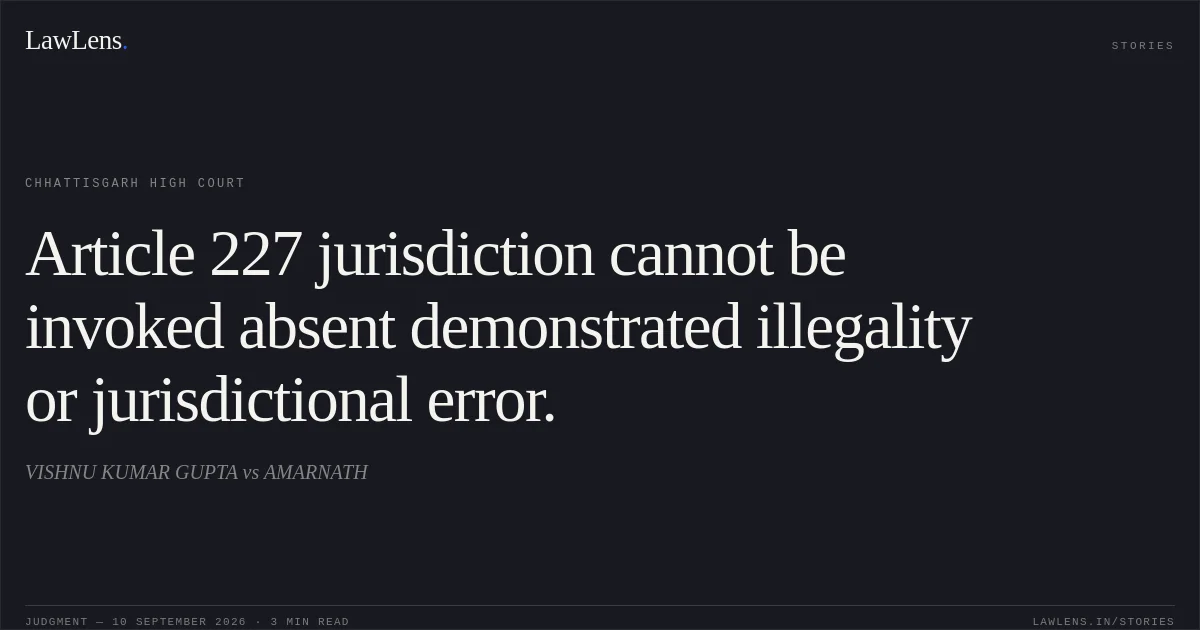
Source reference: para. 6In the absence of material demonstrating that the vakalatnama itself depended upon the expired power of attorney, and considering that the trial court’s order disclosed neither illegality nor jurisdictional error, the High Court found no ground for supervisory interference under Article 227
Source reference: para. 6–7Holding
The High Court answered the issues against the petitioner and held that no illegality or jurisdictional error was established in the trial court’s rejection of the Section 151 CPC application
The writ petition was accordingly dismissed, and the Registry was directed to provide a certified copy of the order to the trial court for information and compliance
Source reference: para. 8–9Acts & Sections Cited
1 provisions across 1 statute referred to in this judgment. Each provision opens on LawLens.
Code of Civil Procedure, 19081
Original Court PDF
VISHNU KUMAR GUPTAvsAMARNATH
Click to open original judgment
Original judgment, available to read, download and summarize on LawLens.in