Facts
The petitioner-plaintiff’s suit was dismissed for non-prosecution on 27 July 2018 after the Trial Court had granted him more than ten opportunities to lead oral evidence.
Source reference: para. 5; p. 5The petitioner asserted that he could not remain present because he was engaged in the festival of Guru Purnima and that, although his advocate had filed an adjournment application, the suit was nevertheless dismissed.
Source reference: paras. 3.1–3.2; pp. 2–3He filed an application under Order IX Rule 9 of the Code of Civil Procedure for restoration on 12 June 2019, more than nine months after dismissal, but did not file a separate application for condonation of delay.
Source reference: para. 4; p. 4The Trial Court rejected the restoration application, and the Appellate Court upheld that decision. The petitioner challenged those orders under Article 227 of the Constitution.
Source reference: paras. 2–3; pp. 1–3Issues
Whether the petitioner established sufficient cause for his absence on the date when the suit was dismissed for non-prosecution and for the delay in filing the restoration application under Order IX Rule 9 CPC?
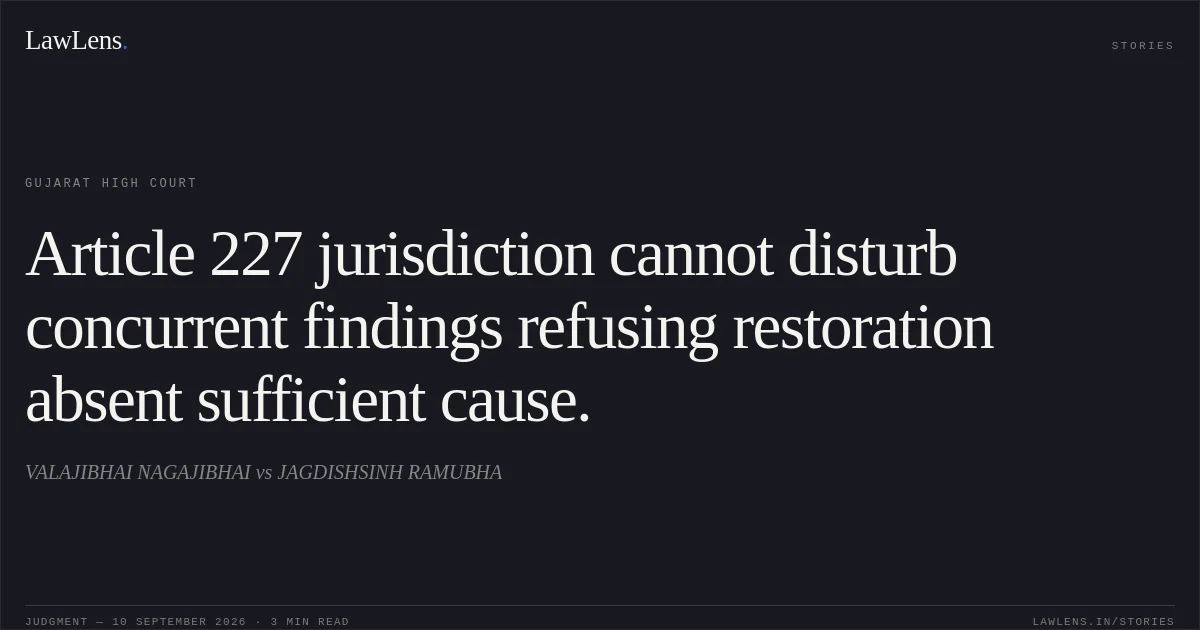
Source reference: paras. 4–5; pp. 4–6Whether the High Court should exercise its supervisory jurisdiction under Article 227 of the Constitution to interfere with the concurrent orders of the Trial Court and Appellate Court refusing restoration of the suit?
Source reference: paras. 6–7; pp. 6–7Law Applied
The Court applied Order IX Rule 9 CPC, under which a suit dismissed for non-prosecution may be restored if the plaintiff demonstrates sufficient cause for non-appearance. It held that a separate application for condonation of delay is not necessarily required when an application under Order IX Rule 9 CPC is filed; however, the plaintiff must still establish sufficient cause both for the absence on the dismissal date and for the delay in seeking restoration.
Source reference: para. 4; p. 4The Court also applied the limited scope of supervisory jurisdiction under Article 227 of the Constitution, holding that the High Court does not sit as an appellate court and should interfere only where the subordinate court’s order is perverse, grossly erroneous, illegal, irregular, or contrary to settled law. Reliance was placed on Sameer Suresh Gupta (Through POA Holder) v. Rahul Kumar Agarwal, (2013) 9 SCC 374, and Garment Craft v. Prakash Chand Goel, (2022) 4 SCC 181.
Source reference: para. 7; p. 6Reasoning
The High Court found that the petitioner had not adequately explained the delay of more than nine months in filing the restoration application or demonstrated sufficient cause for his absence on the date of dismissal.
Source reference: paras. 4–4.1; pp. 4–5The explanation that he was occupied with the Guru Purnima festival was considered insufficient, particularly in light of his overall conduct and his failure to utilise more than ten prior opportunities granted by the Trial Court to lead evidence.
Source reference: para. 5; p. 5Since the Trial Court and Appellate Court had both reached the conclusion that sufficient cause was not established, and their orders were reasoned and neither perverse nor legally erroneous, the requirements for interference under Article 227 were not satisfied.
Source reference: paras. 6–7; pp. 6–7Holding
The Court answered both issues against the petitioner. It held that the petitioner failed to establish sufficient cause for his non-appearance and the delayed filing of the restoration application, and that no ground existed for exercising supervisory jurisdiction under Article 227.
The petition was accordingly dismissed in limine, challenging the order dated 30 March 2026 passed below Exhibit 28 in Misc. Civil Appeal No. 09 of 2026. No order as to costs was made.
Source reference: para. 8; p. 7Original Court PDF
VALAJIBHAI NAGAJIBHAIvsJAGDISHSINH RAMUBHA
Click to open original judgment
Original judgment, available to read, download and summarize on LawLens.in