Facts
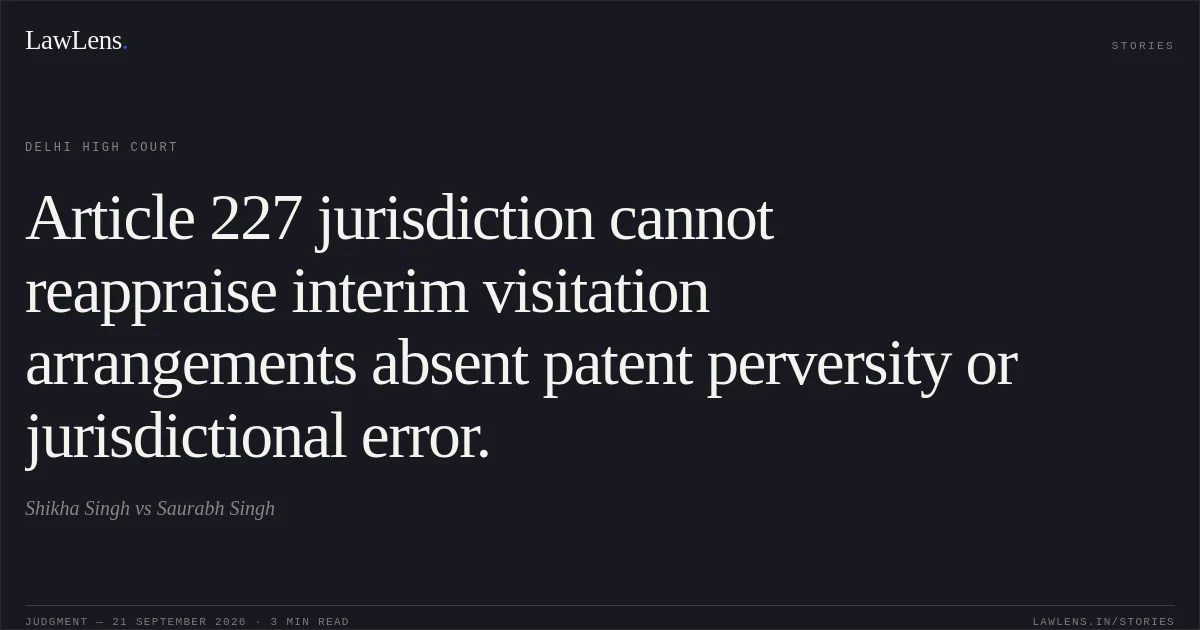
The petitioner-mother invoked Article 227 of the Constitution challenging the interim order dated 30 May 2026 passed by the Family Court, Central District, Tis Hazari Courts, in GP No. 77/2023.
Source reference: pp. 1–3; paras. 1–5The impugned order extended the respondent-father’s visitation period with the minor child from one hour to one and a half hours, permitted visitation on the first, third and fourth Saturdays between 3:00 p.m. and 4:30 p.m., and directed the petitioner to remain outside the Children Room during visitation, although within the same premises.
Source reference: pp. 1–3; paras. 1–5It also restrained both parties from video-recording the visitation, noting the availability of CCTV cameras.
Source reference: pp. 1–3; paras. 1–5During the proceedings, the petitioner admitted that she had consented to extending the visitation period to one and a half hours.
Source reference: p. 2; para. 2Issues
Whether the Family Court’s direction extending the visitation period from one hour to one and a half hours warranted interference under Article 227 of the Constitution, despite the petitioner’s admission that she had consented to the extension.
Source reference: pp. 2, 6–7; paras. 2, 12Whether the direction requiring the petitioner to remain outside the Children Room during the father’s visitation was contrary to the welfare and best interests of the minor child or otherwise suffered from jurisdictional error, perversity or manifest illegality.
Source reference: pp. 2–3, 7–10; paras. 3–4, 13–21Whether the petitioner was entitled to directions regarding maintenance arrears in the present proceedings.
Source reference: p. 6; para. 11Whether the restriction against video-recording the visitation required interference under Article 227.
Source reference: p. 3; para. 5Law Applied
The Court applied the limited supervisory scope of Article 227, holding that the High Court may interfere only to keep subordinate courts within the bounds of their jurisdiction and in cases of patent jurisdictional error, perversity, manifest illegality, gross failure of justice or violation of natural justice; it cannot function as an appellate court or merely substitute its own view (Shalini Shyam Shetty v. Rajendra Shankar Patil, (2010) 8 SCC 329, and Garment Craft v. Prakash Chand Goel, (2022) 4 SCC 181).
Source reference: pp. 3–6; paras. 7–9In child-custody and visitation matters, the paramount consideration is the welfare and best interests of the child.
Source reference: pp. 7–8; para. 14A child of tender years ordinarily requires the love, affection and company of both parents, and meaningful visitation should be ensured unless exceptional circumstances justify denial of contact (Yashita Sahu v. State of Rajasthan, (2020) 3 SCC 67).
Source reference: pp. 7–8; para. 14Interim visitation arrangements may regulate the manner of parental interaction without finally determining either parent’s rights.
Source reference: pp. 8–10; paras. 15–21Reasoning
The Court held that the challenge to the extended visitation period could not be sustained because the petitioner had expressly consented to it.
Source reference: p. 6; para. 12The direction requiring her to remain outside the Children Room was viewed as a permissible regulation intended to facilitate direct interaction between the father and child, rather than as an exclusion of the petitioner from the premises.
Source reference: pp. 8–9; paras. 16–17The child’s tender age and possible crying during visitation were insufficient, by themselves, to establish that the arrangement was contrary to the child’s welfare; the Court considered that familiarity with the father might develop gradually and that the child’s welfare included preserving a meaningful relationship with both parents.
Source reference: pp. 9–10; paras. 18–20The presence of CCTV cameras and the petitioner’s continued presence within the premises provided safeguards against incidents during visitation.
Source reference: p. 9; para. 16Since the impugned order did not concern maintenance arrears, the Court declined to adjudicate that issue and left it open to the petitioner to approach the Family Court.
Source reference: p. 6; para. 11The Court found no patent illegality, perversity or jurisdictional infirmity in the visitation or recording-related directions.
Source reference: p. 6; paras. 11–12Holding
The High Court dismissed the petition and declined to interfere under Article 227 with the Family Court’s interim visitation arrangement.
The extension of visitation to one and a half hours remained operative; the petitioner was required to remain outside the Children Room but could stay within the same premises; and the prohibition on video-recording continued.
Source reference: pp. 10–11; paras. 22–23The issue of maintenance arrears was left open for determination by the Family Court in appropriate proceedings.
Source reference: pp. 6, 10–11; paras. 11, 21, 24The petitioner was also permitted to seek modification before the Family Court if genuine difficulties arose or circumstances subsequently changed.
Source reference: pp. 6, 10–11; paras. 11, 21, 24Original Court PDF
Shikha SinghvsSaurabh Singh
Click to open original judgment
Original judgment, available to read, download and summarize on LawLens.in