Facts
The Petitioner invoked Article 227 of the Constitution challenging the order dated 16.05.2026 of the Principal Judge, Family Court, South-West District, Dwarka, which dismissed her application seeking the striking off of the Respondent’s Written Statement on the allegation that it had been fraudulently inserted into the judicial record.
Source reference: para. 1; p. 1She also sought removal of the Respondent’s subsequent Evidence Affidavit.
Source reference: para. 2; p. 2In view of the allegations of manipulation of the court record, the High Court called for a report from the Family Court.
Source reference: para. 3; p. 2The Report noted that the Written Statement bore the court stamp and signatures of the predecessor Presiding Officer and was dated 27.01.2023.
Source reference: para. 12; p. 3The order dated 25.01.2023 recorded that an advance copy had been supplied to the Petitioner and directed her to file a replication.
Source reference: para. 12; p. 3Although a subsequent order dated 29.05.2023 recorded that the Written Statement had not been filed, the Report attributed this to an omission or inadvertence in the intervening proceedings.
Source reference: para. 13; p. 4Later proceedings recorded completion of pleadings, permitted the Respondent to lead evidence, and reflected cross-examination with reference to the Written Statement.
Source reference: para. 15; p. 4The Petitioner nevertheless alleged discrepancies in the seal and dates and contended that the Written Statement had been introduced into the record only upon her inspection in April 2026.
Source reference: paras. 8–9, 16, 18–19; pp. 2–5Issues
Whether the Written Statement had been fraudulently inserted or manipulated in the judicial record so as to warrant its striking off, along with the Respondent’s subsequent Evidence Affidavit.
Source reference: paras. 1–2, 16–17, 24; pp. 1–2, 4–7Whether the High Court, exercising limited supervisory jurisdiction under Article 227 of the Constitution, should undertake a further factual enquiry into the alleged tampering of the seal and discrepancies in the court record.
Source reference: paras. 20–21, 25–26; pp. 5–8Whether the disputed observation in paragraph 9 of the Family Court’s Report regarding the Petitioner’s failure to object to non-filing or non-supply of the Written Statement affected the conclusion on the application.
Source reference: paras. 22–23; pp. 6–7Law Applied
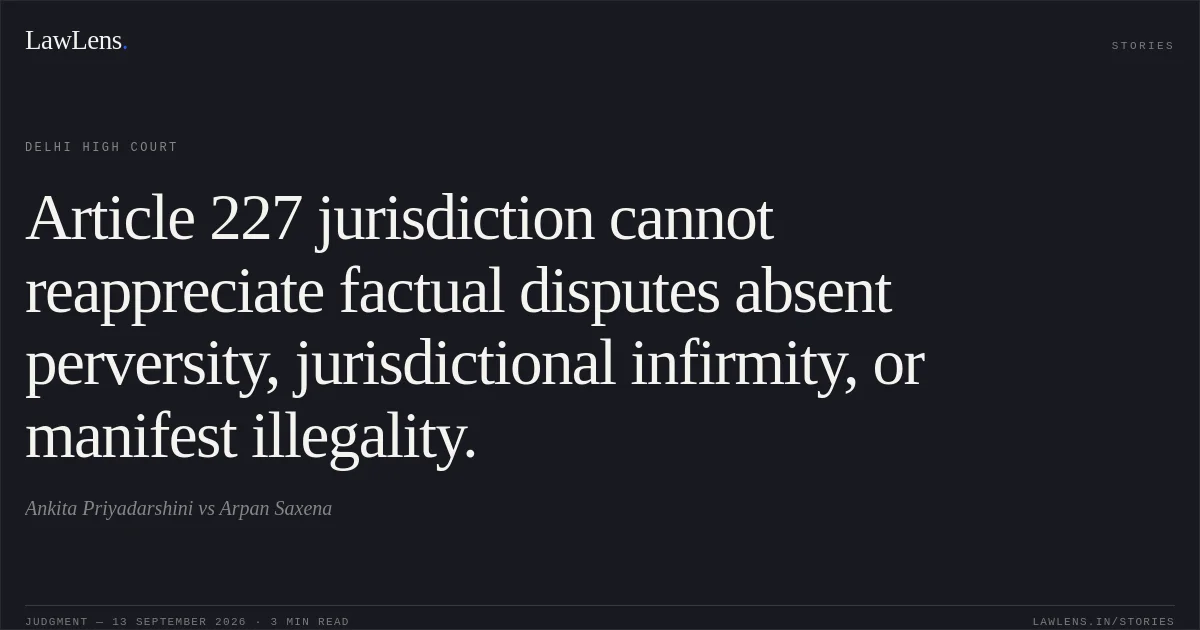
The Court applied Article 227 of the Constitution of India, which confers limited supervisory jurisdiction over subordinate courts and does not ordinarily permit the High Court to undertake a fresh or detailed examination of disputed questions of fact absent perversity, jurisdictional infirmity, or manifest illegality.
Source reference: paras. 20, 25–26; pp. 5–8The Court further applied the principle that allegations of tampering or fraudulent insertion of a judicial document cannot be established merely from an apparent discrepancy in a seal or inconsistency between order-sheets; the record must be assessed cumulatively and contemporaneously.
Source reference: paras. 17, 21, 24; pp. 4–7No specific statutory provision or judicial precedent, apart from Article 227, was cited or relied upon in the judgment.
Source reference: no citationReasoning
The Court found that the contemporaneous record materially contradicted the allegation that the Written Statement first appeared in April 2026.
Source reference: no citationThe document bore the court stamp and signatures of the predecessor Presiding Officer, while the order dated 25.01.2023 recorded that an advance copy had been supplied and directed the filing of replication.
Source reference: para. 12; p. 3The later recording of completed pleadings, permission to lead evidence, and cross-examination of the Respondent with reference to the Written Statement further supported its prior existence on the judicial record.
Source reference: paras. 15–17; pp. 4–5The discrepancy in the order dated 29.05.2023 was considered a probable inadvertence arising from the absence of an effective order on 15.04.2023 and the subsequent change of Presiding Officer.
Source reference: para. 13; p. 4The alleged seal discrepancy and inconsistent dates did not, by themselves, establish tampering.
Source reference: paras. 19–21; pp. 5–6Since the Family Court had already conducted a detailed factual enquiry, the High Court held that a further investigation would exceed the limited scope of Article 227.
Source reference: paras. 20–21, 25; pp. 5–8Even assuming that the Report’s observation regarding the Petitioner’s objections was disputed, it did not affect the conclusion because the cumulative documentary record independently supported the validity and prior filing of the Written Statement.
Source reference: paras. 22–23; pp. 6–7Holding
The High Court held that the allegation of fraudulent insertion of the Written Statement was not borne out by the record.
It found no perversity, jurisdictional infirmity, or manifest illegality in the Family Court’s order warranting interference under Article 227.
Source reference: para. 26; p. 8The prayer to strike off the Written Statement and the consequential Evidence Affidavit was rejected.
Source reference: no citationThe petition and pending applications were accordingly disposed of, with no order as to costs.
Source reference: paras. 27–29; p. 8Original Court PDF
Ankita PriyadarshinivsArpan Saxena
Click to open original judgment
Original judgment, available to read, download and summarize on LawLens.in