Facts
The petitioner, Vikas Uppal, challenged under Article 227 of the Constitution the order dated 7 July 2026 passed by the Family Court-02, Central District, Delhi, in HAMA No. 5/2025.
Source reference: p.1, para.1The Family Court had directed him to pay interim maintenance of ₹6,000 per month to the respondent, his daughter, under Section 20(3) of the Hindu Adoption and Maintenance Act, 1956, from the date of the maintenance application until disposal of the proceedings.
Source reference: p.7, para.19The petitioner contended that the respondent had income from fixed deposits, online gaming/streaming, sale of books through Amazon and other online activities, and had not made full financial disclosure.
Source reference: p.2, paras.2–3He further claimed that he was a junior advocate earning approximately ₹12,000 per month, with his earning capacity affected by incarceration and his own living expenses.
Source reference: p.2, paras.4–5The Family Court considered the rival financial assertions and the respondent’s bank statement for January 2023 to November 2025, but found no evidence of regular income and made a prima facie interim-maintenance determination.
Source reference: pp.3–4, paras.14–17Issues
Whether the Family Court failed to consider the respondent’s fixed deposits, interest income and alleged earnings from online activities while granting interim maintenance.
Source reference: pp.4–5, paras.9–11Whether the interim-maintenance order suffered from patent illegality, perversity, jurisdictional error or other manifest infirmity warranting interference under Article 227 of the Constitution.
Source reference: pp.5–7, paras.12–17Whether the quantum and grant of ₹6,000 per month as interim maintenance required interference in view of the petitioner’s asserted limited income and financial circumstances.
Source reference: p.7, paras.18–19Law Applied
The Court applied Section 20(3) of the Hindu Adoption and Maintenance Act, 1956, under which a child may claim maintenance from a parent where the statutory requirements are satisfied, including at the interim stage on a prima facie assessment.
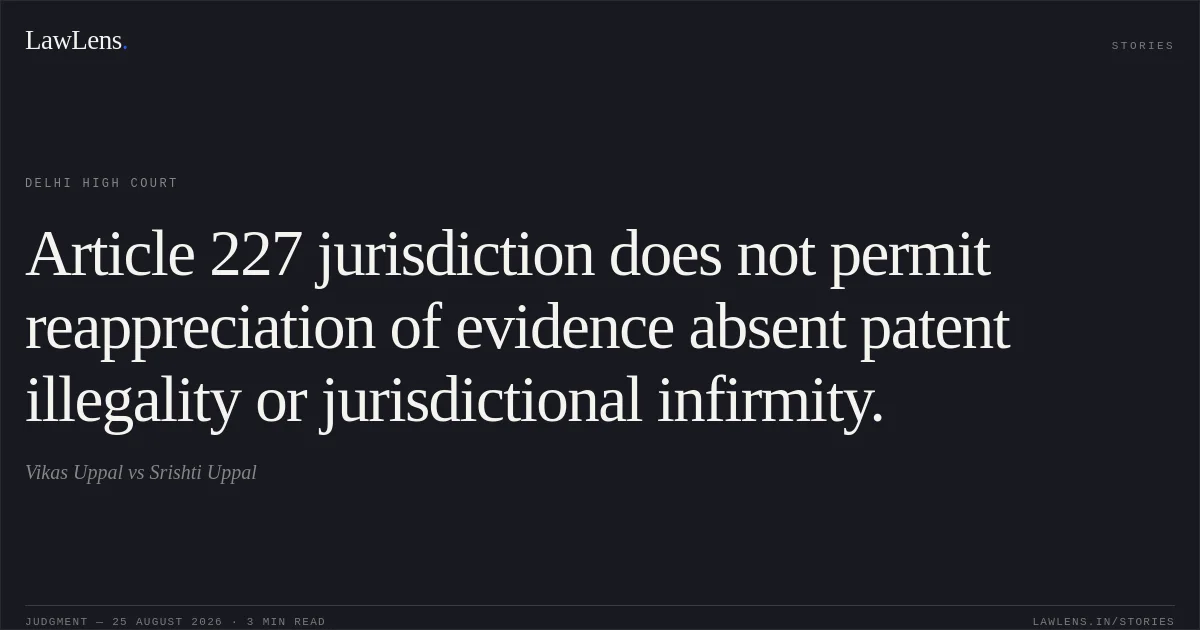
Source reference: p.1, para.1It applied Article 227 of the Constitution, observing that the High Court’s jurisdiction is supervisory and not appellate; it does not ordinarily re-appreciate evidence or substitute its view for that of the subordinate court.
Source reference: pp.5–6, paras.15–16Interference is justified only for jurisdictional error, patent illegality, perversity, manifest infirmity or a defective decision-making process.
Source reference: pp.5–6, paras.15–16An order granting interim maintenance is interlocutory and does not finally determine entitlement, income or the parties’ ultimate financial capacities.
Source reference: pp.5–6, paras.13–14Reasoning
The Court found that the Family Court had expressly considered the allegations concerning the respondent’s fixed deposits, interest income and alleged earnings from online gaming, book sales and other activities.
Source reference: pp.4–5, paras.9–10It had examined the respondent’s bank statement and found no regular income corresponding to the petitioner’s allegation of monthly earnings of approximately ₹1,00,000, thereby reasonably concluding, on a prima facie basis, that she lacked regular income.
Source reference: p.5, para.11; p.7, para.17The petitioner’s asserted income of approximately ₹12,000 per month and his personal expenses had also been noticed while determining the interim amount.
Source reference: p.7, para.18The petitioner’s challenge essentially invited a fresh evaluation of bank statements, fixed deposits and competing income claims, which was impermissible in the limited supervisory jurisdiction under Article 227.
Source reference: p.5, para.12; p.8, paras.20–21Since the Family Court’s findings were interim, reasoned and based on the material then available, no jurisdictional or manifest error was established.
Source reference: p.8, paras.20–22Holding
The High Court held that the Family Court had not overlooked the respondent’s alleged financial resources and had validly made a prima facie assessment for the purpose of interim maintenance.
No patent illegality, perversity, jurisdictional infirmity or other ground for interference under Article 227 was made out.
Source reference: p.8, paras.20–22The petition was accordingly dismissed, and the direction to pay ₹6,000 per month as interim maintenance was left undisturbed.
Source reference: p.8, para.23The Court clarified that its observations would not prejudice the parties’ respective claims or financial evidence in the pending maintenance proceedings, and noted that remedies such as modification remained available in accordance with law.
Source reference: p.7, para.19; p.8, para.24Pending applications were disposed of and no order as to costs was made.
Source reference: p.8, paras.25–26Acts & Sections Cited
1 provisions across 1 statute referred to in this judgment. Each provision opens on LawLens.
Hindu Adoptions and Maintenance Act, 19561
Original Court PDF
Vikas UppalvsSrishti Uppal
Click to open original judgment
Original judgment, available to read, download and summarize on LawLens.in
![Courts will not interfere with transfers absent mala fides or violation of statutory rules.. M Ramya vs EMPLOYEES STATE INSURANCE CORPORATION (ESIC). CAT - ['Chennai']. LawLens](/stories/thumbnails/courts-will-not-interfere-with-transfers-absent-mala-fides-or-violation-of-statutory-rules-a6845e9ca6f548fca284c51c8351957f.webp)
![Courts cannot direct one-time recruitment age relaxation absent authority in the governing rules or advertisement.. UT OF PUDUCHERRY vs M ANDAL. CAT - ['Chennai']. LawLens](/stories/thumbnails/courts-cannot-direct-one-time-recruitment-age-relaxation-absent-authority-in-the-governing-895d78fde47143e2a8ed0207c4b6a44f.webp)
![A review cannot correct an allegedly erroneous decision absent an error apparent on the record.. Ajit Kumar Jha vs RAILWAY BOARD. CAT - ['Delhi']. LawLens](/stories/thumbnails/a-review-cannot-correct-an-allegedly-erroneous-decision-absent-an-error-apparent-on-the-re-8ac952fd4eba470c92f7da20af72a220.webp)