Facts
The petitioner’s father, Md. Azizur Rahman, was taken by a police team led by respondent no. 6 during the intervening night of 6–7 July 2012 in connection with cases arising from a local group clash.
Source reference: paras. 2–3; pp. 3–5, 24He was brought to Kalain Patrol Post, where he became unconscious and was subsequently shifted to Kalain F.R.U. and then to Silchar Medical College and Hospital, where he was declared brought dead.
Source reference: paras. 2–3; pp. 3–5, 24The family alleged custodial torture and lodged Katigorah P.S. Case No. 291/2012 under, inter alia, Sections 448, 325, 354 and 302 IPC.
Source reference: p. 8The post-mortem report recorded no external injury, and the medical opinion attributed the death to syncope following acute or chronic coronary insufficiency.
Source reference: paras. 4(b), 9; pp. 8–9, 24–25A magisterial inquiry was conducted.
Source reference: no citationThe petitioner alleged that the inquiry was incomplete and that the medico-legal register had been tampered with by deletion of an entry concerning his father.
Source reference: paras. 14–16; pp. 26–28The initial final report was rejected by the Chief Judicial Magistrate, who directed reinvestigation.
Source reference: para. 17; p. 28A subsequent final report was also not accepted, and a complaint case was directed to be registered; that proceeding remained pending before the competent criminal court.
Source reference: paras. 17–19; pp. 28–29The petitioner sought an independent investigation by the CBI or NIA, departmental action, production of the death certificate and post-mortem report, and compensation of ₹50,00,000 for the alleged custodial death.
Source reference: paras. 2–3; pp. 3–6The State denied custodial torture and maintained that Azizur Rahman had collapsed due to a cardiac condition.
Source reference: paras. 4(b), 4(j); pp. 7–9, 14–15Issues
Whether the arrest and detention of Md. Azizur Rahman were lawful and compliant with the safeguards under Sections 41B, 41C, 50 and 50A of the Code of Criminal Procedure, 1973.
Source reference: paras. 10–13, 20–21; pp. 25–29Whether the Court could determine, in the writ proceedings, whether Azizur Rahman died because of custodial torture or whether the concerned police officers incurred criminal liability, when the criminal complaint case was pending.
Source reference: para. 19; p. 28–29Whether the petitioner and the deceased’s other legal heirs were entitled to constitutional compensation for his death while in illegal police custody.
Source reference: paras. 13, 20–23; pp. 26, 29–30Law Applied
The Court applied the statutory safeguards governing arrest and custody under Sections 41B, 41C, 50 and 50A of the CrPC, including the requirement of proper identification and documentation of arrest, communication of the grounds of arrest and related information to the arrested person and his relatives, and procedural safeguards during detention.
Source reference: paras. 10–11; pp. 25–26The Court also relied on the public-law remedy of monetary compensation for deprivation of life and personal liberty in illegal custody, constitutionally connected with Article 21 of the Constitution.
Source reference: no citationThe principles concerning custodial safeguards relied upon by the petitioner, including D.K. Basu v. State of West Bengal, AIR 1997 SC 610, were noted; however, the Court refrained from deciding the disputed allegations of torture or murder because the criminal complaint case was pending and any merits-based observation could prejudice that proceeding.
Source reference: paras. 5, 19; pp. 23, 28–29The compensation awarded was held to be palliative and without prejudice to a further claim before a competent civil court.
Source reference: para. 22; p. 30Reasoning
The Court found that Azizur Rahman had undeniably been taken into police custody, brought to the patrol post, and had collapsed there before being shifted to hospital.
Source reference: para. 8; p. 24The State did not specifically deny that no warrant or Section 41A notice preceded the arrest, or that the requirements of Sections 41B(b), 41B(c), 50 and 50A CrPC had not been complied with.
Source reference: para. 10; pp. 25–26The Court therefore held the arrest to be illegal.
Source reference: para. 11; p. 26It further considered it significant that, although the deceased’s house was only approximately 500 metres from the patrol post, the police did not inform his family of his deteriorating condition or allow a family member to accompany him during the transfer first to the F.R.U. and then to the medical college hospital.
Source reference: paras. 12, 20; pp. 26, 29These procedural violations and the death during police custody were sufficient to establish entitlement to public-law compensation, even though the Court declined to determine whether custodial torture caused the death.
Source reference: no citationThe pending criminal complaint was left for adjudication by the trial court without being influenced by the High Court’s observations.
Source reference: para. 19; p. 29Holding
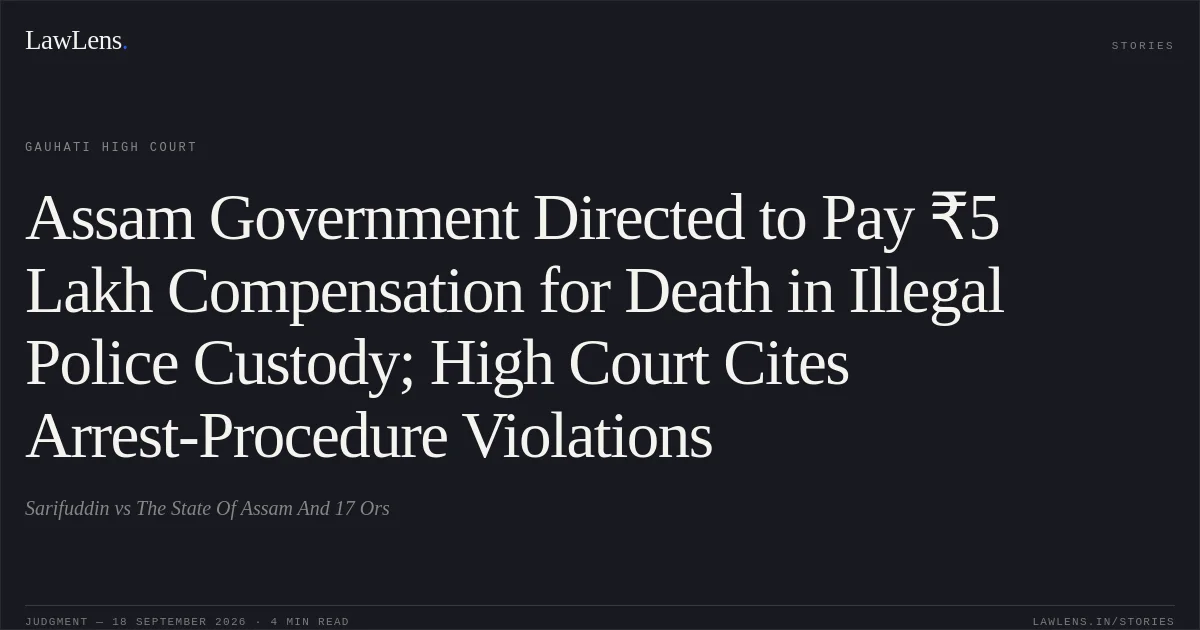
The writ petition was partly allowed.
The Court held that Azizur Rahman died on 7 July 2012 while in police custody and that his arrest had not complied with Sections 41B, 41C, 50 and 50A CrPC.
Source reference: para. 21; p. 29It directed the Government of Assam, Home and Political Department, to pay ₹5,00,000 as palliative compensation to the petitioner for himself and on behalf of the deceased’s widow and other legal heirs within three months of service of the certified judgment.
Source reference: paras. 21–23; pp. 29–30The amount would carry interest at 6% per annum upon default, and distribution among the heirs was to be made according to their respective shares under Mohammedan law.
Source reference: para. 23; p. 30The award was without prejudice to a claim for higher compensation before a competent civil court, subject to adjustment, and the State was granted liberty to recover the amount from officials found guilty in departmental proceedings.
Source reference: paras. 22, 24; p. 30No direction for CBI/NIA investigation or a finding of criminal liability was issued, as the criminal complaint case remained pending.
Source reference: paras. 19, 25–27; pp. 28–31Acts & Sections Cited
20 provisions across 2 statutes referred to in this judgment. Each provision opens on LawLens.
Indian Penal Code, 1860
Code of Criminal Procedure, 19734
Original Court PDF
SarifuddinvsThe State Of Assam And 17 Ors
Click to open original judgment
Original judgment, available to read, download and summarize on LawLens.in