Facts
The Chief Engineer, Public Works Department (Roads), Assam issued a tender notice dated 17 October 2025 comprising two packages under the ASOM MALA project.
Source reference: para. 2The petitioner submitted his bid for Package I.
Source reference: para. 2After an earlier dispute concerning issuance of a site-visiting certificate, resolved by the High Court in WP(C)/6450/2025 on 19 November 2025, the petitioner’s bid was declared technically responsive and, upon opening of the financial bids, was adjudged L1.
Source reference: paras 15–16No Letter of Intent was issued, leading to WP(C)/712/2026 seeking completion of the tender process.
Source reference: paras 15–16During the pendency of that petition, the respondents issued a communication dated 12 February 2026 cancelling the earlier tender and initiating a fresh tender based on a change in construction methodology from Granular Sub-Base (GSB) to Cement Treated Sub-Base (CTSB).
Source reference: para. 2; para. 16The petitioner challenged the cancellation and re-tender in WP(C)/948/2026.
Source reference: para. 2; para. 16It was undisputed that the second package under the same tender had been awarded and completed using the original GSB methodology.
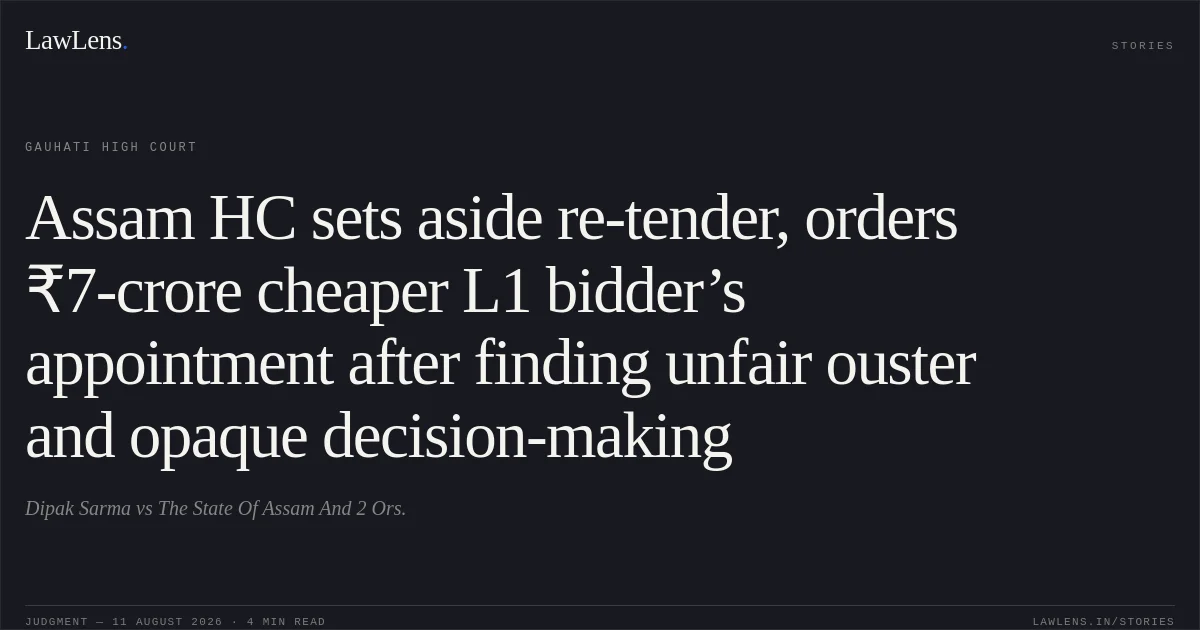
Source reference: paras 4, 15, 21 and 25The petitioner’s bid was approximately ₹7 crore lower than that of the second bidder.
Source reference: paras 4, 15, 21 and 25The respondents did not communicate reasons for cancellation to the petitioner and did not produce any original file or note-sheet explaining the decision-making process.
Source reference: paras 17–20Issues
1. Whether the cancellation of the earlier tender and initiation of a fresh tender, without immediately communicating reasons to the bidders, violated Section 26(3) of the Assam Public Procurement Act, 2017?
Source reference: paras 12, 172. Whether the respondents’ decision to change the construction methodology from GSB to CTSB and cancel the earlier tender was arbitrary, mala fide, or vitiated by malice in law?
Source reference: paras 19–263. Whether the petitioner, despite being adjudged L1, was entitled to judicial relief directing allotment of the work to him?
Source reference: paras 8, 11, 24 and 27Law Applied
The Court applied Section 26(3) of the Assam Public Procurement Act, 2017, which requires immediate communication of reasons to bidders when a tender is cancelled.
Source reference: para. 17It applied the principles of fairness, transparency, non-arbitrariness, and public interest governing State action in the distribution of public largesse.
Source reference: no citationThe Court relied on Subodh Kumar Singh Rathour v. Chief Executive Officer, AIR 2024 SC 3784, for the principle that cancellation of a tender must be supported by cogent materials demonstrating a real and palpable public interest, and that courts may examine the decision-making process, including internal file notings.
Source reference: paras 6 and 22It also considered Mahalaxmi Enterprises v. State of Assam, WP(C)/3832/2024, for the principle that State action must disclose a discernible and reasonable basis.
Source reference: para. 7The Court further recognised the distinction between malice in fact and malice in law, holding that arbitrary exercise of power may be vitiated by malice in law even without impleading an individual officer or beneficiary by name.
Source reference: para. 19Reasoning
The Court held that the respondents admittedly failed to communicate the reasons for cancellation as required by Section 26(3), which raised concerns regarding the bona fides of the decision-making process.
Source reference: para. 17The tender had already progressed through technical evaluation and financial bid opening, and the petitioner had been declared L1.
Source reference: paras 8, 22 and 24Although being L1 did not automatically create an indefeasible right to the contract, the State was nevertheless required to act fairly and on the basis of cogent, demonstrable public-interest considerations.
Source reference: paras 8, 22 and 24The Court found the justification for adopting CTSB insufficient because the change was prompted only after a local MLA’s representation, despite the original tender having been preceded by survey, study, and preparation of a DPR.
Source reference: para. 19The alleged factors—low-lying land and heavy traffic—were not shown to be unique to Package I, particularly since Package II of the same project had been executed using the original GSB methodology.
Source reference: paras 15, 19 and 21The respondents also failed to produce original file notings or other materials demonstrating how and by whom the decision had been taken or establishing that CTSB was necessary for all similarly situated works.
Source reference: paras 18–23In these circumstances, the cancellation appeared designed to exclude the petitioner after he had emerged as L1, especially considering the approximately ₹7 crore difference between his bid and the second bidder’s bid.
Source reference: paras 25–26The Court therefore concluded that the decision was neither fair nor transparent and was vitiated by malice in law and mala fide exercise of power.
Source reference: paras 25–26Holding
The Court allowed both writ petitions.
It set aside the impugned order dated 12 February 2026 cancelling the earlier tender and directing re-tendering.
Source reference: para. 27The Court further directed the respondents to allot the work to the petitioner, who had been adjudged L1, in accordance with law.
Source reference: para. 27No order as to costs was made.
Source reference: para. 28Acts & Sections Cited
2 provisions across 1 statute referred to in this judgment. Each provision opens on LawLens.
ASSAM PUBLIC PROCUREMENT ACT, 20172
Original Court PDF
Dipak SarmavsThe State Of Assam And 2 Ors.
Click to open original judgment
Original judgment, available to read, download and summarize on LawLens.in