Facts
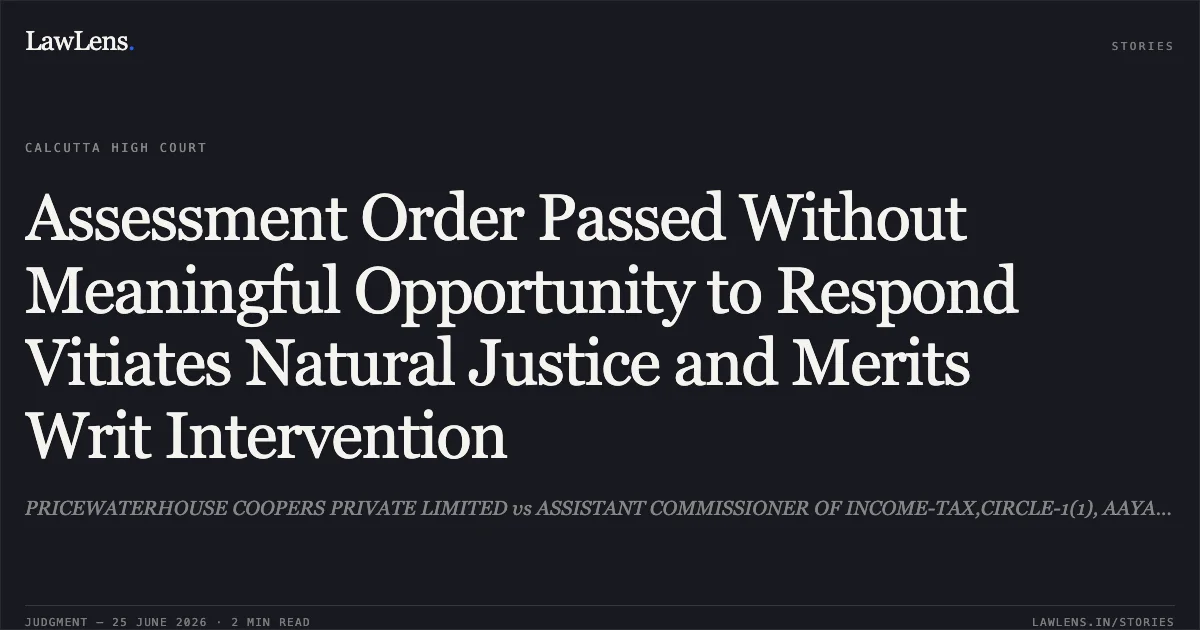
The Petitioner, a consultancy firm, challenged an Assessment Order dated March 30, 2026, passed under Section 143(3) of the Income Tax Act, 1961, for AY 2024-25.
Source reference: para 1The case was initially handled by the National Faceless Assessment Centre (NFAC) but was transferred to the Jurisdictional Assessing Officer (JAO) on December 22, 2025.
Source reference: para 7On March 28, 2026, the JAO issued a show-cause notice based on third-party information alleging the Petitioner's involvement in an acquisition scheme.
Source reference: para 9The Petitioner replied on March 30, 2026; however, on the very same day, the JAO passed the final Assessment Order raising a demand of Rs. 87,20,87,760/- without providing a personal hearing or adequate time for a response.
Source reference: para 11The Petitioner approached the High Court under Article 226 citing gross violation of natural justice.
Source reference: para 12Issues
1. Whether an Assessment Order and consequential proceedings can be set aside on grounds of gross violation of the principles of natural justice and denial of an effective opportunity of hearing.
Source reference: para 32(i)2. Whether the writ petition is maintainable despite the availability of an alternative statutory remedy under the Income Tax Act.
Source reference: para 32(ii)Law Applied
The court primarily applied the principle of Audi Alteram Partem, asserting that no person should be judged without a fair hearing.
Source reference: para 21It relied on Whirlpool Corporation v. Registrar of Trade Marks, which establishes that alternative remedies do not bar writ jurisdiction if natural justice is violated.
Source reference: para 34The court noted the mandatory nature of show-cause notices prior to disallowances as per CBDT Circular No. 27/2019.
Source reference: para 18The Gujarat High Court’s ruling in Inox Wind Energy Ltd v. ACIT regarding procedural mandates during case transfers from NFAC to JAO.
Source reference: para 19Furthermore, it applied Tin Box Company v. CIT, which holds that lack of opportunity at the assessment stage cannot be cured at the appellate stage.
Source reference: para 43Reasoning
The court reasoned that the right to a hearing is a matter of substance rather than form; the JAO's decision to pass a high-value assessment order on the same day the petitioner replied to a complex show-cause notice reduced the process to a "ritualistic formality".
Source reference: para 46Although the Respondents argued that the Petitioner failed to provide documents in earlier notices, the Court found that the specific allegations regarding the KSK Energy acquisition required a meaningful window for rebuttal that was not provided.
Source reference: para 40The Court held that since the challenge was to the "decision-making process" rather than mere merits, it fell under the exceptions to the rule of alternative remedy.
Source reference: para 42The Court emphasized that when the foundation (the assessment order) is removed due to procedural unfairness, the superstructure (demand and penalty) must also fall.
Source reference: para 47Holding
The Court held that the writ petition was maintainable and the impugned order was void ab initio due to procedural unfairness.
It quashed the Assessment Order dated March 30, 2026, the consequential demand notice, and penalty proceedings. The matter was remanded to the Assessing Officer to conduct a fresh assessment within eight weeks, specifically directing the JAO to provide a meaningful opportunity for a personal hearing and a detailed reply. No order as to costs was made.
Source reference: para 51-54Acts & Sections Cited
5 provisions across 1 statute referred to in this judgment. Linked provisions open on LawLens.
Income Tax Act, 19615
Original Court PDF
PRICEWATERHOUSE COOPERS PRIVATE LIMITEDvsASSISTANT COMMISSIONER OF INCOME-TAX,CIRCLE-1(1), AAYAKAR BHAWAN AND ORS
Click to open original judgment
Original judgment, available to read, download and summarize on LawLens.in