Facts
Petitioner No. 1, the wife, and Petitioner No. 2, her minor child, challenged the Family Court, Cuttack’s order awarding interim maintenance of ₹3,000 per month under Section 24 of the Hindu Marriage Act, 1955, from 23 August 2024. They sought enhancement to ₹35,000 per month.
Source reference: pp. 2–3; paras. 2, 4–6The wife was employed as a Block Coordinator and earned ₹16,180 monthly; the husband was a bank Branch Manager and disclosed monthly income of ₹71,000, but did not clarify whether it was gross or net or produce the employer’s certificate or Form 16. He also relied on a ₹45,000 monthly EMI for a loan taken to construct a residential building.
Source reference: pp. 2–3, 6–7; paras. 2, 4–6, 12–12.2The High Court considered the challenge with the husband’s oral objection, there being no counter-affidavit.
Source reference: p. 2; para. 3Issues
Whether the Family Court’s award of ₹3,000 per month as interim maintenance was inadequate and warranted enhancement, having regard to the parties’ incomes and circumstances
Source reference: pp. 2–3, 6–8; paras. 2, 5–7, 12–13Whether the husband’s loan repayments and the wife’s employment justified limiting or reducing the interim maintenance payable
Source reference: pp. 4–6; paras. 7.1–10Law Applied
Section 24 of the Hindu Marriage Act, 1955 provides for interim maintenance during matrimonial proceedings.
Source reference: p. 4; para. 7.1The Court relied on Rajnesh v. Neha, (2021) 2 SCC 324, concerning the criteria for determining maintenance, and Kalyan Dey Chowdhury v. Rita Dey Chowdhury Nee Nandy, (2017) 14 SCC 200, which observed that maintenance equivalent to 25% of the husband’s net salary may be just and proper.
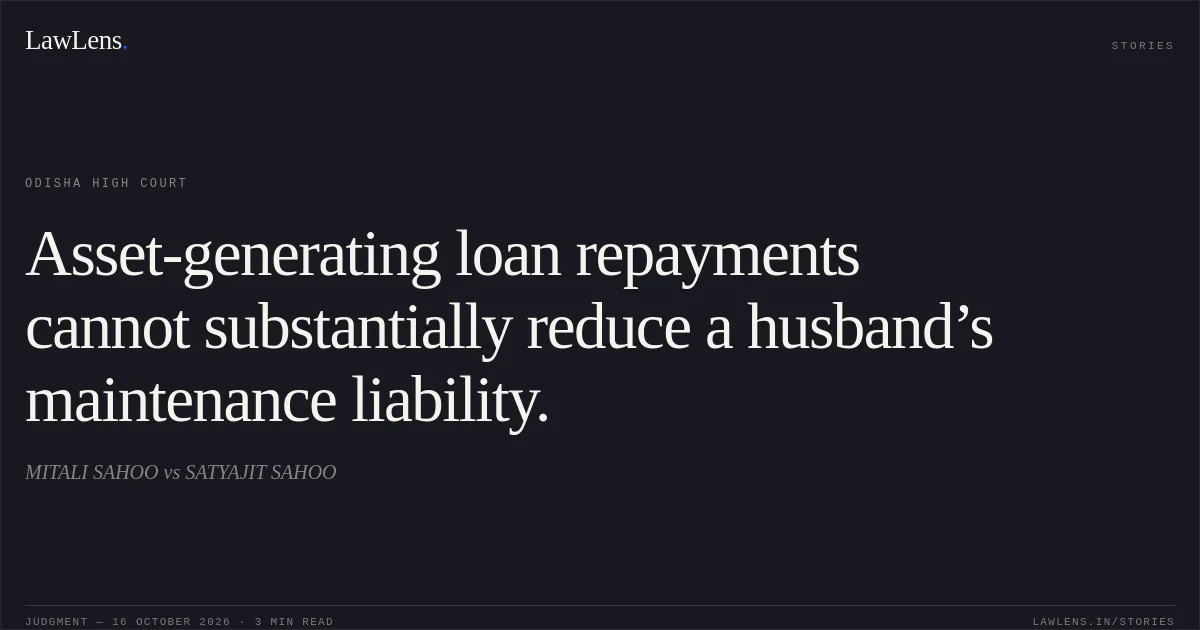
Source reference: pp. 4, 6; paras. 7.1, 11It also applied the principle that repayments on loans used to create or acquire assets are capital investment, not essential expenditure that should substantially reduce maintenance liability, relying on Deepa Joshi v. Gaurav Joshi, 2026 SCC OnLine SC 597.
Source reference: pp. 5–6; paras. 8, 10Citing T.K. Abdulla v. Subaida, 2006 SCC OnLine Ker 686, the Court observed that a wife’s ability to maintain herself does not, by itself, bar a maintenance claim, though it may be relevant to quantum.
Source reference: pp. 4–5; para. 9Reasoning
The Family Court had not given cogent reasons for fixing maintenance at only ₹3,000 per month and had not properly applied the Rajnesh criteria.
Source reference: p. 4; paras. 7–7.1The husband’s disclosed income was ₹71,000 per month, and his failure to provide the required employment certificate and Form 16 left the gross-versus-net position unexplained. Even assuming ₹71,000 was his net income, the award remained inadequate.
Source reference: p. 7; paras. 12–12.1The Court also declined to treat the ₹45,000 EMI for construction of a residential building as a basis for substantially reducing maintenance, since the repayment contributed to creation of an asset.
Source reference: pp. 4–6, 7; paras. 8, 10, 12.2Having considered the wife’s income and the parties’ circumstances, it found ₹15,000 per month to be just, fair and reasonable.
Source reference: p. 8; para. 13Holding
The writ petition was allowed in part, and the interim maintenance was enhanced from ₹3,000 to ₹15,000 per month, payable from 23 August 2024 until disposal of the matrimonial proceeding.
The husband was directed to pay the arrears, after credit for amounts already paid, in four equal instalments within six weeks, and thereafter to pay the monthly amount by the 10th of each succeeding month through electronic transfer.
Source reference: p. 8; para. 14The parties were directed to avoid unnecessary adjournments and cooperate in the early conclusion of the pending proceedings.
Source reference: p. 9; para. 16No order as to costs.
Source reference: p. 9; para. 17Acts & Sections Cited
3 provisions across 2 statutes referred to in this judgment. Each provision opens on LawLens.
Hindu Marriage Act, 19552
Muslim Women (Protection of Rights on Divorce) Act, 19861
Original Court PDF
MITALI SAHOOvsSATYAJIT SAHOO
Click to open original judgment
Original judgment, available to read, download and summarize on LawLens.in